Western Swing
When cowboys discovered jazz and refused to apologize.
Get your song in Western Swing
Make yours in this styleHear it before you pay.$19 USD · your first song for $5.50 USDIf it doesn't move you, we give you your money back · 7 days.
Western Swing is a style from the Dust and Highway family. 130 BPM, Experimentation 30, Style strength 88.
What is Western Swing?
Jazz in a cowboy hat: western swing, a Texas-born blend of country and jazz, had the dance floors moving before anyone else did.
How it sounds
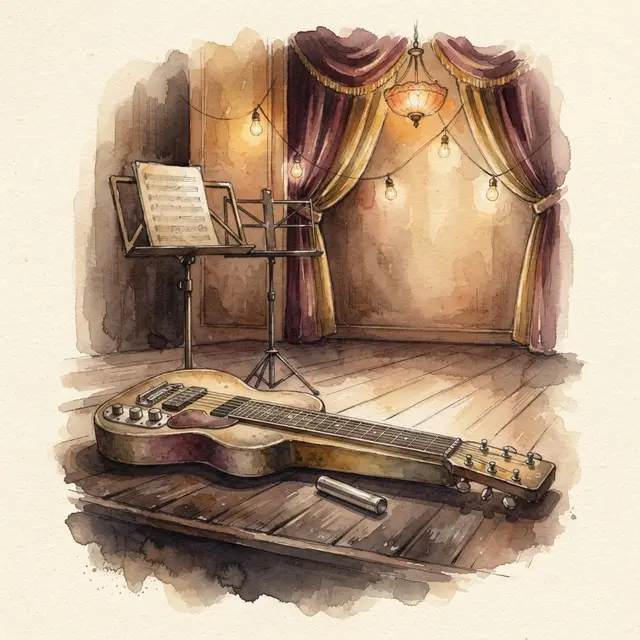
The dance hall floor is buffed so bright your boot spurs leave a white streak before the road dust on your lapel settles for good. It is half past nine on a Tuesday in Fort Worth and the heat clings to your shirt collar like a damp rag. Up on the stage, the big band taps brass stands under amber lamps that hum with the patience of insects. Someone tilts a highball glass of bourbon and the ice cubes clink like tiny bells.
The upright bass starts walking, keeping time with the cold precision of a sober watchmaker, and then the fiddle cuts the air clean, smelling of pine rosin and cheap liquor. You are not sad, exactly, but the corner of your mouth pulls into a dry grin that looks like an old handshake. The steel guitar shines like a polished mirror in the back, waiting to bend a note right where the heart starts wondering whether to stay for another round or head for the door.
You adjust your hat, find your partner’s waist, and your hips take the cue before your head can cook up an excuse. There are no speeches here; just the piano hitting the beat and the scrape of leather soles against scarred oak, telling a story that already happened but still has enough legs for two more turns.
Palette: warm sepia / amber gold / curtains burgundy
- BPM
- 130 BPM
- Family
- Dust and Highway
- Serial
- PLV-17
- Rarity
- Epic
- Style strength
- 88
- Experimentation
- 30
Typical structure
[Big band Intro] → [Verse] → [Chorus] → [Fiddle Solo] → [Steel guitar Solo] → [Chorus] → [Outro]
What you see above is the dance floor and the dust on the boot, but writing the lyrics takes a different kind of math. Two specific traps sink this genre: sliding into cheap romantic schmaltz or sounding like a cartoon cowboy shouting catchphrases. That balance lives in an unpublished internal distillate of eight parameters that the motor crosses with your raw history before the first line is drafted. At the end, an internal judge measures the lyrics against six dimensions of the canon and sends back anything that rings false. The tempo can be copied. The swagger, no.
How a lyric in this style thinks
A western swing lyric does not pause to feel its feelings — it keeps moving, the way a good dancer keeps moving even when the song is about someone who left three counties ago. The genre lives in forward motion, which means every line has to earn its place by propelling the story rather than sitting down in it.
Western swing arrived out of 1930s and 40s Texas ballrooms where the brass section and the fiddle shared the same stage and nobody thought that was strange, and the lyric logic followed the music: light on its feet, warm in tone, and never so burdened by emotion that it forgets to swing. If the feeling is grief, western swing converts it into a dry grin before it reaches the microphone. That is not avoidance — it is a specific emotional register, and writing past it into heavy territory is the first mistake an imitator makes.
The base tone is amber and unhurried confidence. Emotion in western swing arrives sideways, tucked into a well-chosen noun or an offhand verb rather than announced in the chorus. A line about the upright bass walking through a late Tuesday night says more about loneliness than the word loneliness ever could. Repetition in the chorus is strategic — it functions the way the rhythm section does, giving dancers a reliable place to land — but it should never tip into the earnest hammering you find in straight country.
The line lengths tend to run long enough to follow the jazz phrasing of the fiddle or the steel guitar, with internal rhythmic pockets that mirror a horn player's breath. When you read a western swing lyric aloud, your jaw should swing slightly on the stressed syllables, the way a good upright bass player leans into the beat without rushing it.
The sensory field is specific and unhesitating: boot heels on scarred oak, pine rosin in the air, bourbon ice clinking against glass, the amber hum of stage lamps, a steel guitar catching light from across the room. Road dust, truck radios, county lines at dusk, the particular weight of a Stetson adjusted before stepping onto the floor — these are the objects this genre trusts. What western swing never uses is the language of stillness or interior darkness: no unmade beds, no 3 a.m. silence, no kitchen-table confessions.
The production backdrop — a big band intro, walking bass, jazzy steel guitar bends, a fiddle that cuts rather than weeps — demands lyrics with the same outward-facing energy. The instrumentation is doing too much interesting work for the lyric to go quiet and private.
Structurally, the canon moves through its sections with the confidence of a band that has played the room before: a big band intro that sets the temperature, verses that carry the story forward in plain declarative sentences, a chorus that plants the emotional flag without melodrama, and solo sections for fiddle and steel guitar that function as breathing room — the lyric writer's job is to make sure what comes before each solo earns the listener's patience for the instrumental stretch, and what comes after lands with renewed authority.
The outro does not resolve into silence or sentiment; it resolves into motion, as if the band is still playing when you push through the door into the night air.
What separates a genuine western swing lyric from a generic country-with-horns imitation is precision of mood. The crooked grin is not a smirk and it is not a smile — it sits exactly between pride and affection, the expression of someone who has driven far enough to know what they left behind was worth leaving, and what they came back to was worth the drive. Every lyric choice should aim for that same calibrated warmth: specific enough to feel lived in, loose enough to keep dancing. The moment a line starts explaining itself, or reaches for a big emotional declaration, the boots stop moving and the whole floor feels it.
- JAZZ IN A HAT
- BALLROOM
Sample excerpt
I dusted off my boots in the Amarillo light Left the radiator hissing in the dead of night Found the key under the porch near the rusted pail Took the long way home through the rusted rail My shadow stretches long on the linoleum floor I don't need a map to find the pantry door.
Turn that radio dial to the fiddles and the brass Watch the amber horizon let the evening pass I’m back in the saddle with a grin that fits Dancing through the kitchen while the coffee hits.
Workshop note — Western swing relies on a rhythmic, bouncing cadence that pairs syncopated phrasing with upbeat, conversational storytelling. Keep your lines punchy and rhythmic so they can swing against a walking bassline, avoiding heavy internal rhyming schemes that might bog down the tempo. This genre demands a jaunty, confident perspective that favors momentum over introspection.
Sample excerpt written by MUSAI Song. Your lyrics are written from scratch, based on your story.
When to choose this style
Choose this card when you want to tell a story of coming home without getting heavy about it. It works for celebrating an old friend you no longer need to explain yourself to, for remembering a long drive across county lines where the truck radio was the only company, or for accepting a change of scenery with a crooked grin. It suits when pride and affection walk arm in arm and you refuse to lower your voice to prove it.
Do not pick it if you are chasing a quiet bedroom drama, a midnight confession, or a clean breakdown across the kitchen table; western swing never stops to wipe its eyes. It fails for lullabies and goodbyes where grief is the only thing left in the room. If you are looking for a raw confession that breaks the voice without a backing band, the card is Country Ballad.
Your story in this style
MUSAI Song writes original lyrics from your story, in the Western Swing style, and delivers the finished sung song, the ready-to-use style recipe, and an illustrated art plate with its numbered certificate, private by default; public only if its owner publishes it.
- Original lyrics written from your story
- A finished sung song, ready to play and share
- Art plate with a unique seal and a numbered certificate, private by default; public only if its owner publishes it
Frequently asked questions
What BPM is Western Swing?
Western Swing usually runs at 130 BPM.
What does Western Swing sound like?
Jazz in a cowboy hat: western swing, a Texas-born blend of country and jazz, had the dance floors moving before anyone else did.
What song structure does Western Swing use?
[Big band Intro] → [Verse] → [Chorus] → [Fiddle Solo] → [Steel guitar Solo] → [Chorus] → [Outro]
How do I write Western Swing lyrics?
Tell MUSAI Song your story and pick Western Swing: it writes original lyrics for this style at 130 BPM, you edit them word by word, and you get the song sung in Western Swing, with an illustration of the song and its numbered certificate. $19 USD per song, one-time payment.
Explore more styles
- 80s Heartland Rock
- Alt-Country
- Americana
- Appalachian Folk
- Classic Country
- Country Blues
- Country Duet
- Country Gospel
- Country Pop
- Country Rock
- Country Soul
- Country Waltz
- Cowboy Western
- Desert Highway Rock
- Fiddle Hoedown
- First Dance Country
- Folk Country
- Front Porch Acoustic
- Hick-Hop
- Honky Tonk
- Jukebox Country Ballad
- Modern Country Anthem
- Mountain Bluegrass
- Nashville Sound
Your idea or story, sung in this style
Card · secure payment via Stripe, charged in USD
If it doesn't move you, we give you your money back · 7 days