Alt-Country
Sad cowboy music for people with record collections.
Get your song in Alt-Country
Make yours in this styleHear it before you pay.$19 USD · your first song for $5.50 USDIf it doesn't move you, we give you your money back · 7 days.
Alt-Country is a style from the Dust and Highway family. 96 BPM, Experimentation 38, Style strength 85.
What is Alt-Country?
Country with indie melancholy and noisy edges. For hearts that live off the radar.
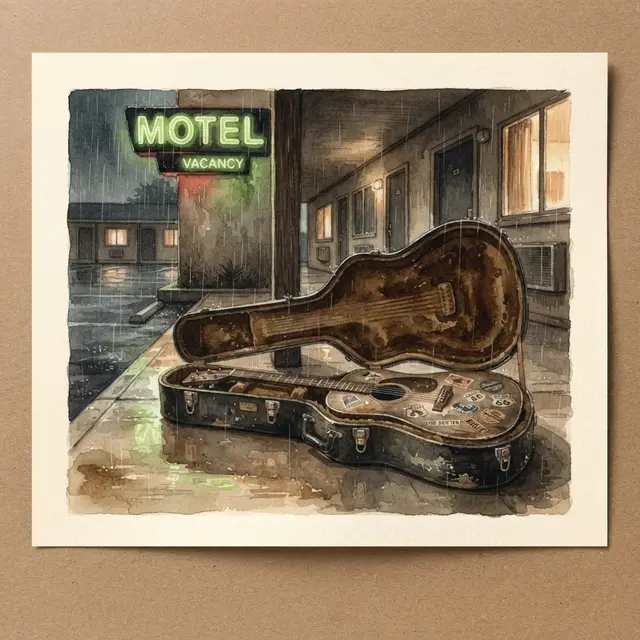
How it sounds
It is half-past three in the morning at an unbranded truck stop just off Route fifty-four. The sign above the pumps flickers in a sharp acid-green glow, buzzing against the black sky like a fat insect. Outside, intermittent rain taps a lazy, heavy rhythm against the truck’s metal roof. Inside, the air smells of scorched coffee from the glass pot and worn brake pads left on the counter by the cash register.
A cheap radio plays a guitar with strings tuned slightly too loose, dragging behind a vocalist who isn't singing outward but inward, carrying the stubborn lethargy of someone who stopped waiting for the shift to end. You are wearing a denim jacket with frayed seams at the elbows and a folded road map in your breast pocket, worn so thin at the creases that the small towns have dissolved into paper fuzz. Your boots drag slightly on the linoleum floor; the heels are rounded off from pressing down at red lights that never seemed to change.
There is nobody else within five miles. A distortion pedal sits half-engaged on the floorboards, letting out a low, steady hum that blends with water sheeting down the windshield. You stare at the bottom of the paper cup, watching the coffee oil form a stubborn ring that refuses to break, while far out on the highway a transport truck sweeps its high beams across the dark before swallowing itself back into the flat, wet night.
Palette: neon green / rain gray / night black / warm brown
- BPM
- 96 BPM
- Family
- Dust and Highway
- Serial
- PLV-12
- Rarity
- Rare
- Style strength
- 85
- Experimentation
- 38
Typical structure
[Intro] → [Verse] → [Chorus] → [Verse 2] → [Chorus] → [Noisy Bridge] → [Final Chorus]
The data above is copied in a minute. What doesn't copy is the judgment: how many mundane objects to stack before the image loses its weight, and exactly where to drop the guitar feedback so the silence does the heavy lifting. All of that lives in a hidden eight-parameter distillate, and the engine cross-checks it against your raw material before a single line is written. When it finishes, an internal judge measures the lyrics against six canons and trims the fat. The distortion pedal is easy to find. The dust on the tongue, not.
How a lyric in this style thinks
An alt-country lyric does not deliver emotion — it withholds it, and that withholding is the whole mechanism. The genre works by placing an enormous feeling just off the page, just behind the teeth, and letting the reader feel the pressure of it without ever naming it directly. A line in alt-country doesn't say grief; it says the coffee ring on the paper cup that won't break apart no matter how long you stare at it. That gap between the concrete image and the enormous thing it stands in for is where alt-country lives, and every craft decision in the genre is designed to protect that gap from collapsing.
The base tone is exhaustion that has long since stopped performing itself. Emotion in alt-country arrives through accumulation rather than climax — a worn jacket, a road map dissolved to fuzz at the creases, heels rounded from pressing brake pedals at lights that never changed. These are not decorative details. They are the argument. The sensory field stays in the specific and the weathered: truck stop linoleum, scorched coffee, brake pad smell, rain on a metal roof, a guitar strung slightly loose so it drags behind the beat.
This genre has no use for abstraction, and it has no use for clean or bright objects. Nothing here smells like perfume or celebration. The palette is neon-sign green buzzing against night black, rain gray, the warm brown of old leather and bad whiskey. If an image could belong in a hotel lobby, it doesn't belong in an alt-country lyric.
Line length and rhythm in alt-country behave like someone talking who is trying to keep their voice steady. Lines tend to be conversational and uneven, with the stress falling where speech stress would naturally fall rather than where a metronomic count would put it. The guitar — jangly, with feedback edges that never quite resolve — models this same slightly-off-centre quality. At 96 BPM the tempo is neither urgent nor slow; it has the pace of someone walking a highway shoulder at night with no particular destination.
Repetition in the chorus is not triumphant; it is insistent in the way that a thought you can't shake is insistent. The chorus returns not to release tension but to confirm that the tension is still there.
Structurally, the form follows an emotional logic of delay. The verse builds a physical scene with almost documentary patience — no editorializing, just what you can see and smell and hear. The chorus does not erupt; it steps slightly forward, offering one more degree of clarity about what the scene means, and then retreats. The noisy bridge is where the distortion pedal comes fully alive, where the feedback hum that has been sitting just under everything gets its moment — but even here the noise is not catharsis, it is more like the sound of something that cannot be said being said anyway by the instruments. The final chorus returns changed only by the weight of everything that preceded it.
What separates a real alt-country lyric from a generic imitation is the refusal of dramatic resolution. A beginner writing in this genre will feel the pull toward the redemptive turn, the moment where the road becomes possibility rather than just road. Alt-country resists that pull with discipline. The wrong turn in the narrative is not redeemed — it is simply acknowledged, then lived with. The person on the front porch watching the car leave does not have a revelation. The person driving does not look at the rearview.
The engine either turns over or it doesn't. What remains after the final chord is not hope or despair but the specific texture of a particular kind of honest fatigue — the kind that has worn itself into you like a wool coat until you can no longer tell where it ends and your skin begins.
- BOOTS AND BLUES
- OFF THE RADAR
Sample excerpt
The radiator hissed like a cornered snake I left your spare key on the porch rail Oil stains mapping out the gravel drive Where the weeds grow tall around the porch swing You didn't look up from your coffee cup Just watched the dawn crawl over the fence line.
It’s a long way down to the state line With a trunk full of clothes and a map I don't trust Just keeping the needle steady on the dial While the morning turns to ink black dust.
Workshop note — Alt-country relies on specific, tactile imagery that grounds the melancholy in physical space, like the radiator hiss or the oil stains. Use short, blunt sentences to show emotional exhaustion rather than describing the sadness outright. The chorus should act as an anchor, repeating a sense of motion or distance to emphasize the protagonist's detachment from the scene.
Sample excerpt written by MUSAI Song. Your lyrics are written from scratch, based on your story.
When to choose this style
Choose this card when your story requires the exact measured distance between someone leaving and someone watching from a front porch. It works for packing a life into the backseat of a sedan and driving three states away without looking at the rearview. For a quiet parting that ended not with shouting but with two people staring at an engine that wouldn't turn over. For telling an old friend that things went sideways, but the road is still there. For admitting a mistake wasn't a grand tragedy, just a wrong turn you decided to live with.
Alt-country is the ledger of honest fatigue: it fits when sadness is a heavy wool coat you've worn so long it just feels like your skin. Do not choose it for a loud family reunion, a wedding toast, or any room that smells like perfume and celebration; this genre has no use for clean happiness. Avoid it if your story demands shouting or dramatic catharsis, because here the anger stays trapped behind the teeth. If you are looking for a tender, acoustic serenade for a quiet Sunday morning, the card is Prairie Ballad.
Your story in this style
MUSAI Song writes original lyrics from your story, in the Alt-Country style, and delivers the finished sung song, the ready-to-use style recipe, and an illustrated art plate with its numbered certificate, private by default; public only if its owner publishes it.
- Original lyrics written from your story
- A finished sung song, ready to play and share
- Art plate with a unique seal and a numbered certificate, private by default; public only if its owner publishes it
Frequently asked questions
What BPM is Alt-Country?
Alt-Country usually runs at 96 BPM.
What does Alt-Country sound like?
Country with indie melancholy and noisy edges. For hearts that live off the radar.
What song structure does Alt-Country use?
[Intro] → [Verse] → [Chorus] → [Verse 2] → [Chorus] → [Noisy Bridge] → [Final Chorus]
How do I write Alt-Country lyrics?
Tell MUSAI Song your story and pick Alt-Country: it writes original lyrics for this style at 96 BPM, you edit them word by word, and you get the song sung in Alt-Country, with an illustration of the song and its numbered certificate. $19 USD per song, one-time payment.
Explore more styles
- 80s Heartland Rock
- Americana
- Appalachian Folk
- Classic Country
- Country Blues
- Country Duet
- Country Gospel
- Country Pop
- Country Rock
- Country Soul
- Country Waltz
- Cowboy Western
- Desert Highway Rock
- Fiddle Hoedown
- First Dance Country
- Folk Country
- Front Porch Acoustic
- Hick-Hop
- Honky Tonk
- Jukebox Country Ballad
- Modern Country Anthem
- Mountain Bluegrass
- Nashville Sound
- Outlaw Country
Your idea or story, sung in this style
Card · secure payment via Stripe, charged in USD
If it doesn't move you, we give you your money back · 7 days