Country Gospel
Church, but with better boots and zero judgment.
Get your song in Country Gospel
Make yours in this styleHear it before you pay.$19 USD · your first song for $5.50 USDIf it doesn't move you, we give you your money back · 7 days.
Country Gospel is a style from the Dust and Highway family. 84 BPM, Experimentation 15, Style strength 89.
What is Country Gospel?
A country Sunday with a heavenly choir. Country gospel lifts the soul with hands still dirty from the earth.
How it sounds
The red dirt dust drifts through the open double doors of the clapboard chapel, catching in a slant of morning sunlight right above the third row of pews. It is half past ten on a Sunday that smells of dry pine and black coffee boiling on a two-burner stove in the back room. There are no vaulted stone ceilings here; just whitewashed cedar planks that groan underfoot when someone shifts their weight.
At the front, a Hammond B3 organ starts to breathe before a single note is struck. The player's hands move over the drawbars with the quiet authority of someone who knows every knot in the timber. The opening chord doesn't hit you; it rises like a warm tide straight up through the pine floorboards, stirring the floating dust and settling deep behind your ribs. An acoustic guitar keeps a steady, unhurried picking pattern, like an old horse trotting down a familiar gravel lane.
Then a voice lifts from the middle pews without a microphone or any studio trickery. It is a throat that has swallowed August dust and holstered a hay baler; a voice with soil beneath the fingernails, singing straight and plain. And when the chorus hits, the dozen people scattered through the pews lean forward and open their mouths. This is no polished choir loft: these are raw, work-roughened tones blending together, stacking up until they rattle the thin glass in the side windows. You feel the heat of your neighbor's shoulder, the worn grain of the wooden bench beneath your palms keeping time, and that sudden, quiet certainty that hard work and grace finally share the exact same room.
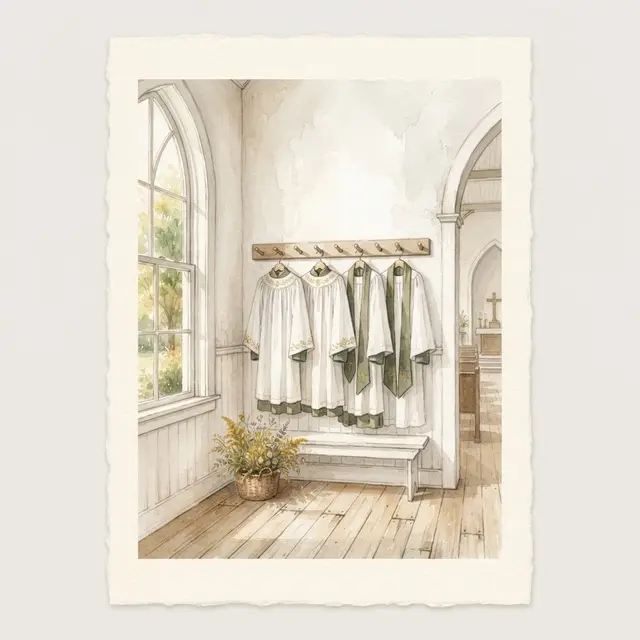
Palette: vestments white / stoles olive green / embroidery gold / wood ochre
- BPM
- 84 BPM
- Family
- Dust and Highway
- Serial
- PLV-16
- Rarity
- Rare
- Style strength
- 89
- Experimentation
- 15
Typical structure
[Organ Intro] → [Verse] → [Chorus] → [Verse 2] → [Chorus with Choir] → [Bridge] → [Glorious Final Chorus]
The data points above are just the surface. Two specific writing traps in this genre refuse to fit into a table: how to keep devotion from sounding like a Sunday sermon, and how to keep rural simplicity from sliding into parody. That lives inside an unpublished eight-parameter distillate, and the engine crosses it with your raw material. When it finishes, an internal judge measures the lines against six canons of the craft and forces a rewrite on anything that smells like greasepaint. Organ stops can be bought anywhere. Truth in the throat cannot.
How a lyric in this style thinks
A country gospel lyric does not describe faith so much as it demonstrates what faith looks like after sixty years of hard use. The words carry the weight of calloused hands and cracked boots, and the spiritual arrival is earned, not announced. This is a genre where gratitude moves through the body before it reaches the mouth, where a man might grip the back of a pew to steady himself not from weakness but from the sheer force of something finally named. Country gospel works because it refuses to separate the sacred from the agricultural, the divine from the domestic. The same breath that smells of black coffee and pine sap is the breath lifted in praise.
The base tone is steady and warm, never frantic. Emotion in country gospel does not spike; it rises the way heat rises off dry summer ground, slowly and then all at once. A verse typically runs in even, unhurried lines that mirror the walking tempo of the genre itself, usually sitting around 84 BPM, with an acoustic guitar holding a deliberate fingerpicked pattern underneath. The Hammond B3 organ is not decoration here; it is structural, breathing between phrases, filling the silence that a lyric deliberately leaves open. Vocal delivery is plain and direct, with no affectation. The voice sounds like it has been outside. Runs and melisma belong to a different building.
Repetition in country gospel is not laziness; it is testimony. A chorus line that returns three times is not repeating itself, it is insisting. The chorus is where the congregation leans in, where the choir harmonies stack up rough and warm, like voices that have never been trained to smooth out their edges. When you write the chorus, write it so that a person who cannot sing a note can still open their mouth and mean it.
The bridge exists to name the specific cost of what is being celebrated — the winters, the dry seasons, the silences between two people that somehow held. It should feel like a confession before the final return, which arrives louder and fuller than anything that came before.
The sensory field of country gospel is narrow and deliberate. Red dirt. Whitewashed wood. The grain of a pine bench under a palm. Black coffee. Morning light cutting through a door that was never quite square in its frame. These are the objects that belong here. What this genre never uses: urban abstraction, irony, nighttime settings, anonymous crowds. A city skyline kills the lyric before the first chord resolves. The images stay close to the ground and close to the body, because country gospel understands that holiness arrives in specific, unremarkable places and only becomes visible in hindsight.
What separates a real country gospel lyric from a generic imitation is restraint at exactly the moment when the temptation to oversell is strongest. A lesser writer reaches for celestial imagery the moment the chorus hits. A working country gospel lyric stays on the porch, stays at the long wooden table, stays in the moment where two rough hands finally clasp across a silence that lasted too long. The glory, when it comes, is earned by everything that was ordinary first.
Structure follows this logic: the organ intro establishes the room, the verses build the particular human story, and the final chorus opens up only because the listener has been made to feel the full weight of what preceded it. Nothing is wasted, and nothing is rushed.
- COUNTRY SUNDAY
- HEAVENLY CHOIR
Sample excerpt
The screen door whines on a rusted hinge I laid my hat on the oak bench in the hall Sixty harvest moons left a stain on the floor But the cedar rafters didn't buckle or fall My knuckles are thick like the roots of the pine And the morning light is tracing the line.
Oh, lead me home to the field I know Where the amber dust settles slow Grace is a heavy, steady plow And I’m standing in the harvest now.
Workshop note — This sample works by grounding spiritual gratitude in the physical labor of the land, using concrete objects like the screen door and cedar rafters to anchor the sentiment. The chorus utilizes a steady, rhythmic cadence to mimic the pace of farm work, ensuring the melody feels communal and earned. It avoids abstract jargon by focusing on the endurance of the body and the earth.
Sample excerpt written by MUSAI Song. Your lyrics are written from scratch, based on your story.
When to choose this style
Choose this card when you want to give thanks for something that endured the years without breaking. It works to honor a grandfather who worked the same acreage for sixty winters without complaint. For a family reunion where rough, calloused hands meet again across a long wooden table after a long absence. For dropping an old grudge that made your knees ache when you knelt. For a golden anniversary on a porch where love never needed grand speeches, only stubborn presence.
Do not choose it if your story takes place in a sprawling city with asphalt, sirens, and nighttime ambition: country gospel suffocates far from an open horizon. It also fails for bitter breakups, angry grief, or telling a story of betrayal, because this genre has no room for vengeance or sustained resentment. If you are looking for a more intimate, solitary reflection beside a front porch light, the card is Country Waltz.
Your story in this style
MUSAI Song writes original lyrics from your story, in the Country Gospel style, and delivers the finished sung song, the ready-to-use style recipe, and an illustrated art plate with its numbered certificate, private by default; public only if its owner publishes it.
- Original lyrics written from your story
- A finished sung song, ready to play and share
- Art plate with a unique seal and a numbered certificate, private by default; public only if its owner publishes it
Frequently asked questions
What BPM is Country Gospel?
Country Gospel usually runs at 84 BPM.
What does Country Gospel sound like?
A country Sunday with a heavenly choir. Country gospel lifts the soul with hands still dirty from the earth.
What song structure does Country Gospel use?
[Organ Intro] → [Verse] → [Chorus] → [Verse 2] → [Chorus with Choir] → [Bridge] → [Glorious Final Chorus]
How do I write Country Gospel lyrics?
Tell MUSAI Song your story and pick Country Gospel: it writes original lyrics for this style at 84 BPM, you edit them word by word, and you get the song sung in Country Gospel, with an illustration of the song and its numbered certificate. $19 USD per song, one-time payment.
Explore more styles
- 80s Heartland Rock
- Alt-Country
- Americana
- Appalachian Folk
- Classic Country
- Country Blues
- Country Duet
- Country Pop
- Country Rock
- Country Soul
- Country Waltz
- Cowboy Western
- Desert Highway Rock
- Fiddle Hoedown
- First Dance Country
- Folk Country
- Front Porch Acoustic
- Hick-Hop
- Honky Tonk
- Jukebox Country Ballad
- Modern Country Anthem
- Mountain Bluegrass
- Nashville Sound
- Outlaw Country
Your idea or story, sung in this style
Card · secure payment via Stripe, charged in USD
If it doesn't move you, we give you your money back · 7 days