Jukebox Country Ballad
Warning: may cause spontaneous slow-dancing in kitchens.
Get your song in Jukebox Country Ballad
Make yours in this styleHear it before you pay.$19 USD · your first song for $5.50 USDIf it doesn't move you, we give you your money back · 7 days.
Jukebox Country Ballad is a style from the Dust and Highway family. 68 BPM, Experimentation 14, Style strength 90.
What is Jukebox Country Ballad?
The country ballad: a steel guitar crying in slow motion and a confession too tender to shout.
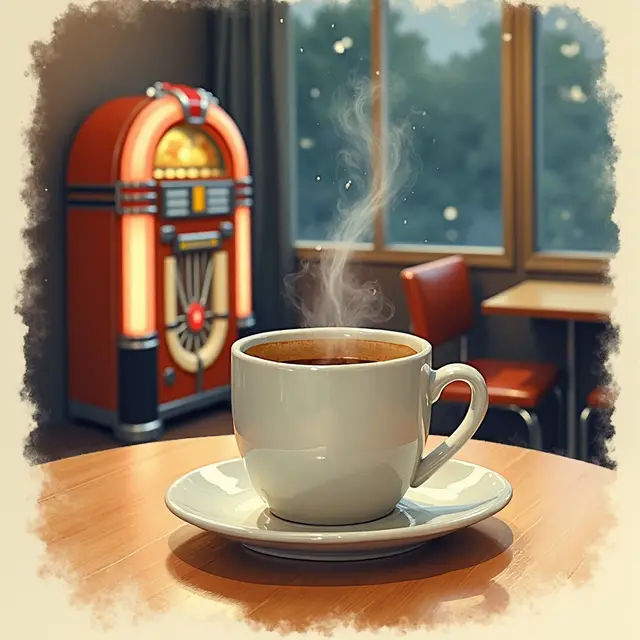
How it sounds
It is half past two in the morning inside a highway diner where the white linoleum floor lost its shine twenty years ago. Outside, rain falls with steady insistence against the black asphalt, turning the headlights of distant trucks into red and yellow streaks that slide across the glass. You are sitting in the back booth, over synthetic leather that groans every time you shift your weight.
In your hand, you hold a heavy ceramic mug of coffee that no longer steams; the rim barely warms your fingertips, but the liquid inside is lukewarm and tastes of metal and wasted hours. In the corner, a square jukebox of amber and green light holds a thick silence broken only by the constant hum of the pie cooler. The first notes of a steel guitar drift in: the pedal pulls the string upward with a long lament, bending back on itself as if the instrument were carrying a secret no one asked for.
There is no rush because there is nowhere else to go. The voice enters slowly, almost speaking, recounting a tiny detail—the stub of a ticket kept in a pocket, the dust on the dashboard of a truck that will not start anymore—while outside the water keeps hitting the window with a rhythm identical to brushes on a snare. The air smells of old grease and damp wool. There are no shouts or arguments in the room; only the exact weight of what was kept quiet for years and now fills every inch of space between the table and the door.
Palette: jukebox red / gold amber / window grayish blue / wood brown
- BPM
- 68 BPM
- Family
- Dust and Highway
- Serial
- PLV-15
- Rarity
- Common
- Style strength
- 90
- Experimentation
- 14
Typical structure
[Steel Intro] → [Verse] → [Chorus] → [Verse 2] → [Chorus] → [Bridge] → [Soft Final Chorus]
The four data points above fit in any production table. What is missing is the invisible pulse: how to measure the exact distance between one note and the next so the pedal steel sounds like breathing rather than decoration, and how to choose an everyday object without making the scene look like a hardware inventory. That lives in an internal distillate of eight unpublished parameters that the engine crosses with your story before drafting the first line. Upon completion, an internal judge measures the output against six dimensions of the canon and orders a rewrite for anything falling short. The 6/8 time signature can be copied in a second. The restraint, not.
How a lyric in this style thinks
A country ballad lyric does one specific thing: it holds still long enough for the truth to surface. Where other genres build toward a climax or chase resolution, the country ballad sits down at the table with whatever loss or reckoning it carries and refuses to leave until the room has absorbed it completely. The confession at the center of a country ballad is never announced — it arrives the way cold arrives through a drafty window, gradually, until you realize you've been shivering for some time without noticing. That quality of slow revelation is not a mood choice; it's structural. Every section of the lyric exists to earn the moment when the weight finally becomes visible.
The emotional register of a country ballad runs on restraint, not silence. The voice delivers lines at something close to speech cadence, particularly in the verses, where the syllable count tends to sprawl just enough to feel like thinking out loud rather than performing. Line lengths are uneven by design — a longer line followed by a short one that lands like a period on a sentence you didn't expect to end.
Rhyme is present but never forced into tidiness; a near-rhyme or a delayed rhyme often carries more emotional authority than a perfect one because it feels earned rather than arranged. The chorus tightens the line length and the rhythm locks into the 6/8 sway more firmly, which in a country ballad at 68 BPM feels less like a lift and more like a slow wave that carries you under rather than over.
The sensory world of the country ballad is built from objects that have been handled and worn. A ticket stub. A dashboard layered in dust. A ceramic mug that has gone cold. A paler rectangle on the wall where a picture hung for twenty years. These details are never decorative — each one is doing the emotional labor that the lyric refuses to do through direct statement. The genre lives in linoleum, in vinyl seating, in the amber glow of a jukebox in a diner at two in the morning.
It does not use the language of abstraction, and it has no patience for metaphors that reach for grandeur. When the pedal steel bends a note upward and holds it, the lyric underneath should be doing the same thing: holding a single true detail until the listener feels the weight of everything left unsaid around it.
Structurally, the country ballad earns its bridge. The Steel Intro establishes the emotional temperature before any words arrive — the weeping pedal steel is not background; it is the first verse, instrumental, and the lyric has to honor what it already communicated. The two verses carry the narrative accumulation, the second verse always slightly further into the wound than the first. The chorus names the condition without explaining it — four to six lines that circle the central ache without resolving it.
The bridge does not pivot to hope; in a country ballad, the bridge is where you stop moving and acknowledge that some parallel tracks never converge, that forgiving someone is not the same as things becoming whole. The Soft Final Chorus returns not louder but quieter, as if the voice has run out of reasons to project and is now simply telling the truth to the table in front of it.
What separates a genuine country ballad lyric from an imitation is the absence of explanation. The imitation tells you what to feel. The real thing places a cold mug in your hand and lets you understand the loneliness yourself. There are no slammed doors here, no cinematic arguments, no cathartic release that cleans the air. The rain keeps hitting the glass. The pie cooler keeps humming.
The voice finishes its last line and the steel guitar answers it, bending one more time, not resolving the phrase but letting it hang in the amber-and-shadow air of the room until the silence that follows feels inhabited. That inhabited silence is what a country ballad is actually writing toward from the very first note.
- SLOW TEAR
- WEEPING STEEL
Sample excerpt
The dust settled on the windowsill in layers of gray, I traced a line through it, watching the afternoon decay. Your coffee mug sits on the coaster by the sink, I leave it there, not wanting to watch the porcelain blink. The porch light flickers, a slow pulse against the dark, Tracing the ghost of a tire track etched in the park.
It is not the slamming door that keeps me awake, Just the weight of the silence, a slow steady ache. I am learning to walk through this amber-lit hall, Without reaching out for your shadow at all.
Workshop note — This sample relies on low-stakes, domestic imagery to anchor the listener in a tangible sense of loss rather than abstract grief. By focusing on physical objects like a coffee mug or a dust-covered sill, the lyrics create an intimacy that allows the weeping steel guitar to carry the emotional heavy lifting. Avoid explosive metaphors; in a country ballad, the most painful truths are those whispered to the furniture.
Sample excerpt written by MUSAI Song. Your lyrics are written from scratch, based on your story.
When to choose this style
Choose this card when your story calls for a confession that cannot fit into an argument. It works for when you had to say goodbye to someone in silence, without slammed doors or heavy tears, just crossing a threshold under the drizzle. For the moment you understood that forgiving your father did not mean things were fixed, but accepting that his story and yours ran on parallel tracks that would never meet.
For the day you returned to the empty house after moving the last boxes and sat on the hardwood floor to stare at the paler rectangle where a picture used to hang. It serves to name an absence that has already settled into routine, morning coffee for one, the empty space in the passenger seat that nobody occupies again. Do not choose this for an eufphoric reconciliation, nor for a celebration where whiskey flows and laughter fills the room: country music has neither the rush nor the volume for a party.
And if your story asks for a fast tempo, a loud electric guitar up front, and a forward rush stepping on the gas without looking back, this card will not achieve it. If you are looking for a confession that keeps a slow stride without breaking the measure, the letter is Country Waltz.
Your story in this style
MUSAI Song writes original lyrics from your story, in the Jukebox Country Ballad style, and delivers the finished sung song, the ready-to-use style recipe, and an illustrated art plate with its numbered certificate, private by default; public only if its owner publishes it.
- Original lyrics written from your story
- A finished sung song, ready to play and share
- Art plate with a unique seal and a numbered certificate, private by default; public only if its owner publishes it
Frequently asked questions
What BPM is Jukebox Country Ballad?
Jukebox Country Ballad usually runs at 68 BPM.
What does Jukebox Country Ballad sound like?
The country ballad: a steel guitar crying in slow motion and a confession too tender to shout.
What song structure does Jukebox Country Ballad use?
[Steel Intro] → [Verse] → [Chorus] → [Verse 2] → [Chorus] → [Bridge] → [Soft Final Chorus]
How do I write Jukebox Country Ballad lyrics?
Tell MUSAI Song your story and pick Jukebox Country Ballad: it writes original lyrics for this style at 68 BPM, you edit them word by word, and you get the song sung in Jukebox Country Ballad, with an illustration of the song and its numbered certificate. $19 USD per song, one-time payment.
Explore more styles
- 80s Heartland Rock
- Alt-Country
- Americana
- Appalachian Folk
- Classic Country
- Country Blues
- Country Duet
- Country Gospel
- Country Pop
- Country Rock
- Country Soul
- Country Waltz
- Cowboy Western
- Desert Highway Rock
- Fiddle Hoedown
- First Dance Country
- Folk Country
- Front Porch Acoustic
- Hick-Hop
- Honky Tonk
- Modern Country Anthem
- Mountain Bluegrass
- Nashville Sound
- Outlaw Country
Your idea or story, sung in this style
Card · secure payment via Stripe, charged in USD
If it doesn't move you, we give you your money back · 7 days