Country Blues
One guitar, zero filters, infinite feelings.
Get your song in Country Blues
Make yours in this styleHear it before you pay.$19 USD · your first song for $5.50 USDIf it doesn't move you, we give you your money back · 7 days.
Country Blues is a style from the Dust and Highway family. 82 BPM, Experimentation 26, Style strength 88.
What is Country Blues?
One string, one ache, and a sun-soaked porch. Country blues doesn't need anything else to break you in two.
How it sounds
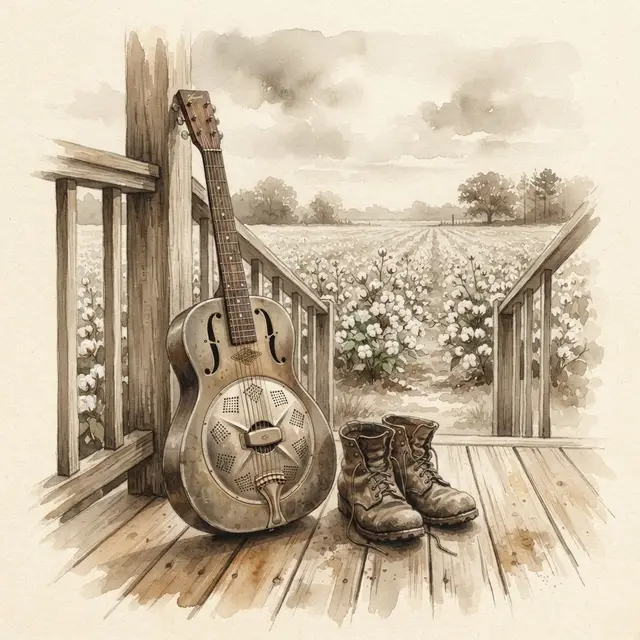
The four o'clock sun hits the warped porch planks dead-on, and the wood groans under your boot just like it did yesterday. There is no wind. The cotton field across the fence is a flat white smear fading into the grey belly of a storm that has been threatening since Tuesday and refuse to break. You lean your forearm on your knee, and the red roadside dust has settled deep into the cracks of your skin, a dry map that doesn't hurt anymore.
The metal-body resonator guitar sits across your lap; the aluminum cone is dented, and one of the nickel strings has a hard knot in it because it snapped back in January and nobody bothered to swap it out. The neck is dark and smooth where thumbs pressed down decades before you were born. You push the brass slide against the third fret and the note doesn't ring clean—it drags a metallic rasp that hits the clapboard wall and dies slow in the heavy air.
The voice doesn't come from the throat; it crawls up from the bottom of your ribs with the dry scratch of a man who hasn't swallowed water in hours. There is no crowd. Just a slow housefly circling a heavy glass half-full of lukewarm tea. Every chord is an old debt paid in full, a line drawn in the dirt that nobody else can cross for you.
Palette: brown sepia / storm gray / cotton white / ochre wood
- BPM
- 82 BPM
- Family
- Dust and Highway
- Serial
- PLV-19
- Rarity
- Common
- Style strength
- 88
- Experimentation
- 26
Typical structure
[Slide Intro] → [Verse] → [Chorus] → [Verse 2] → [Slide Solo] → [Final Chorus]
What you see on the sheet is just the porch and the heat. What stays hidden is how to keep hardship from sounding like a postcard, and how to make a single plain sentence weigh heavier than three clever verses. That lives inside an unpublished internal distillate of eight parameters, and the engine cross-references it with your history before writing a single line. When it stops, an internal judge checks the lyric against six canons and sends back anything that smells fake. The slide is copied. The weight, not.
How a lyric in this style thinks
A country blues lyric doesn't narrate grief — it holds it the way warped wood holds heat. The song doesn't explain what happened or how the singer feels about it. It states a condition, flat and without apology, and lets that condition do all the heavy lifting. The genre works through accumulation rather than confession: a cracked jar on a shelf, a screen door that won't latch, a debt that's been paid so many times it's just a habit now. Country blues operates at 82 beats per minute, which is slow enough to feel like dragging your boot through red clay but not slow enough to be mournful in any theatrical sense. This is endurance music, not elegy.
The base tone sits somewhere between resignation and a stubborn kind of dignity. Emotion doesn't arrive in a surge — it seeps in through the concrete details. You write a verse about the knot in a guitar string and the listener understands a whole year of not fixing things. That's the mechanism: the object carries the weight the voice won't claim out loud. Line length in country blues tends to stay short and irregular, more spoken than sung, with pauses that function like rests in the slide guitar's phrasing.
Repetition in the chorus is not anthemic; it's more like a man saying the same thing twice because the first time it didn't quite land right, and the second time he's already accepted it won't.
The sensory field is narrow and specific. Resonator guitar with a brass slide dragging against wound nickel strings, the metallic rasp hitting clapboard and dying in still air. Foot stomp as rhythm, not production choice — it's the sound of someone keeping time alone on a porch where no drummer will ever show up. The voice sits gravelly and low, crawling up from the chest, with the texture of someone who hasn't spoken much today and doesn't plan to. Country blues has no use for reverb-soaked spaces, cathedral acoustics, or anything that suggests amplification. The production should feel like it was recorded in the room where the thing happened, not in a room built to remember it.
Structurally, the genre opens with the slide guitar doing the work that lyrics will later confirm — the Slide Intro is not decorative, it's declarative. By the time the first Verse arrives, the listener already knows the key and the mood; your words are filling in a shape already drawn. The Chorus in country blues is rarely a lift. It's a return to the central fact, the thing you can't get around, stated with slightly more weight than the first time you passed it. The Slide Solo in the middle is not a showcase — it's the part of the conversation where words run out and the guitar says what they couldn't. The Final Chorus lands like a door closing quietly, not slamming.
What separates a real country blues lyric from a generic imitation is the absence of visible craft. A good country blues lyric reads like the singer just remembered something while sitting still, not like someone composed a song about remembering. Avoid any image that has been laundered into metaphor — no broken roads standing in for broken lives, no rain as a symbol for sorrow.
In this genre, rain is rain that hasn't come since Tuesday, and the cotton field is a flat white smear going grey, and the glass of tea is lukewarm because nobody thought to ice it. The specificity is the point. The moment you reach for the universal, country blues slides away from you like a note that won't ring clean.
- STRING AND SORROW
- SUN-SOAKED PORCH
Sample excerpt
The screen door swings on a rusted hinge, I swept the dust from the concrete floor. Left my shadow near the water pump, And the heavy silence behind the door. My thumb is raw from the copper wire, Watching the afternoon turn to ink black.
I put the ledger down in the shade, There ain't no debt left to pay tonight. Just the wind moving through the dry corn, And the porch light humming out of sight.
Workshop note — Country blues relies on short, observational lines that ground the listener in the physical exhaustion of a task. The chorus should function as a release of tension rather than a dramatic statement, focusing on simple imagery that marks the end of a long day. Avoid flowery metaphors; the power here comes from the mundane weight of objects like tools, keys, or dust.
Sample excerpt written by MUSAI Song. Your lyrics are written from scratch, based on your story.
When to choose this style
Choose this card when you need to lay out a quiet exhaustion, the kind that doesn't leave scars for a show but changes how a person walks. It works when an old man looks at the dirt he worked his whole life and accepts it won't ever be his. For the afternoon you lock up a workshop because the numbers stopped working and you drop the key on the counter without looking back. For an apology that arrives ten years late, after the other person already learned how to get by without it.
For remembering a grandfather who spoke in grunts and left behind a rusted box of socket wrenches. Country blues has no room for clean anger or cinematic goodbyes; there is no grandeur in this grief, just grit and a ledger closing. Do not pick this for a sudden windfall, teenage romance, or moving to the big city with big plans. If your story calls for a bright horizon, an optimistic twist, or the promise that everything heals, this card will feel like a costume. If you want a sweet closure or a sunlit reconciliation, the card is Prairie Ballad.
Your story in this style
MUSAI Song writes original lyrics from your story, in the Country Blues style, and delivers the finished sung song, the ready-to-use style recipe, and an illustrated art plate with its numbered certificate, private by default; public only if its owner publishes it.
- Original lyrics written from your story
- A finished sung song, ready to play and share
- Art plate with a unique seal and a numbered certificate, private by default; public only if its owner publishes it
Frequently asked questions
What BPM is Country Blues?
Country Blues usually runs at 82 BPM.
What does Country Blues sound like?
One string, one ache, and a sun-soaked porch. Country blues doesn't need anything else to break you in two.
What song structure does Country Blues use?
[Slide Intro] → [Verse] → [Chorus] → [Verse 2] → [Slide Solo] → [Final Chorus]
How do I write Country Blues lyrics?
Tell MUSAI Song your story and pick Country Blues: it writes original lyrics for this style at 82 BPM, you edit them word by word, and you get the song sung in Country Blues, with an illustration of the song and its numbered certificate. $19 USD per song, one-time payment.
Explore more styles
- 80s Heartland Rock
- Alt-Country
- Americana
- Appalachian Folk
- Classic Country
- Country Duet
- Country Gospel
- Country Pop
- Country Rock
- Country Soul
- Country Waltz
- Cowboy Western
- Desert Highway Rock
- Fiddle Hoedown
- First Dance Country
- Folk Country
- Front Porch Acoustic
- Hick-Hop
- Honky Tonk
- Jukebox Country Ballad
- Modern Country Anthem
- Mountain Bluegrass
- Nashville Sound
- Outlaw Country
Your idea or story, sung in this style
Card · secure payment via Stripe, charged in USD
If it doesn't move you, we give you your money back · 7 days