Americana
Literature you can hum on a gravel road.
Get your song in Americana
Make yours in this styleHear it before you pay.$19 USD · your first song for $5.50 USDIf it doesn't move you, we give you your money back · 7 days.
Americana is a style from the Dust and Highway family. 88 BPM, Experimentation 28, Style strength 88.
What is Americana?
American roots music with a writer's touch: golden dust, dobro, and verses that read like short fiction.
How it sounds
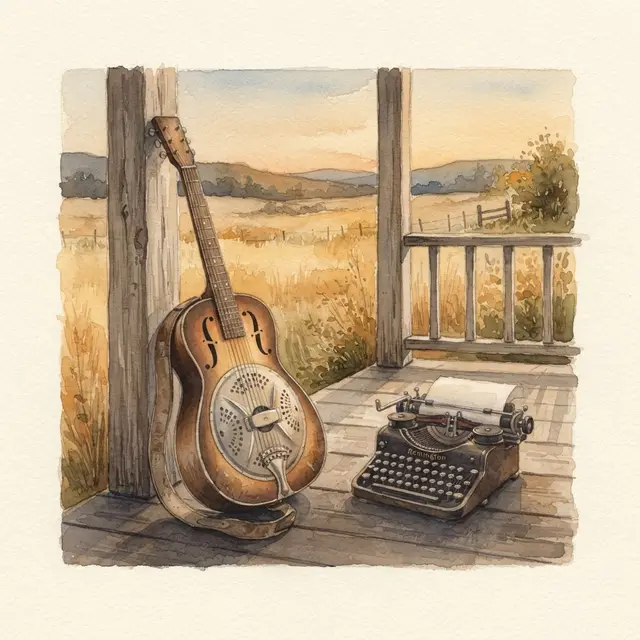
It is six in the evening on a pine plank porch that groans under the exact weight of the years. The sun hangs low over dry wheat fields, staining the air a thick, old-honey yellow. Far off, the silhouette of a rusted metal silo cuts against the sky like a scar. You are sitting in a wicker rocker that lost its rhythm long ago, with a black-covered notebook propped on your knees and a worn pencil that barely has a point. On the lower step, a white enamel mug holds cold coffee with a dark ring dried along the rim.
The air smells of warm dirt after last night's storm and cut grass losing its green. There is no traffic. Only the distant sound of a tractor cutting its engine two miles away and the scrape of dry leaves brushing against the foundation. The dobro rests in its open case on the floorboards, its steel strings catching the fading light, waiting for someone to decide to tell what happened without raising their voice. Every note that comes out of there does not aim to fill the room, but to measure the size of the silence left by those who are gone.
The wood creaks again. The paper waits.
Palette: gold amber / brown coffee brown / bluish gray / olive green
- BPM
- 88 BPM
- Family
- Dust and Highway
- Serial
- PLV-11
- Rarity
- Common
- Style strength
- 88
- Experimentation
- 28
Typical structure
[Intro] → [Verse] → [Chorus] → [Verse 2] → [Chorus] → [Bridge] → [Final Chorus]
The details above are just the peeling paint on the barn. What remains hidden is how to keep nostalgia from sounding like a cheap postcard, or how to pick the exact object that carries memory without sliding into cheap sentimentality. That lives inside an unpublished internal distillate of eight parameters that the engine crosses with the personal history you provide. In the end, an internal judge measures the lyrics against six dimensions of the canon and sends back anything that rings false. The porch is built with pine. The honesty, not.
How a lyric in this style thinks
An Americana lyric does not explain how it feels — it shows you the object that carries the feeling and then steps back. The genre works by accumulating weight through specific, unremarkable things: the dried coffee ring on the rim of an enamel mug, the pair of boots left too long by the door, the two-lane road that crosses a state line without ceremony. Where other genres reach for emotion directly, Americana trusts the concrete detail to do the emotional labor. The feeling arrives late, quietly, the way grief does when you finally sit down.
A lyric in this style is essentially a short story with the middle taken out — you get the before and the after, and the listener fills the gap with their own version of what was lost.
The base tone is restraint. Americana does not raise its voice. Its emotional register lives somewhere between dry-eyed acceptance and the kind of ache that has been carried so long it has become ordinary. The genre understands that the most devastating line in a song is often the most factual one — not 'I miss you' but 'your coat is still on the hook by the back door.' Repetition in Americana is structural and deliberate: a phrase returns not because it is a hook in the pop sense but because returning to it changes its meaning. The first time you hear a line, it is observation. By the third time, it is reckoning.
Line length in Americana tends toward the unhurried. Verses carry more syllables than the chorus, not fewer, because the verse is where the story lives. At 88 BPM, there is room to breathe between phrases, room for the dobro's steel-string sustain to settle into the space a word leaves behind. The vocal delivery is conversational, pitched low, weathered rather than polished — you are not performing the story, you are remembering it out loud. The chorus, by contrast, earns its brevity.
It distills the whole verse into something that could be said standing at a fence post looking at nothing in particular. Subtle organ underneath adds harmonic warmth without pushing the emotion forward; it sits behind the vocal the way old furniture sits in a room you grew up in.
The sensory field of Americana is specific and bounded. It belongs to dry wheat fields, pine plank porches, rusted metal, warm dirt after rain, cut grass going brown at the edges. It uses objects that show their age. It never uses anything that suggests speed, novelty, or urban density — no glass towers, no neon, no traffic. The genre lives in places where the horizon is visible and the silence has texture.
When you write in this style, you are selecting from a palette of worn, tactile things: enamel, iron, cedar, denim, gravel, the particular quality of late-afternoon light in flat country. Color in Americana is amber, dust-gold, the bluish gray of an overcast sky over brown fields. It is never bright.
Structurally, the intro gives the dobro or acoustic guitar time to establish place before a word is spoken — this is not decoration, it is orientation. The two verses carry the narrative, with the second verse deepening or complicating what the first established. The bridge is where the lyric's argument, if it has one, surfaces briefly before the final chorus absorbs it.
What separates a real Americana lyric from a generic imitation is exactly this: the imitation reaches for the rustic aesthetic — the boots, the pickup truck, the back road — without earning the emotional weight those images are supposed to carry. In genuine Americana songwriting, every concrete detail has been chosen because it is the specific thing, not a type of thing. The coffee stain is on this table, in this kitchen, left by this person. That precision is the whole craft.
- ROOTS AND PEN
- GOLDEN DUST
Sample excerpt
The screen door whines on a rusted hinge, I’m wiping grease from a knuckle joint. Your winter coat still hangs by the mudroom trim, Collecting dust like a slow-moving clock. There’s a copper penny wedged in the floorboard seam, And the kettle is whistling a thin, high note.
Oh, the amber light stretches thin on the grain, We’re just two shadows waiting on a freight train. Whatever we held is sinking in the dirt, Underneath the weight of an unstitched shirt.
Workshop note — Americana relies on grounded imagery, focusing on physical objects to carry the emotional burden rather than naming feelings directly. Keep the meter steady and the language plain, prioritizing the internal rhythm of spoken prose over complex rhyming schemes to maintain a sense of authentic, lived-in weariness.
Sample excerpt written by MUSAI Song. Your lyrics are written from scratch, based on your story.
When to choose this style
Choose this card when you need to tell a story that has spent too much time locked in a desk drawer. It works when a father finally puts down his tools and sits to watch the horizon without speaking, or when moving day forces you to clear out a house full of objects that still carry someone's scent. It fits an anniversary where grand speeches don't belong, only small facts: the weight of boots left by the door, the coffee stain on the kitchen table, the two-lane highway crossing the state line without looking back.
It serves to speak of a distance that isn't just miles, but the gap between what you meant to say and what you kept inside. Do not pick this for a party, a loud victory, or a city story where asphalt hides the earth. Americana does not understand urban rush or shouting. If you want a quick celebration or lyrics full of emotional fireworks, the card is Country Pop.
Your story in this style
MUSAI Song writes original lyrics from your story, in the Americana style, and delivers the finished sung song, the ready-to-use style recipe, and an illustrated art plate with its numbered certificate, private by default; public only if its owner publishes it.
- Original lyrics written from your story
- A finished sung song, ready to play and share
- Art plate with a unique seal and a numbered certificate, private by default; public only if its owner publishes it
Frequently asked questions
What BPM is Americana?
Americana usually runs at 88 BPM.
What does Americana sound like?
American roots music with a writer's touch: golden dust, dobro, and verses that read like short fiction.
What song structure does Americana use?
[Intro] → [Verse] → [Chorus] → [Verse 2] → [Chorus] → [Bridge] → [Final Chorus]
How do I write Americana lyrics?
Tell MUSAI Song your story and pick Americana: it writes original lyrics for this style at 88 BPM, you edit them word by word, and you get the song sung in Americana, with an illustration of the song and its numbered certificate. $19 USD per song, one-time payment.
Explore more styles
- 80s Heartland Rock
- Alt-Country
- Appalachian Folk
- Classic Country
- Country Blues
- Country Duet
- Country Gospel
- Country Pop
- Country Rock
- Country Soul
- Country Waltz
- Cowboy Western
- Desert Highway Rock
- Fiddle Hoedown
- First Dance Country
- Folk Country
- Front Porch Acoustic
- Hick-Hop
- Honky Tonk
- Jukebox Country Ballad
- Modern Country Anthem
- Mountain Bluegrass
- Nashville Sound
- Outlaw Country
Your idea or story, sung in this style
Card · secure payment via Stripe, charged in USD
If it doesn't move you, we give you your money back · 7 days