Mountain Bluegrass
Banjos at 140 BPM: cardio you can dance to.
Get your song in Mountain Bluegrass
Make yours in this styleHear it before you pay.$19 USD · your first song for $5.50 USDIf it doesn't move you, we give you your money back · 7 days.
Mountain Bluegrass is a style from the Dust and Highway family. 140 BPM, Experimentation 25, Style strength 92.
What is Mountain Bluegrass?
Lightning-speed banjo and mountain harmonies. Bluegrass: fingers of fire on old wood.
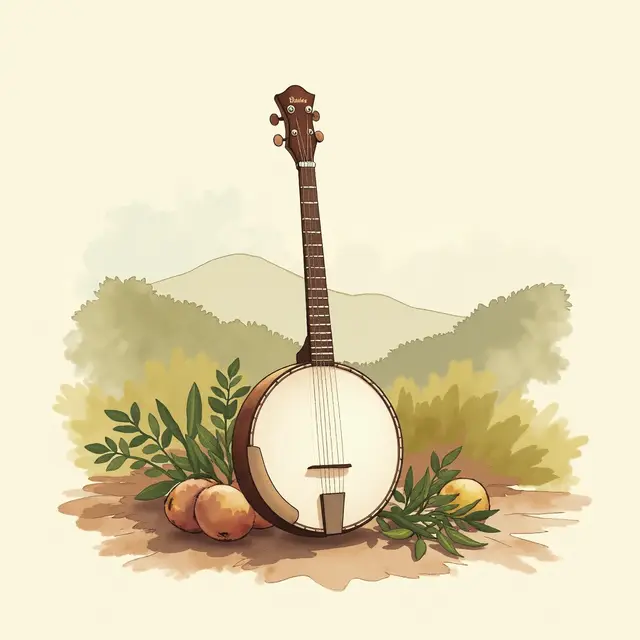
How it sounds
You are standing on the unpainted pine planks of a mountain porch, right when the early fog settles heavy in the hollow. The air smells of damp oak woodsmoke and fresh creek mud. In front of you, five strings stretched tight across the skin of a nickel-plated banjo ring out at one hundred forty beats per minute. Your thumb and fingers drive brass picks into metal at a reckless speed, a blind gallop where a single missed note would collapse the entire frame.
Beside you, a fiddle bow bites into steel strings with fresh rosin, scattering white dust over a body scratched by decades of use. The mandolin cuts the offbeat with a dry, wooden chop—sharp as a dry branch snapping under a work boot. Then the vocal arrives: a high major third locked above the lead line, pushing raw and sharp toward the black pine ridge. There are no amplifiers here, no cords stretched across the grass; only acoustic wood vibrating directly against your ribs and breath steaming in the mountain cold.
The speed is not there to show off skill: it is the only tempo fast enough to keep grief from catching up. You feel the bite of the picks on your fingers and the wood floor giving beneath your heels. The music offers no warm shelter; it runs clean, hard, and fast until your lungs burn.
Palette: mahogany wood / hill green / soft fog gray / ochre earth
- BPM
- 140 BPM
- Family
- Dust and Highway
- Serial
- PLV-05
- Rarity
- Rare
- Style strength
- 92
- Experimentation
- 25
Typical structure
[Instrumental Intro] → [Verse] → [Chorus] → [Banjo Solo] → [Verse 2] → [Fiddle Solo] → [Final Chorus]
The specs above are merely the visible surface of the blueprint. They do not write the song. Beneath this card lies an internal engine with eight hidden parameters that solve two critical problems: how to maintain narrative weight inside a runaway tempo, and where to place the high lonesome vocal break so the mountain harmony hits with raw truth rather than pastiche. The engine crosses those parameters with your personal story. Upon completion, an internal judge evaluates the text against six dimensions of the Appalachian canon and repairs any weakness. Fast fingerpicking can be copied. The density of old timber cannot.
How a lyric in this style thinks
A bluegrass lyric does not describe grief — it outruns it. The words arrive at a sprint, carried by a tempo that sits around 140 beats per minute, and the emotional weight is delivered not through pause or stillness but through velocity and compression. Where other genres let feeling pool, bluegrass forces it through a narrow channel at pressure. The result is a lyric that feels urgent, almost reckless, as if the singer knows that slowing down means being caught by something too heavy to face head-on. That is the foundational contract of the form: speed is the emotional strategy, not the decoration.
The tone of a bluegrass lyric lives in what craftspeople call the high lonesome register — not darkness exactly, but a brightness pitched so sharp it cuts. Harmony arrives as a major third stacked above the lead vocal, raw and slightly nasal, which means the emotional texture is never soft or blurred. The words need to match that texture. Concrete nouns do the work: a callused hand, creek mud on a boot sole, the unpainted pine of a porch plank, woodsmoke settling into a wool collar. These are not decorative details. They are load-bearing.
A bluegrass lyric that reaches for abstraction loses its footing immediately, because the acoustic instruments — banjo, fiddle, mandolin chop, upright bass — are already speaking in the language of physical vibration and wood grain. The lyric has to meet them there.
Line length in bluegrass tends to run short and declarative, cut to fit the syllable density the banjo rolls demand. Rhyme is close and functional, often end-stopped, because the mandolin's dry offbeat chop lands like punctuation. Repetition works differently here than in pop: a chorus in bluegrass is not a place for emotional release so much as a place to confirm what the verse already proved.
The structure moves fast — intro, verse, chorus, instrumental break, verse, another break, final chorus — and the instrumental solos are not interruptions but equal voices. The banjo break and the fiddle break carry narrative weight; they are not filler between lyric sections, they are the moments when the story breathes without words.
The sensory field of a genuine bluegrass lyric is narrow and specific. Mountains, hollow roads, timber frames, rivers running cold, the smell of damp earth after rain, tools worn smooth by decades of the same grip. What it never uses: urban imagery, synthetic textures, ambient softness, anything that suggests distance from the physical world. The genre has no patience for metaphors that float. If you write about loss, it arrives as a specific object — a chair left empty, a truck parked in the same spot, a jar of something still on the shelf. Abstraction is not forbidden, but it must be earned by three lines of concrete detail first.
What separates a real bluegrass lyric from an imitation is the relationship between stubbornness and tenderness. A generic version leans on grit alone and ends up hollow. The genuine article carries something almost unbearably tender underneath the breakneck delivery — a tribute to labor, a drive away from a place you loved, a bond that never needed many words to be real. The speed is not toughness for its own sake. It is the only pace at which certain kinds of love and loss can be spoken without collapsing. Write a lyric that knows why it is running, and bluegrass will carry it the rest of the way.
- FINGERS OF FIRE
- LIVING MOUNTAIN
Sample excerpt
Old man carved the poplar beam Down where the mill race runs Tried to buy an honest dream Out from beneath the guns Dirt is caked beneath his nail Iron rusts upon the rail
Run the ridge before the dew Take the path the fox once knew Nothing left to keep us down Leaving every ghost in town
Workshop note — This verse relies on hard physical nouns and unvarnished labor to build immediate mountain grit. The chorus picks up the pace with short, driving lines that mirror the relentless roll of a banjo. Avoid smooth metaphors and urban vocabulary here; every image must smell of pine rosin and damp earth.
Sample excerpt written by MUSAI Song. Your lyrics are written from scratch, based on your story.
When to choose this style
Choose this card when your story carries history and dirt on its boots. It fits a tribute to a grandfather who worked the earth with callused hands, a drive away from a hometown seen only in the rearview mirror, or a bond forged through years of shared labor and unspoken respect. It works when loss doesn't ask for quiet weeping, but for a breakneck sprint forward, or when a personal milestone was carved out purely through stubborn grit. Bluegrass turns memory into a fired-up engine.
Do not pick it for a smooth city romance, a gentle apology delivered in quiet tones, or a tragedy that needs to sit still by the window. Bluegrass cannot walk slowly and does not offer lukewarm comfort. It has no patience for urban sheen or quiet contemplation. If you want a slow dance for an anniversary or a quiet, reflective heartbreak, the card is Country Waltz.
Your story in this style
MUSAI Song writes original lyrics from your story, in the Mountain Bluegrass style, and delivers the finished sung song, the ready-to-use style recipe, and an illustrated art plate with its numbered certificate, private by default; public only if its owner publishes it.
- Original lyrics written from your story
- A finished sung song, ready to play and share
- Art plate with a unique seal and a numbered certificate, private by default; public only if its owner publishes it
Frequently asked questions
What BPM is Mountain Bluegrass?
Mountain Bluegrass usually runs at 140 BPM.
What does Mountain Bluegrass sound like?
Lightning-speed banjo and mountain harmonies. Bluegrass: fingers of fire on old wood.
What song structure does Mountain Bluegrass use?
[Instrumental Intro] → [Verse] → [Chorus] → [Banjo Solo] → [Verse 2] → [Fiddle Solo] → [Final Chorus]
How do I write Mountain Bluegrass lyrics?
Tell MUSAI Song your story and pick Mountain Bluegrass: it writes original lyrics for this style at 140 BPM, you edit them word by word, and you get the song sung in Mountain Bluegrass, with an illustration of the song and its numbered certificate. $19 USD per song, one-time payment.
Explore more styles
- 80s Heartland Rock
- Alt-Country
- Americana
- Appalachian Folk
- Classic Country
- Country Blues
- Country Duet
- Country Gospel
- Country Pop
- Country Rock
- Country Soul
- Country Waltz
- Cowboy Western
- Desert Highway Rock
- Fiddle Hoedown
- First Dance Country
- Folk Country
- Front Porch Acoustic
- Hick-Hop
- Honky Tonk
- Jukebox Country Ballad
- Modern Country Anthem
- Nashville Sound
- Outlaw Country
Your idea or story, sung in this style
Card · secure payment via Stripe, charged in USD
If it doesn't move you, we give you your money back · 7 days