Country Duet
Couples therapy, but in perfect two-part harmony.
Get your song in Country Duet
Make yours in this styleHear it before you pay.$19 USD · your first song for $5.50 USDIf it doesn't move you, we give you your money back · 7 days.
Country Duet is a style from the Dust and Highway family. 94 BPM, Experimentation 16, Style strength 88.
What is Country Duet?
Two voices, one fire: a sung conversation where love argues, gives in, and finds itself wrapped up in the chorus.
How it sounds
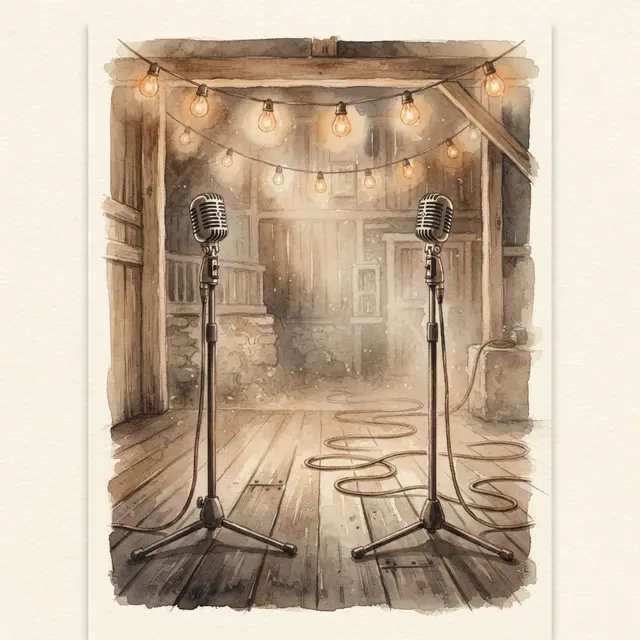
It is past ten and dust hangs heavy beneath the single amber bulb dangling from the plank ceiling inside the barn. Outside, tires crunch over gravel as the truck engine cuts; the hood cools down with a tiny metallic ping in the open country dark. Inside, two wooden chairs face the upright mic. An acoustic guitar with worn edges around the soundhole rests on a stand, its strings smelling of aged nickel. Someone props heavy boots against the chair rung and the leather groans.
The voices start testing the room: first his, low and scraping against the wood, half-telling a story that has rolled down highways for years. Then hers cuts in before the measure ends, correcting a detail from the past with a sharpness that clears the air. There are no screens here, only the squeak of fingertips sliding against steel strings and the warm air rising from the dirt floor. A second guitar answers from the dark corner with a clean arpeggio, mirroring the porch light through the screen door.
Both breaths fall into time together, measuring the exact space between one syllable and the next, knowing right now the only way forward is to share the weight.
Palette: warm amber / wood brown / silver gray
- BPM
- 94 BPM
- Family
- Dust and Highway
- Serial
- PLV-22
- Rarity
- Rare
- Style strength
- 88
- Experimentation
- 16
Typical structure
[Intro] → [His Verse] → [Her Verse] → [Chorus Together] → [Alternating Verse] → [Bridge] → [Final Chorus Together]
The data above is just the lumber for the porch. What does not fit in the table is how to keep two distinct voices in balance without them sounding like a petty argument, and how to make her reply dismantle his premise with surgical grace. All of that lives in an internal distillate that cross-references conversational timing with your specific memory. At the finish line, an internal judge measures the lyric against six canonical dimensions and repairs any forced rhyme. Steel strings are bought anywhere. The dead-center aim of the duet, no.
How a lyric in this style thinks
A lyric in Country Duet does not describe a relationship from the outside — it enacts one. The form is a live argument, a negotiation, a reckoning where two people talk at the same time and somehow reach the same syllable by the chorus. Country Duet works because the song's architecture mirrors the dynamic it is trying to capture: two stubborn, weathered voices who share a history so dense they can correct each other mid-sentence without breaking the melody. The genre lives in the collision between those two accounts of the same event, and the craft is in making both accounts feel true.
Emotion in this genre does not announce itself. It arrives through friction — a word one voice uses that the other quietly revises in the next line, a pause where an agreement almost happens but doesn't quite. The base tone is warm and worn, amber and wood-brown, the kind of feeling that has been around long enough to lose its shine without losing its hold. Sentimentality is the enemy here. What replaces it is precision: the creak of a chair, the ping of a cooling engine hood, the smell of nickel on old guitar strings.
When the sensory field is concrete enough, the emotion needs no explanation. The genre never reaches for abstraction. It stays in rooms, in trucks, in barns under a single bulb. It does not float above the scene.
Rhythmically, Country Duet runs at a mid-tempo that leaves space for breath and for response — around 94 BPM is the natural home, a pace where a line can land and the second voice has room to pick it up without rushing. Line lengths tend to be unequal between the two voices, because real conversation is unequal. His verse might run long and declarative, hers might cut in shorter and sharper, correcting a detail he let slide.
The alternating verse section is where the form earns its name: lines trade hands almost measure by measure, and the writing has to be tight enough that neither voice sounds like an echo of the other. Each speaker needs a distinct verbal texture — different idioms, different cadence, different relationship to the past they are describing.
Structurally, the chorus is the only place both voices fully agree, and that agreement has to feel earned. If the chorus arrives too easily, the duet collapses into a simple love song. The listener should feel the two perspectives pressing against each other through the verses, so that when the voices finally lock together in harmony, it reads as a resolution rather than a given. The bridge is where the argument pauses — not to resolve, but to acknowledge what neither voice has said directly yet.
That silence-before-the-final-chorus is the emotional hinge of the whole piece. After the bridge, the final chorus together should feel different from the first one: heavier, more certain, the kind of agreement that only comes after something real has been said.
What separates a genuine Country Duet lyric from a generic imitation is whether the two voices could be separated and still each make sense. In a weak duet, the two parts are interchangeable. In a strong one, each voice has a position — a version of events, a grievance, a loyalty — and the song is the record of those positions finding common ground. The call-and-response is not decorative; it is the argument.
Acoustic guitar with worn frets, steel strings sliding under fingertips, a second guitar answering from across the room — the production mirrors the lyric. Two instruments in conversation, just like the two voices. If you can hear one voice finishing the other's sentence and feel the weight of how long it took them to get there, the song is doing its job.
- TWO VOICES ONE FIRE
- CALL AND RESPONSE
Sample excerpt
You left the truck keys in the frost-covered grass, And the porch light is flickering out in the cold. You say it’s a habit, a trick of the glass, But I’m tired of watching the stories unfold. I packed up the blankets, I swept out the hall, While you spent the evening just staring at walls.
We’re two jagged edges trying to make a straight line, Trading our secrets for a glass of cheap wine. I’ll take the burden if you’ll take the blame, 'Cause we’re burning the map just to keep the same name.
Workshop note — This genre relies on the tension of a conversational 'call and response' where lines must be punchy to allow the two vocalists to interject. A successful duet chorus works by merging the individual complaints into a shared realization, using short, rhythmic meter that feels like two people stepping into the same dance. Avoid flowery metaphors; keep the dialogue grounded in domestic clutter and physical gestures to make the friction feel earned.
Sample excerpt written by MUSAI Song. Your lyrics are written from scratch, based on your story.
When to choose this style
Choose this card when your story is not a solo confession but a back-and-forth between two stubborn people who know each other too well to trade empty sweetness. It works for a long partnership that weathered a harsh move and learned to divide the blame across a midnight kitchen table. For two siblings clearing the air after years of stubborn quiet, putting old grievances on the table without breaking the room.
For any bond where two distinct versions of the same history collide and the only true ground is where they interrupt and finish each other's sentences. Do not pick this for gentle romances where friction does not exist, nor for solitary grief where no one answers from across the room. If you are looking for a quiet, unbroken confession where a single voice carries the entire weight of memory without an echo, the card is Country Ballad.
Your story in this style
MUSAI Song writes original lyrics from your story, in the Country Duet style, and delivers the finished sung song, the ready-to-use style recipe, and an illustrated art plate with its numbered certificate, private by default; public only if its owner publishes it.
- Original lyrics written from your story
- A finished sung song, ready to play and share
- Art plate with a unique seal and a numbered certificate, private by default; public only if its owner publishes it
Frequently asked questions
What BPM is Country Duet?
Country Duet usually runs at 94 BPM.
What does Country Duet sound like?
Two voices, one fire: a sung conversation where love argues, gives in, and finds itself wrapped up in the chorus.
What song structure does Country Duet use?
[Intro] → [His Verse] → [Her Verse] → [Chorus Together] → [Alternating Verse] → [Bridge] → [Final Chorus Together]
How do I write Country Duet lyrics?
Tell MUSAI Song your story and pick Country Duet: it writes original lyrics for this style at 94 BPM, you edit them word by word, and you get the song sung in Country Duet, with an illustration of the song and its numbered certificate. $19 USD per song, one-time payment.
Explore more styles
- 80s Heartland Rock
- Alt-Country
- Americana
- Appalachian Folk
- Classic Country
- Country Blues
- Country Gospel
- Country Pop
- Country Rock
- Country Soul
- Country Waltz
- Cowboy Western
- Desert Highway Rock
- Fiddle Hoedown
- First Dance Country
- Folk Country
- Front Porch Acoustic
- Hick-Hop
- Honky Tonk
- Jukebox Country Ballad
- Modern Country Anthem
- Mountain Bluegrass
- Nashville Sound
- Outlaw Country
Your idea or story, sung in this style
Card · secure payment via Stripe, charged in USD
If it doesn't move you, we give you your money back · 7 days