Country Rock
When the farm boy discovered distortion pedals.
Get your song in Country Rock
Make yours in this styleHear it before you pay.$19 USD · your first song for $5.50 USDIf it doesn't move you, we give you your money back · 7 days.
Country Rock is a style from the Dust and Highway family. 116 BPM, Experimentation 20, Style strength 87.
What is Country Rock?
Two engines in one song: the soul of the open land and the muscle of rock, headed straight for the horizon.
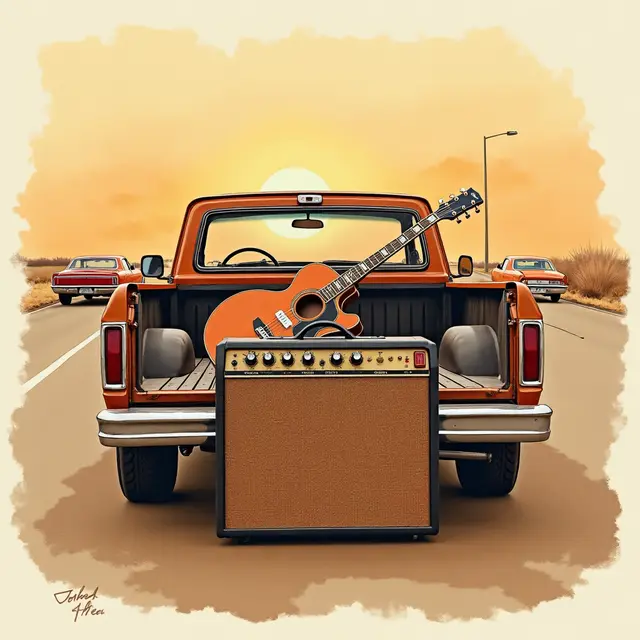
How it sounds
It is six in the afternoon and the desert sun presses down like a hot iron on the hood of the Chevrolet C10. The rolled-down window lets in a dry wind smelling of red clay dust and spilled gasoline. Your left arm rests on the door, skin baked by a thousand miles of hot asphalt, and your elbow feels every shudder of the V8 block beneath the floorboards.
There is no music on the radio because the signal died two counties back, but behind the bench seat sits a Fender amplifier with the reverb cranked and a Les Paul resting in its tweed case, waiting for the next stop. To the right, telephone poles tick past like a row of fence posts slicing through an orange-ochre and purple sky. The gas pedal gives another fraction of an inch under your worn leather boot. The white highway stripe stretches ahead as if painted with a ruler, straight into an emptiness that doesn't frighten, it clears.
A slide guitar hums in your mind before you even play it: that metal bar gliding over a nickel wound string, mimicking the whistle of air against the windshield. Every mile strips weight from your shoulders. The engine growls a deep, dull thrum that settles in your breastbone and locks in step with your pulse. You are not running away; you are arriving at the only place where the air fits entirely inside your lungs.
Palette: sunset orange / ochre brown / black / chrome
- BPM
- 116 BPM
- Family
- Dust and Highway
- Serial
- PLV-08
- Rarity
- Common
- Style strength
- 87
- Experimentation
- 20
Typical structure
[Intro riff] → [Verse] → [Chorus] → [Verse 2] → [Chorus] → [Guitar Solo] → [Final chorus]
What you see above is just the surface of the ride. Beneath it lie hidden hurdles: how to keep the fusion of dirt and rock from sounding like a commercial cliche, and how to make highway speed amplify rather than drown out lyric honesty. That lives in an unpublished eight-parameter internal distillate, and the engine crosses it with every turn of your real history. When finished, an internal judge measures the output against six canons and forces a rewrite on anything that lacks hot metal. The V8 engine is bought at a junkyard. The open road is not.
How a lyric in this style thinks
A country rock lyric doesn't describe the road — it moves at the speed of it. The genre earns its place by putting the listener inside a physical experience so precisely rendered that the body responds before the mind catches up: the vibration through a truck floor, the dry heat pressing against a forearm, the smell of asphalt warming after a rain that ended three states ago. Country rock operates on forward momentum as its primary emotional logic. Feeling doesn't arrive through confession; it arrives through accumulation — one concrete image after another, stacked like telephone poles ticking past at highway speed, until the weight of all of them together lands somewhere in the chest.
The tone runs amber and chrome, never sentimental. Grief in this genre is something you drive out of, not something you sit inside. The emotional core is almost always transition — a life being left behind, a horizon being chosen — and the lyric earns that transition by making the departure physical rather than psychological. You don't write "I felt free"; you write about the gas pedal giving another fraction of an inch under a worn leather boot.
The sensory field is specific and dry: red clay dust, nickel-wound strings, a V8 block rumbling through the floorboards, the dead radio signal two counties back. What country rock never uses is interior decoration — no curtains, no candlelight, no whispered kitchen details. The landscape here is open, sun-struck, and indifferent in the best possible way.
Rhythmically, lines in this genre tend to run long and then snap short, mimicking the way a highway stretches and then delivers a sudden exit. The verse builds geography and circumstance; it sets the physical scene with working-class precision. The chorus lifts — not into abstraction, but into the one declarative truth the verse was building toward. At 116 BPM, the rhythm section locks into a rolling groove that sits between a country shuffle and a rock drive, and your syllable count has to fit that engine without fighting it.
Southern twang vocals deliver lines with a slight drawl on the stressed syllables, which means monosyllabic Anglo-Saxon words land harder than polysyllabic ones. "Gone" hits. "Departed" doesn't.
The guitar solo isn't decoration — it's a structural argument. In the canon form for country rock, the solo falls after the second chorus, and it carries the emotional weight that a third verse would otherwise need to speak. A slide guitar phrase, that metal bar gliding over a wound string, can say in eight bars what four lines of lyric might fumble. This means your lyric should be aware of the solo's presence: don't over-explain in the second verse what the guitar is about to demonstrate. Leave the air.
The Hammond organ underneath thickens the low-mid frequency range and gives the track its canyon warmth — the 70s California sound this genre draws from is as much about that organ sustain as it is about the electric guitar's bite.
What separates a real country rock lyric from a generic imitation is the refusal to romanticise the road in the abstract. The generic version says "freedom" and "wide open spaces" and stops there. The real version gives you the elbow on the door panel, skin baked, feeling every shudder of the block below. The real version understands that the open plain at the end of a broken relationship isn't a metaphor — it's a physical relief, a literal change in the air pressure in your lungs. Write toward that specificity. The dual engine the genre runs on — the soul of the land and the muscle of rock — only fires when both cylinders are loaded: the twang earns the drive, and the drive earns the twang.
- DUAL ENGINE
- OPEN ROAD
Sample excerpt
Left the keys on the counter by the leaking sink Salt on the windshield from a cheap roadside drink Dashboard rattling loose at eighty miles an hour Leaving behind every concrete clock and tower
Roll the windows down let the dust blow in We are burning up the miles where the rivers begin No looking back when the tires hit the gravel track Just the hum of the engine and the open back
Workshop note — This sample anchors heavy emotion in tangible, noisy objects like a leaking sink and a rattling dashboard rather than abstract feelings. The lines use steady, percussive pacing that matches highway speed, while the chorus opens wide with vowel sounds designed to carry over a driving rock beat. It strictly avoids static indoor reflection, keeping the narrative moving forward with every measure.
Sample excerpt written by MUSAI Song. Your lyrics are written from scratch, based on your story.
When to choose this style
Choose this track when your story demands physical movement and an open horizon. It works when you walk away from a life-draining job and get into the truck without knowing where you will sleep tonight. For the moment a friend crosses the country to start over on the coast and you hand them a soundtrack smelling of asphalt and dust. To celebrate that a broken relationship stopped being dead weight in your chest and turned into an open plain where you can drive with both hands on the wheel.
For anyone who prefers the grit of the highway to the comfort of a living room. Do not choose it for motionless grief where the only proper action is sitting silent inside a locked house. Neither for whispered kitchen reconciliations in the dark nor for stories where nostalgia acts as an anchor preventing you from moving forward. If you are looking for an intimate, fragile confession by a fireplace, the card is Country Ballad.
Your story in this style
MUSAI Song writes original lyrics from your story, in the Country Rock style, and delivers the finished sung song, the ready-to-use style recipe, and an illustrated art plate with its numbered certificate, private by default; public only if its owner publishes it.
- Original lyrics written from your story
- A finished sung song, ready to play and share
- Art plate with a unique seal and a numbered certificate, private by default; public only if its owner publishes it
Frequently asked questions
What BPM is Country Rock?
Country Rock usually runs at 116 BPM.
What does Country Rock sound like?
Two engines in one song: the soul of the open land and the muscle of rock, headed straight for the horizon.
What song structure does Country Rock use?
[Intro riff] → [Verse] → [Chorus] → [Verse 2] → [Chorus] → [Guitar Solo] → [Final chorus]
How do I write Country Rock lyrics?
Tell MUSAI Song your story and pick Country Rock: it writes original lyrics for this style at 116 BPM, you edit them word by word, and you get the song sung in Country Rock, with an illustration of the song and its numbered certificate. $19 USD per song, one-time payment.
Explore more styles
- 80s Heartland Rock
- Alt-Country
- Americana
- Appalachian Folk
- Classic Country
- Country Blues
- Country Duet
- Country Gospel
- Country Pop
- Country Soul
- Country Waltz
- Cowboy Western
- Desert Highway Rock
- Fiddle Hoedown
- First Dance Country
- Folk Country
- Front Porch Acoustic
- Hick-Hop
- Honky Tonk
- Jukebox Country Ballad
- Modern Country Anthem
- Mountain Bluegrass
- Nashville Sound
- Outlaw Country
Your idea or story, sung in this style
Card · secure payment via Stripe, charged in USD
If it doesn't move you, we give you your money back · 7 days