Cowboy Western
Yee, and furthermore, haw — with cinematic reverb.
Get your song in Cowboy Western
Make yours in this styleHear it before you pay.$19 USD · your first song for $5.50 USDIf it doesn't move you, we give you your money back · 7 days.
Cowboy Western is a style from the Dust and Highway family. 76 BPM, Experimentation 32, Style strength 89.
What is Cowboy Western?
A whistle, spurs, and an endless desert. The cowboy song rides the line between myth and dust.
How it sounds
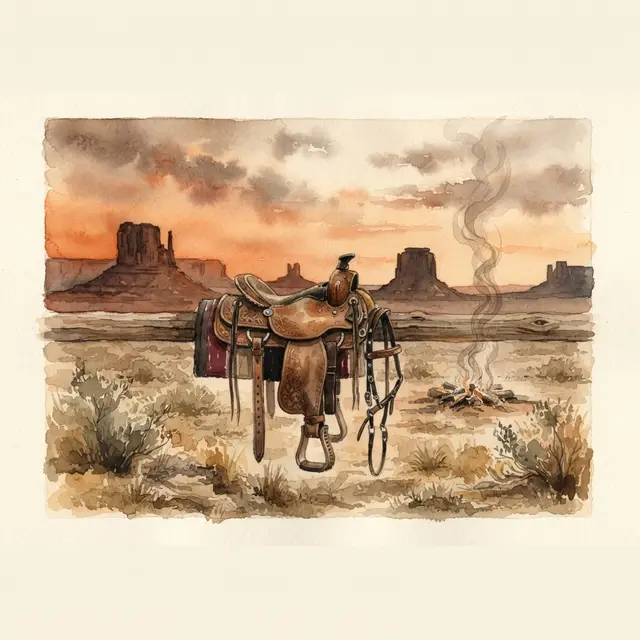
The sun drops behind the red sandstone bluffs and the dry air catches in your throat like warm ash. You are leaning against the tailgate of an old truck or the dry cedar rail of a fence, one boot resting in the red dirt kicked up by the wind ten minutes ago. The quiet out here is not empty; it has weight, mineral and dense, like the earth itself holding its breath before the dark sets in.
Then the pulse takes hold. It is not a drum kit; it is the deadened thud of a thumb against the bass strings of an old flat-top acoustic, tracking a steady seventy-six beats per minute. A single low note sustains through the spring reverb of a tube amp, wet and distant, like cold water drawn from an iron pipe. Above it, a solo human whistle cuts clean through the expanse, hitting intervals with the unbothered precision of someone accustomed to talking only to a horse. The metallic click of a drop-forged spur against rock marks the offbeat.
The voice that follows does not perform; it leans into the microphone as if addressing the horizon, dry from black coffee and road gravel, perfectly aware that shouting in a canyon only makes a man look small.
There is the scent of sun-baked saddle leather, juniper wood smoldering in an unseen camp, and dry clay cooling as the light fades. Your ribs tighten with a sudden, immovable calm.
Palette: sunset orange / leather brown / rock red / silhouette black
- BPM
- 76 BPM
- Family
- Dust and Highway
- Serial
- PLV-18
- Rarity
- Rare
- Style strength
- 89
- Experimentation
- 32
Typical structure
[Whistle Intro] → [Verse] → [Chorus] → [Verse 2] → [Desert interlude] → [Final chorus]
The parameters above merely map the surface. What escapes any chart are two craft problems unique to this style: how to anchor an intimate loss to an everyday relic of iron or worn leather without slipping into frontier pastiche, and how to measure the breath between lines so the silence carries the vastness of the plains without dragging the tempo. That knowledge lives in eight unpublished parameters that the engine crosses directly with your story. An internal evaluator audits the draft against six canonical dimensions, repairing anything that leans theatrical. The whistle can be mimicked. The weight of the horizon cannot.
How a lyric in this style thinks
A Cowboy Western lyric does not confide — it reports. Where other genres ask the listener to feel alongside the narrator, this one places the listener at a respectful distance, the way you'd watch a man walk the last mile of a long trail without calling out to him. The emotion arrives sideways, embedded in the weight of a fence post driven into hardpan or the sound a screen door doesn't make because it's been left open. Dry dignity is the operating principle: Cowboy Western holds pain the way a canyon holds heat after sunset, quietly and without apology.
The rhythmic foundation of the genre is deceptively simple. At seventy-six beats per minute, the pulse never rushes and never drags — it tracks like a horse at a steady walk, each beat falling with the flat certainty of a boot heel on packed earth. The thumb-driven bass pattern on a flat-top acoustic carries most of the low-end weight, and the arrangement stays spare by design. Spring reverb on a single sustained guitar note opens space rather than filling it.
A human whistle, dry and interval-precise, functions as the melodic conscience of the song — it says what the vocal won't. Clip-clop percussion is not decoration; it is the metronome of a world that moves at its own pace regardless of what you feel about it. When a spur clicks the offbeat, that's the genre reminding you that ornamentation here must earn its place.
Line length in a Cowboy Western lyric tends toward the long and unhurried. Lines breathe out fully before the next one arrives. Rhyme schemes are clean but never clever — slant rhymes work better than perfect ones because perfect rhymes can feel like a trick, and this genre has no patience for tricks. Repetition, when it appears in the chorus, does not escalate emotionally; it deepens, the way a canyon deepens not by growing louder but by going further down. The chorus is not a release valve. It is a statement of position, delivered the same way each time, because the landscape hasn't changed and neither has the man.
The sensory field of Cowboy Western is tightly bounded and should stay that way. You are working with sun-baked sandstone, cedar smoke, saddle leather, iron pipe water, red dirt, and the specific silence that precedes full dark in open country. The concrete objects that belong here are worn, functional, and unnamed by brand: a flat-top guitar, a duffel tossed in a truck bed, a fence rail, a tin cup. What the genre refuses is sentimentality's props — no candles, no rain on glass, no softening metaphors. If water appears, it comes from a hard source and tastes of minerals. Warmth in this genre is the warmth of sun on rock, not of an embrace.
Structurally, the whistle intro serves a precise function: it establishes the emotional register before a single word is sung, so the listener calibrates to restraint before the vocal even arrives. The desert interlude — an instrumental passage between the second verse and the final chorus — is not a guitar solo in the conventional sense. It is a pause in which the landscape itself seems to speak. The final chorus lands with accumulated weight, not increased volume.
What separates a real Cowboy Western lyric from a generic imitation is this refusal to perform feeling. The imitator reaches for sentiment in the bridge; the genuine article trusts that the image of an empty highway stretching north carries everything that needs carrying, and says nothing more.
- ENDLESS DESERT
- WHISTLE AND SPURS
Sample excerpt
The gate latch clicks against the cedar post, Sixty miles of salt and iron grit. I left the silver spurs upon the kitchen table, And a gallon of amber tea beside the sink. The sun bleeds out across the canyon floor, Dragging a long, ink black shadow behind the truck.
Keep the wheels turning on the gravel line, There’s nothing left to settle in the dust. The horizon is a promise kept in stone, Moving north until the engine turns to rust.
Workshop note — This sample works by prioritizing concrete physical markers—like the latch and the tea—over emotional declarations, which keeps the tone grounded and stoic. The chorus uses a steady, rhythmic cadence to mimic the motion of a long drive, ensuring the song emphasizes the act of moving forward rather than dwelling on the departure. Avoid flowery metaphors; in this genre, the weight of the story is carried entirely by the harshness of the landscape.
Sample excerpt written by MUSAI Song. Your lyrics are written from scratch, based on your story.
When to choose this style
Pick this card when your story calls for dry dignity rather than confession. It works to honor a father who never delivered a sermon, whose life was measured in calloused hands, fence posts, and quiet consistency. It fits an exit that unfolded without shouting or slamming doors: a duffel bag tossed in the bed of a truck and an empty highway stretching north. It honors anyone who crossed their own personal desert—years of quiet recovery, a closed business, or a solitary grief—and wants the milestone treated not like a triumph, but like ground covered.
Cowboy Western never begs for sympathy; it regards pain simply as another rock on the trail. Do not choose it for a sweet, vulnerable love confession, nor for a boisterous anniversary where people want to raise glasses and jump to the chorus. If you need tender sorrow framed in three-four time with a weeping fiddle, the card is Country Waltz.
Your story in this style
MUSAI Song writes original lyrics from your story, in the Cowboy Western style, and delivers the finished sung song, the ready-to-use style recipe, and an illustrated art plate with its numbered certificate, private by default; public only if its owner publishes it.
- Original lyrics written from your story
- A finished sung song, ready to play and share
- Art plate with a unique seal and a numbered certificate, private by default; public only if its owner publishes it
Frequently asked questions
What BPM is Cowboy Western?
Cowboy Western usually runs at 76 BPM.
What does Cowboy Western sound like?
A whistle, spurs, and an endless desert. The cowboy song rides the line between myth and dust.
What song structure does Cowboy Western use?
[Whistle Intro] → [Verse] → [Chorus] → [Verse 2] → [Desert interlude] → [Final chorus]
How do I write Cowboy Western lyrics?
Tell MUSAI Song your story and pick Cowboy Western: it writes original lyrics for this style at 76 BPM, you edit them word by word, and you get the song sung in Cowboy Western, with an illustration of the song and its numbered certificate. $19 USD per song, one-time payment.
Explore more styles
- 80s Heartland Rock
- Alt-Country
- Americana
- Appalachian Folk
- Classic Country
- Country Blues
- Country Duet
- Country Gospel
- Country Pop
- Country Rock
- Country Soul
- Country Waltz
- Desert Highway Rock
- Fiddle Hoedown
- First Dance Country
- Folk Country
- Front Porch Acoustic
- Hick-Hop
- Honky Tonk
- Jukebox Country Ballad
- Modern Country Anthem
- Mountain Bluegrass
- Nashville Sound
- Outlaw Country
Your idea or story, sung in this style
Card · secure payment via Stripe, charged in USD
If it doesn't move you, we give you your money back · 7 days