Country Waltz
Three-quarter time, one hundred percent swoon.
Get your song in Country Waltz
Make yours in this styleHear it before you pay.$19 USD · your first song for $5.50 USDIf it doesn't move you, we give you your money back · 7 days.
Country Waltz is a style from the Dust and Highway family. 90 BPM, Experimentation 12, Style strength 89.
What is Country Waltz?
One-two-three of a slow embrace under barn lights. The country waltz stops the clock cold.
How it sounds
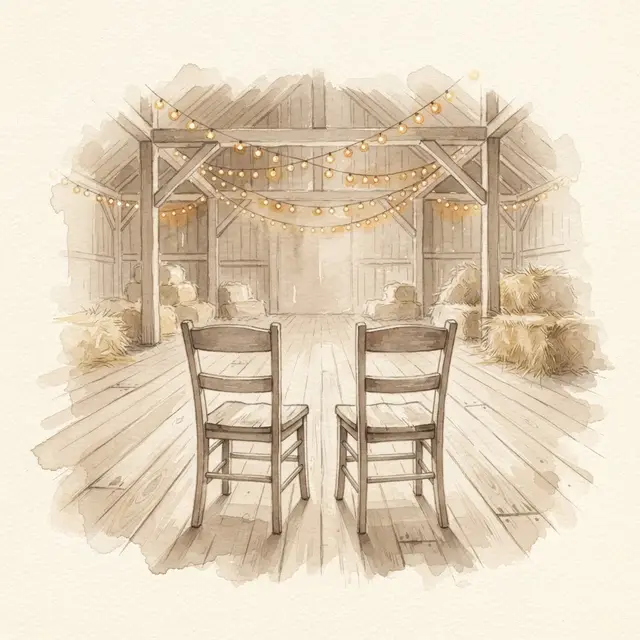
It is eleven past nine inside a weathered barn just outside Lubbock. The double doors are thrown wide open, letting in an August wind that still carries the day's asphalt heat but now smells sharply of damp earth. Strung from beam to beam, rows of amber bulbs hum softly, casting a light so thick across the pine floorboards it feels almost tangible. The boards groan beneath the weight of three couples moving in tight, unbroken circles. Nobody speaks.
The outside world, with its highways and glowing screens, has been erased by the rhythm mapped out on the floor. One-two-three. One-two-three. In the corner improvised from old apple crates, a fiddler rests his cheek against aged wood while his bow draws out a long, unhurried sigh that rises and falls like a sleeping chest. Beside him, the accordion breathes: opening its bellows with a dry intake and closing to release notes that blend with the scent of ochre hay and worn leather.
Your hand rests against the back of the person in front of you, right over the coarse flannel fabric holding yesterday's warmth. The wall clock in the farm office has either broken or simply given up, because minutes no longer measure anything. There is only this ring of amber illumination, the scuff of scuffed boots against timber, and the ternary pulse carrying the precise weight of what neither of you has dared to name yet.
Palette: gold amber / wood coffee brown / ochre hay
- BPM
- 90 BPM
- Family
- Dust and Highway
- Serial
- PLV-25
- Rarity
- Common
- Style strength
- 89
- Experimentation
- 12
Typical structure
[Intro] → [Verse] → [Chorus] → [Verse 2] → [Chorus] → [Waltz instrumental] → [Final chorus]
What you see above is merely the barn set design. Beneath these public parameters lie two hurdles a spreadsheet cannot clear: keeping the ternary pulse exact without the lines sounding like a nursery rhyme, and stopping the nostalgia from dissolving into sugar. That lives inside an unpublished internal distillate of eight parameters that the engine crosses directly with your raw memories. When it finishes, an internal judge measures the lyric against six canonical dimensions and sends back anything that breaks the sway. The amber bulbs are sold at any hardware store. The slow turn, not.
How a lyric in this style thinks
A lyric in Country Waltz does not describe a moment so much as suspend it. The form asks the words to behave the way the dance does — circling back, landing on the same weighted beat, refusing to resolve too quickly. Where most country writing moves in a straight line from hurt to lesson, the country waltz keeps returning to the center of the floor, each rotation adding a little more weight to what is already known but not yet spoken. The emotion does not arrive as a declaration. It arrives as a pressure, the way a hand pressed flat against flannel feels the warmth of the body underneath without either person having to say a word about it.
The base tone is amber, not bright. Grief and tenderness share the same sentence here, and bitterness is almost never useful. When loss appears in a country waltz lyric, it comes attached to something physical — the grain of a porch board, the particular smell of hay after an August rain, a wall clock that stopped on a Tuesday nobody can precisely name. The sensory field is domestic and rural: barn wood, worn leather, kerosene light, flannel, the creak of a floor that has held weight for forty years.
What the genre never uses is abstraction without an object. You cannot write about time slipping away unless you anchor it to a specific broken clasp or a coffee cup left on the same shelf for a decade. The fiddle and accordion are your tonal guides — the fiddle draws long, unhurried sighs between lines, and the accordion breathes with the verse, opening and closing like the chest of someone who has decided to stop arguing.
Rhythm in this genre is structural, not decorative. The three-quarter pulse — one-two-three, one-two-three — should be audible in the syllable count of your lines even before the melody is set. Longer lines tend to fall on the one, the stressed landing, while the two and three carry lighter syllables that feel like a half-step or a lean. Repetition is not laziness here; it is choreography.
The chorus returns not because the writer ran out of ideas but because the dance requires you to pass the same window twice, and the second time you see something you missed. A line that felt like simple observation in the first chorus should feel like quiet confession by the final one, without a single word having changed.
The structural logic of the country waltz follows a specific logic of delay. The intro establishes the room — the tempo, the texture, the particular amber of the light — before any story is told. The first verse sets the scene without explaining it. The chorus names the feeling obliquely, circling it rather than landing on it directly. The second verse moves time, either forward or back, adding a detail that reframes the first verse slightly.
Then comes the waltz instrumental, which in lyric terms is a held breath — the section where the singer steps back and lets the fiddle say what words cannot. The final chorus carries all the accumulated weight of what has been circling, and if the lyric is working, it does not need a new line to land. The old one, heard a third time, is heavier than it was.
What separates a real country waltz lyric from a generic imitation is the quality of its restraint. Imitations mistake slowness for vagueness and sentiment for emotion. A real lyric in this genre is precise about the concrete and silent about the conclusion. The singer never explains what the dance means. The listener understands because the boots on the pine floor, the amber bulbs, and the accordion's exhale have already done the explaining. If you find yourself writing toward a tidy moral or a grand gesture of reconciliation, pull back.
The country waltz earns its feeling by refusing to name it outright, trusting instead that the three-quarter turn, repeated long enough, will say everything that matters.
- ONE TWO THREE
- SLOW EMBRACE
Sample excerpt
The screen door swings on a rusted hinge, Coffee grounds cooling in the chipped white tin. I trace the grain on the oak kitchen table, Watching the afternoon stretch thin. Your boots are mud-caked by the garden gate, Where the shadows lean long and amber-deep.
One, two, three, let the floorboards hum, We are steady as the turning tide. One, two, three, let the silence come, With nowhere left for us to hide.
Workshop note — The Country Waltz relies on the rhythmic sway of a three-quarter time signature to create a sense of cyclical intimacy. By focusing on mundane, tactile details like mud-caked boots or a chipped tin, the lyrics anchor the emotional weight in a specific, lived-in space rather than abstract sentiment. The chorus should function as a gentle pivot, using repetitive phrasing to mimic the physical act of circling the room.
Sample excerpt written by MUSAI Song. Your lyrics are written from scratch, based on your story.
When to choose this style
Choose this track when your story demands a protected room where time stops and rushing no longer exists. It works for celebrating fifty years with the same person in the familiar kitchen. For saying goodbye to a father who taught you how to step on the porch before his legs gave out. For a quiet reconciliation that needs no shouting or grand promises, just standing together while the music holds the floor. For looking back without bitterness, remembering a long summer that slipped away but whose residue still warms the house.
The country vals is useless for stories driven by speed, urgency, or sharp endings. It is not the genre for a brutal breakup, a loud city triumph, or shouting a secret across a crowded room. If the core emotion needs to shake you up, break molds, or demand vengeance, this card will fall short. And if you want the same rural memory but with a straighter confession that skips the constant three-quarter turn, the card is Prairie Ballad.
Your story in this style
MUSAI Song writes original lyrics from your story, in the Country Waltz style, and delivers the finished sung song, the ready-to-use style recipe, and an illustrated art plate with its numbered certificate, private by default; public only if its owner publishes it.
- Original lyrics written from your story
- A finished sung song, ready to play and share
- Art plate with a unique seal and a numbered certificate, private by default; public only if its owner publishes it
Frequently asked questions
What BPM is Country Waltz?
Country Waltz usually runs at 90 BPM.
What does Country Waltz sound like?
One-two-three of a slow embrace under barn lights. The country waltz stops the clock cold.
What song structure does Country Waltz use?
[Intro] → [Verse] → [Chorus] → [Verse 2] → [Chorus] → [Waltz instrumental] → [Final chorus]
How do I write Country Waltz lyrics?
Tell MUSAI Song your story and pick Country Waltz: it writes original lyrics for this style at 90 BPM, you edit them word by word, and you get the song sung in Country Waltz, with an illustration of the song and its numbered certificate. $19 USD per song, one-time payment.
Explore more styles
- 80s Heartland Rock
- Alt-Country
- Americana
- Appalachian Folk
- Classic Country
- Country Blues
- Country Duet
- Country Gospel
- Country Pop
- Country Rock
- Country Soul
- Cowboy Western
- Desert Highway Rock
- Fiddle Hoedown
- First Dance Country
- Folk Country
- Front Porch Acoustic
- Hick-Hop
- Honky Tonk
- Jukebox Country Ballad
- Modern Country Anthem
- Mountain Bluegrass
- Nashville Sound
- Outlaw Country
Your idea or story, sung in this style
Card · secure payment via Stripe, charged in USD
If it doesn't move you, we give you your money back · 7 days