Fiddle Hoedown
Caution: floors have filed complaints about this one.
Get your song in Fiddle Hoedown
Make yours in this styleHear it before you pay.$19 USD · your first song for $5.50 USDIf it doesn't move you, we give you your money back · 7 days.
Fiddle Hoedown is a style from the Dust and Highway family. 148 BPM, Experimentation 28, Style strength 87.
What is Fiddle Hoedown?
The barn on fire: a devil-fast fiddle, handclaps, and stomping until the floorboards beg for mercy.
How it sounds
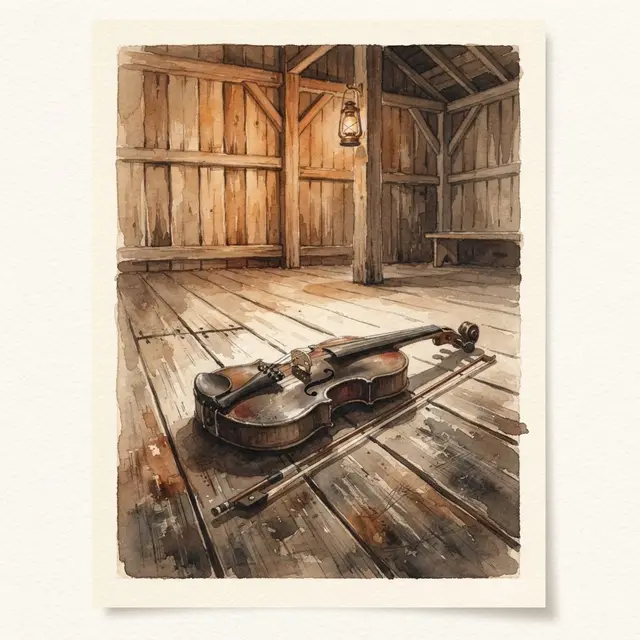
It is ten at night inside a rough pine barn in the dead of August. The air outside is dead still, but inside, a thick cloud of rosin dust and sawdust clings to the sweat on your neck. No modern amps here: just a ribbon microphone hovering over a stage made of timber planks that rumble from beneath. You are right in the middle of the floor, jammed between eighty pairs of leather boots that do not need pitch-perfect tuning to know where the downbeat lands.
The fiddle starts alone, digging into a double-stop bow shuffle that sounds raw, almost metallic, as if horsehair were trying to set gut strings on fire. The player isn’t looking at anyone; his chin is locked into the rest, his right elbow pumping at a brutal hundred and forty-eight beats per minute. On the third turnaround, the heel taps hit the floor and a hundred palms crack in unison—a dry snap that clears out your ears. You feel the floorboards humming straight up through your ankles, a constant tremor that knocks your knees loose.
Someone lets out a wild holler from the back, a wordless shout cutting through the amber lantern light. At this speed, there’s no time to revisit yesterday or worry about tomorrow. Your body only understands leather rubbing against splintered oak, the heat radiating off the shoulders around you, and that fiddle pushing half a step faster like the floor is giving way.
Palette: wood brown / warm amber / dark sepia
- BPM
- 148 BPM
- Family
- Dust and Highway
- Serial
- PLV-30
- Rarity
- Rare
- Style strength
- 87
- Experimentation
- 28
Typical structure
[Fiddle Intro] → [Verse] → [Chorus] → [Fiddle Solo] → [Handclap breakdown] → [Chorus] → [Accelerated Outro]
The specs above are just the visible crust of the stomp. What stays off the sheet are two craft hurdles unique to this genre: holding a runaway train of physical imagery without the lyrics stumbling over their own velocity, and placing native vocal hollers so they feel like raw human instinct rather than a stage gimmick. That balance sits inside an internal distillate of eight unpublished parameters that the engine merges with your story. Afterward, an internal judge checks the lyric against six canon dimensions to fix anything off-key. Anyone can copy the fiddle tune. The floorboards shaking underneath are another story.
How a lyric in this style thinks
A fiddle hoedown lyric doesn't reflect on feeling — it produces it, physically, in the body of whoever is singing or listening. The words exist to drive the heel into the floor harder on the next downbeat. Every syllable is a percussion instrument before it is a meaning, and the best lines in this genre are the ones that feel wrong to say slowly. At 148 beats per minute, the fiddle has already made its argument before the first word lands, so the lyric's job is to confirm what the boots already know: that right now, in this barn, in this heat, there is nowhere else to be and nothing else to settle.
The emotional register of a fiddle hoedown is not happiness exactly — it is release. There is a difference, and the lyric has to honour it. The feeling arrives not through confession but through accumulation: a list of physical facts delivered at speed, one after another, until the weight of them becomes the emotion. You name the pine boards, the rosin cloud, the borrowed boots, the amber light swinging on its hook. You do not explain why these things matter. The hoedown assumes the listener's body will do the explaining.
Line length stays short and punchy, rarely more than seven or eight syllables, because the fiddle's bow shuffle is already filling the space between words and there is no room for a clause that meanders. Repetition is structural, not decorative — the same phrase hammered across two or three lines until it stops being language and starts being a rhythm you could tap out on a barn wall.
The sensory field of this genre is extremely specific and the lyric must stay inside it. Splintered oak, sweat on a collar, leather soles, gut strings, rosin dust, the amber glow of lanterns, the crack of a hundred palms in unison — these are the allowable textures. What the hoedown never uses: interior monologue, metaphors that require stillness to unpack, any reference to sky or horizon in a meditative sense, and certainly no whispered confession. If a line could work in a slow ballad, cut it.
The holler from the back of the room — that wordless shout that cuts the air — is the emotional peak of the genre, and a good lyric saves its most stripped-down, vowel-heavy syllables for that moment, the kind of word that opens the throat rather than shapes the lips.
Structurally, the hoedown follows a logic of escalation rather than resolution. The fiddle intro sets the tempo as a physical fact, not an invitation. The verse names the scene in short declarative strokes. The chorus is where the collective body takes over — shorter lines, harder consonants, the handclap written into the rhythm of the words themselves. The fiddle solo is a structural rest for the lyric, which means when the verse returns it must feel like re-entry at speed, not continuation.
The handclap breakdown strips everything back to percussion and a single repeated phrase — one line, maybe two, delivered with the bluntness of a hammer. Then the accelerated outro does something most genres avoid: it asks the words to get faster than is comfortable, which is exactly the point. The lyric should feel like it is barely holding on at the end, matching the fiddle pushing half a step beyond what the room can sustain.
What separates a real fiddle hoedown lyric from a generic imitation is the refusal to be clever. Generic versions reach for wit, for a neat turn of phrase, for the kind of line that reads well on paper. A genuine hoedown lyric reads badly on paper and sounds inevitable in a barn. The rhymes are blunt and unapologetic — floor, more, door, roar — because the fiddle is not asking for your admiration, it is asking for your heel. The hollers are not decorative; they are load-bearing.
If your draft has a line where you pause to appreciate your own imagery, replace it with something that hits the downbeat so hard the floorboards tremble. The genre's authority comes from weight and momentum, not from nuance, and the lyric earns its place only by submitting entirely to that physical contract.
- FULL STOMP
- BARN ON FIRE
Sample excerpt
Old man Silas threw his hammer in the hay, Said he’s done with hauling timber by the bay. The floorboards groan beneath his heavy boot, He’s kicking up the dust right by the root. Twenty years of cedar under every nail, Now we’re riding on the rhythm of the rail.
Stomp the oak until the joists start shaking, Keep the fiddle tight until the dawn is breaking. Swing your partner, let the splinters fly, We’re dancing amber sparks into the ink black sky.
Workshop note — This genre thrives on short, percussive lines that mimic the frantic pace of a fiddle melody and the rhythm of a heavy boot hitting wood. The chorus acts as a physical command to the listener, prioritizing high-energy action verbs over internal reflection to keep the tempo aggressive and relentless. Avoid introspective or static imagery; every word must feel like it is being rattled out by the vibrations of the floorboards.
Sample excerpt written by MUSAI Song. Your lyrics are written from scratch, based on your story.
When to choose this style
Pick this card when a personal story demands driving out grief or sheer joy with heavy heel taps, without getting solemn about it. It works to celebrate a family that built a workshop from the ground up through sheer physical grit. For a reunion of hometown friends who haven't met in a decade and need to prove they still strike the ground with the same force. For an uncle retiring after forty years in the mud by throwing his boots into the rafters. For breaking a long stretch of mourning not with pity, but with an absolute storm of sound that forces blood back into the veins.
Do not choose it for quiet confessions or a gentle love story that prefers stillness. A hoedown cannot hold a slow embrace or whisper a forgiveness. It won't work for tracing the ache of someone who left home for good. If you want to tell the nostalgia of open land with quiet tenderness, the card is Prairie Ballad.
Your story in this style
MUSAI Song writes original lyrics from your story, in the Fiddle Hoedown style, and delivers the finished sung song, the ready-to-use style recipe, and an illustrated art plate with its numbered certificate, private by default; public only if its owner publishes it.
- Original lyrics written from your story
- A finished sung song, ready to play and share
- Art plate with a unique seal and a numbered certificate, private by default; public only if its owner publishes it
Frequently asked questions
What BPM is Fiddle Hoedown?
Fiddle Hoedown usually runs at 148 BPM.
What does Fiddle Hoedown sound like?
The barn on fire: a devil-fast fiddle, handclaps, and stomping until the floorboards beg for mercy.
What song structure does Fiddle Hoedown use?
[Fiddle Intro] → [Verse] → [Chorus] → [Fiddle Solo] → [Handclap breakdown] → [Chorus] → [Accelerated Outro]
How do I write Fiddle Hoedown lyrics?
Tell MUSAI Song your story and pick Fiddle Hoedown: it writes original lyrics for this style at 148 BPM, you edit them word by word, and you get the song sung in Fiddle Hoedown, with an illustration of the song and its numbered certificate. $19 USD per song, one-time payment.
Explore more styles
- 80s Heartland Rock
- Alt-Country
- Americana
- Appalachian Folk
- Classic Country
- Country Blues
- Country Duet
- Country Gospel
- Country Pop
- Country Rock
- Country Soul
- Country Waltz
- Cowboy Western
- Desert Highway Rock
- First Dance Country
- Folk Country
- Front Porch Acoustic
- Hick-Hop
- Honky Tonk
- Jukebox Country Ballad
- Modern Country Anthem
- Mountain Bluegrass
- Nashville Sound
- Outlaw Country
Your idea or story, sung in this style
Card · secure payment via Stripe, charged in USD
If it doesn't move you, we give you your money back · 7 days