Desert Highway Rock
Hypnosis at highway speed — keep hands on the wheel.
Get your song in Desert Highway Rock
Make yours in this styleHear it before you pay.$19 USD · your first song for $5.50 USDIf it doesn't move you, we give you your money back · 7 days.
Desert Highway Rock is a style from the Dust and Highway family. 100 BPM, Experimentation 34, Style strength 86.
What is Desert Highway Rock?
A sonic mirage at 100 miles an hour: baritone guitar, shimmering heat, and a horizon that sings back.
How it sounds
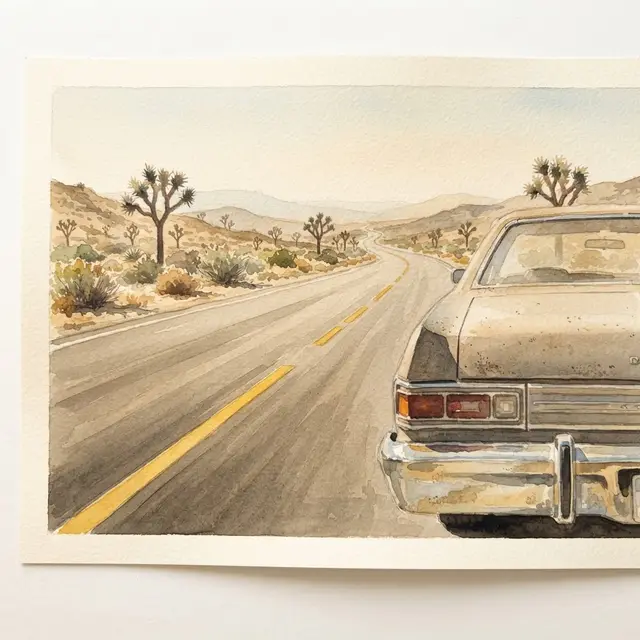
It is four in the afternoon and the dashboard thermometer reads one hundred and ten degrees. You are stranded in the middle of nowhere, on asphalt so black it seems to melt and swallow the light. On both sides, joshua trees repeat in exact monotony, twisted silhouettes of dry wood against a sky so white it hurts to look. The air rushing through the open window burns your skin like gas-stove heat.
The baritone guitar hums from the open glove compartment, a low, heavy drone vibrating straight into the steering wheel and the knuckles gripping the rim. Every note drips with reverb, floating over the hood before getting swallowed by the clay dust. The engine roars with a dull, steady growl that has become the only pulse left in the world. The yellow centerline rushes toward you and disappears beneath the chassis with hypnotic precision.
There is no background track: the music is the sound of four tires biting gravel, a half-empty gas tank, and the chrome bumper throwing a blind flash every time the sun hits the rearview mirror. You have not seen a gas station for three hours, nor passed a single car, yet you carry the strange certainty that you are never arriving anywhere, because the road is not a path to a destination, but the only place left to inhabit.
Palette: line yellow / sand ochre / bumper chrome / taillight red
- BPM
- 100 BPM
- Family
- Dust and Highway
- Serial
- PLV-32
- Rarity
- Legendary
- Style strength
- 86
- Experimentation
- 34
Typical structure
[Atmosphere Intro] → [Verse] → [Chorus] → [Verse 2] → [Chorus] → [Desert Solo] → [Final chorus]
The data above takes a minute to copy. What cannot be copied is the invisible tension: how to sustain a one-hundred-bpm pulse without making the listener feel rushed, and how to use baritone guitar reverb to make the space sound bone-dry and vast at once. All of that lives in an internal distillate of eight unreleased parameters, which the engine cross-references with your story before writing a line. Once finished, an internal judge measures the lyrics against six canonical dimensions and sends back anything that misses the mark. The highway is paved. The mirage, not.
How a lyric in this style thinks
A Desert Highway Rock lyric does not describe a journey — it becomes the journey. The words move the way asphalt unrolls under tires at a steady hundred beats per minute: no sudden turns, no decorative detours, just forward momentum that accumulates weight the longer it sustains. The genre earns its emotional charge through accumulation and heat, not through confession.
Feeling arrives sideways, the way a mirage arrives — you are not quite sure when it appeared, only that it is there, shimmering just ahead of the hood, and retreating at the same speed you chase it. Desert Highway Rock trusts the road to carry the grief, the relief, the unspoken goodbye, without ever announcing any of those things by name.
The base tone sits low and wide. The baritone guitar is the structural spine — its drone vibrates below the melody line the way engine noise vibrates below conscious thought, constant and load-bearing. Reverb is applied generously but not carelessly; every note has room to float a few feet above the asphalt before the dry air absorbs it. Mirage-like synth pads fill the middle distance, neither melodic nor percussive, functioning more like heat shimmer than instrumentation. The tempo holds at a hypnotic one hundred BPM — fast enough to feel like motion, slow enough to feel like trance. The groove never rushes. Rushing would mean arrival is possible. In this genre, arrival is always deferred.
Lyrically, the sensory field is ruthlessly specific and geographically spare. You work with dashboard thermometers, centerlines, joshua trees, the chrome glint off a rearview mirror, a gas tank needle riding the red. These are not decorative details — they are the emotional vocabulary. The genre does not live in rooms, kitchens, or any closed space. It lives on asphalt, under bleached sky, in the two feet of burning air between an open window and a moving horizon. Abstract language stalls the vehicle. Concrete nouns keep it rolling. The things you never use: candlelight, rain on glass, anything that implies shelter or stillness. This is a genre of exposure, not enclosure.
Line length and repetition follow the yellow centerline logic — regular, hypnotic, slightly relentless. Verses tend to run long enough to build a sense of distance traveled, with images accumulating like miles on an odometer. The chorus is not a release so much as a widening: the same forward motion but opened up, the baritone guitar pushed higher in the mix, the reverb tail longer.
Repetition in Desert Highway Rock is structural, not lazy — the chorus returns because the road returns, because the horizon you thought you left behind is somehow in front of you again. The desert solo section, placed after the second chorus, functions as the genre's emotional center of gravity: no words, just the guitar saying what the verses were careful not to say directly. It is the equivalent of driving in total silence across a state line.
What separates a real Desert Highway Rock lyric from a generic road-song imitation is restraint and scale simultaneously. Generic road songs reach for freedom as a concept and announce it. This genre earns the feeling by never naming it — the freedom is in the odometer climbing, in the absence of a gas station for three hours, in the certainty that the road is not a means to an end but the only inhabitable space left. If your chorus explains the emotion, you have left the desert and walked into a living room. The lyric should feel like dry air on skin: immediate, physical, slightly merciless, and impossible to hold onto.
- SONIC MIRAGE
- ENGINE AND HORIZON
Sample excerpt
Oil pressure needle trembling against the glass Your apartment keys buried in the floor mat dust I left the electric bill face-down on the counter Just a line of amber light chasing the rear axle Crossing the county line before the coffee turns cold.
One hundred miles of sand for every regret The horizon doesn't care if I’m not coming back Only the chrome heat flickering on the dash And the road singing a low, hollow hum.
Workshop note — This style relies on short, punchy lines that mirror the rhythmic vibration of an engine at high speed. The chorus functions as an anchor, emphasizing the indifference of the landscape to keep the tone detached and observational rather than melodramatic. Avoid overly complex metaphors, as the desert setting demands a stark, direct language that focuses on physical movement and scorched objects.
Sample excerpt written by MUSAI Song. Your lyrics are written from scratch, based on your story.
When to choose this style
Choose this track when you need to tell the story of a journey that was an escape forward, a life shift that asked for no permission and left no forwarding address. It works when you left behind a dead-end job, a city, or a broken promise, and the only thing that mattered was watching the odometer climb while dry air baked the tears on your cheeks. It fits a father who spent his life behind the wheel, whose only way of saying goodbye was driving across state lines in total silence.
It also serves for a reconciliation that needs no embraces, just sitting in the passenger seat watching the same retreating horizon. Do not choose this for stories demanding living-room intimacy, small spaces, or whispered confessions; the desert keeps no secrets, it only scatters them. It fails for loud celebrations or quiet grief that requires sitting still in a dark room. If you are looking for a tender, close-up confession, the card is Country Ballad.
Your story in this style
MUSAI Song writes original lyrics from your story, in the Desert Highway Rock style, and delivers the finished sung song, the ready-to-use style recipe, and an illustrated art plate with its numbered certificate, private by default; public only if its owner publishes it.
- Original lyrics written from your story
- A finished sung song, ready to play and share
- Art plate with a unique seal and a numbered certificate, private by default; public only if its owner publishes it
Frequently asked questions
What BPM is Desert Highway Rock?
Desert Highway Rock usually runs at 100 BPM.
What does Desert Highway Rock sound like?
A sonic mirage at 100 miles an hour: baritone guitar, shimmering heat, and a horizon that sings back.
What song structure does Desert Highway Rock use?
[Atmosphere Intro] → [Verse] → [Chorus] → [Verse 2] → [Chorus] → [Desert Solo] → [Final chorus]
How do I write Desert Highway Rock lyrics?
Tell MUSAI Song your story and pick Desert Highway Rock: it writes original lyrics for this style at 100 BPM, you edit them word by word, and you get the song sung in Desert Highway Rock, with an illustration of the song and its numbered certificate. $19 USD per song, one-time payment.
Explore more styles
- 80s Heartland Rock
- Alt-Country
- Americana
- Appalachian Folk
- Classic Country
- Country Blues
- Country Duet
- Country Gospel
- Country Pop
- Country Rock
- Country Soul
- Country Waltz
- Cowboy Western
- Fiddle Hoedown
- First Dance Country
- Folk Country
- Front Porch Acoustic
- Hick-Hop
- Honky Tonk
- Jukebox Country Ballad
- Modern Country Anthem
- Mountain Bluegrass
- Nashville Sound
- Outlaw Country
Your idea or story, sung in this style
Card · secure payment via Stripe, charged in USD
If it doesn't move you, we give you your money back · 7 days