First Dance Country
Guaranteed to outlast the wedding cake and the DJ.
Get your song in First Dance Country
Make yours in this styleHear it before you pay.$19 USD · your first song for $5.50 USDIf it doesn't move you, we give you your money back · 7 days.
First Dance Country is a style from the Dust and Highway family. 72 BPM, Experimentation 10, Style strength 91.
What is First Dance Country?
The first-dance song: a promise sung at the tempo of an embrace, built to last longer than the party.
How it sounds
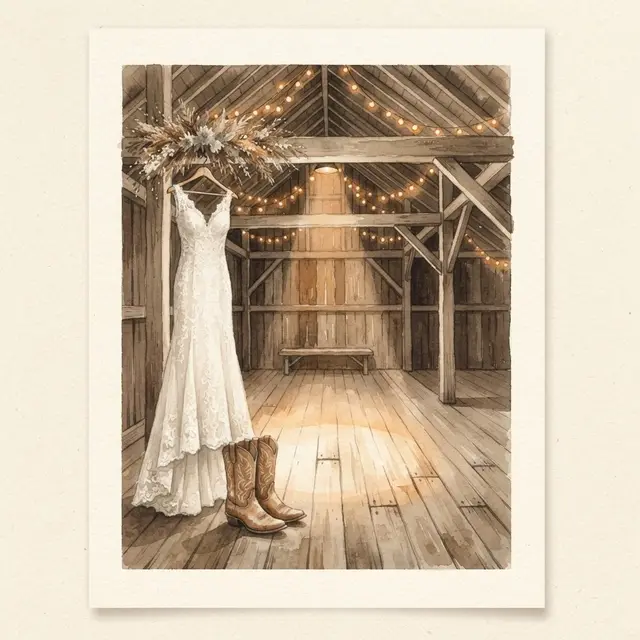
It is eleven past ten in a converted barn smelling of dry pine, melted beeswax, and the cheap perfume you dabbed behind your ears before walking through the double doors. Outside, gravel crunches under the tires of the last departing cars, but inside, the entire universe shrinks to a rectangle of polished oak where the floorboards groan in the exact same key as the porch of the house where you learned to walk.
Fairy lights loop across the vaulted beams, casting a amber grid that pools against an abandoned bourbon glass sitting on an empty whiskey barrel. Your palm rests flat against his shoulder blade, right where the linen jacket gives way to the heavy heat of bone and muscle. Across the room, the pedal steel guitar bends a note, a long, clean cry that rises as slowly as smoke from a snuffed candle. Nobody is in a rush to leave this spot.
The white heels are kicked off under a folding table; now there are only stocking feet sliding over worn knots in the wood. The tempo holds steady at seventy-two beats, the exact pace of blood settling down after a long run. The acoustic guitar sustains the open chord, an invisible bridge connecting who you were this morning to the person staring right back at you, breathing in time.
Palette: wood brown warm amber lace white
- BPM
- 72 BPM
- Family
- Dust and Highway
- Serial
- PLV-28
- Rarity
- Legendary
- Style strength
- 91
- Experimentation
- 10
Typical structure
[Intro] → [Verse] → [Chorus] → [Verse 2] → [Chorus] → [Promise bridge] → [Final chorus]
The data points above can be copied in a minute. What cannot be copied is the architecture of restraint: how to make a line sound like a lifelong vow without slipping into sentimentality, and where to drop the exact silence so the steel guitar does not sound like cheap melodrama. All of that lives in an unpublished eight-parameter distillate that the engine cross-references with your personal history before writing a single word. When it finishes, an internal judge measures the lyrics against six canons and orders a rewrite for anything out of tune. The tempo is easy to copy. The gravity, no.
How a lyric in this style thinks
A First Dance Country lyric does one specific thing: it converts a fleeting physical moment into a permanent record. The lyric does not describe falling in love or wanting someone; it witnesses the fact of being here, together, right now, and insists that this moment will not dissolve when the lights come up. That is the genre's whole project.
Everything in a First Dance Country song is engineered around presence, the weight of a hand on a shoulder blade, the particular creak of a floorboard, the smell of beeswax and warm wood, because the lyric needs the listener to feel located in a specific room, not drifting through some abstract romantic landscape. Vagueness is the enemy. If the song could have been written about anyone, it fails.
The emotional temperature stays warm and resolved. There is no tension that needs resolving, no wound that needs closing. The feeling that drives a First Dance Country lyric is closer to quiet recognition than to passionate declaration: the understanding that staying is not inertia but an active choice, renewed each morning. Emotion arrives through accumulation rather than explosion. You build it line by line, image by image, until the chorus lands not as a surprise but as an inevitability the listener already felt coming.
The chorus is the only moment where the lyric earns the right to speak plainly and directly, to say the thing out loud without metaphor, because the verses have done the work of grounding it in something real.
Line length in this genre runs medium to long, mirroring the unhurried tempo of seventy-two beats per minute, which is roughly the pace of a resting heartbeat after a long day rather than an elevated one. The rhythm breathes. Internal rhymes are more useful than end rhymes that clang too cleanly; you want the sound to feel natural, like speech between two people who have had years to finish each other's sentences. Repetition is structural and deliberate.
The promise bridge, which sits between the second chorus and the final chorus, is where a phrase gets repeated with a shift in weight, the same words returned to you after the verses have changed what they mean. That repetition is not laziness; it is the lyrical equivalent of a second vow.
The sensory field of First Dance Country is narrow by design. You are inside: warm timber, amber light pooling against glass, the give of worn floorboards under stocking feet, the sustain of an open acoustic chord, the long bend of a pedal steel note that rises like smoke from a candle just extinguished.
The production underlines all of this: acoustic guitar carrying the harmonic foundation, pedal steel handling the emotional color, gentle strings arriving in the bridge to lift the ceiling without breaking it, a tempo that never accelerates because urgency would betray the whole premise. Male-female harmonies work especially well in this genre because they literalize the duet at the center of the scene. The voices should feel like two people leaning into the same microphone, not performing for a crowd.
What separates a genuine First Dance Country lyric from a generic wedding-song imitation is specificity of commitment rather than specificity of feeling. Generic wedding lyrics say I love you in seventeen different ways. This genre says I would choose this exact floor, this exact light, this exact person again tomorrow, and the word again carries everything. The Promise bridge is where that choice gets spoken aloud, quietly, without decoration.
If you find yourself reaching for abstractions like forever or always without tethering them to a concrete image, you have drifted into greeting-card territory. Anchor every large claim to something small enough to touch. The genre's staying power, the reason it holds up fifty years later when someone plays the recording, is that it was never trying to describe love in general. It was trying to preserve one room, one tempo, one pair of stocking feet on worn oak, long enough for the people who were there to find it again.
- FIRST DANCE
- SUNG PROMISE
Sample excerpt
The porch light is humming a low amber tune, We left the guests dancing under the moon. Your hand is a compass, my palm is the map, I’m settling in for the long, steady nap. Those boots by the door have walked miles on the grit, But here in this circle, I’m finding my fit.
I’ll hold this rhythm long after the band packs away, Through the frost on the glass and the heat of the day. Just you and the floor, and the weight of the vow, It’s a simple surrender, right here and right now.
Workshop note — This genre relies on a steady, waltz-like meter that mimics the physical movement of a slow dance, keeping lines rhythmic and predictable. The lyrics focus on physical anchors like boots or porch lights to ground the promise in reality rather than abstract emotion. Avoid irony or complex metaphors; the goal is to make the listener feel that the commitment is as solid and permanent as the furniture in the room.
Sample excerpt written by MUSAI Song. Your lyrics are written from scratch, based on your story.
When to choose this style
Choose this card when a promise needs to outlast the party and anchor itself permanently in the room. It works for the wedding night when you want the exact weight of that embrace to stay intact fifty years from now. For a milestone anniversary where the accumulated years outweigh the white dress but carry the same quiet grace. For telling someone that staying isn't an accident but a choice you would make again tomorrow morning.
Do not pick it for a relationship that is currently fracturing or a summer fling looking for a bittersweet exit; this style has no room for irony or second thoughts. It will not fit a loud backyard barbecue where people are shouting over the speakers. If you are looking for a raw, dusty chronicle of hard roads, the card is Country Ballad.
Your story in this style
MUSAI Song writes original lyrics from your story, in the First Dance Country style, and delivers the finished sung song, the ready-to-use style recipe, and an illustrated art plate with its numbered certificate, private by default; public only if its owner publishes it.
- Original lyrics written from your story
- A finished sung song, ready to play and share
- Art plate with a unique seal and a numbered certificate, private by default; public only if its owner publishes it
Frequently asked questions
What BPM is First Dance Country?
First Dance Country usually runs at 72 BPM.
What does First Dance Country sound like?
The first-dance song: a promise sung at the tempo of an embrace, built to last longer than the party.
What song structure does First Dance Country use?
[Intro] → [Verse] → [Chorus] → [Verse 2] → [Chorus] → [Promise bridge] → [Final chorus]
How do I write First Dance Country lyrics?
Tell MUSAI Song your story and pick First Dance Country: it writes original lyrics for this style at 72 BPM, you edit them word by word, and you get the song sung in First Dance Country, with an illustration of the song and its numbered certificate. $19 USD per song, one-time payment.
Explore more styles
- 80s Heartland Rock
- Alt-Country
- Americana
- Appalachian Folk
- Classic Country
- Country Blues
- Country Duet
- Country Gospel
- Country Pop
- Country Rock
- Country Soul
- Country Waltz
- Cowboy Western
- Desert Highway Rock
- Fiddle Hoedown
- Folk Country
- Front Porch Acoustic
- Hick-Hop
- Honky Tonk
- Jukebox Country Ballad
- Modern Country Anthem
- Mountain Bluegrass
- Nashville Sound
- Outlaw Country
Your idea or story, sung in this style
Card · secure payment via Stripe, charged in USD
If it doesn't move you, we give you your money back · 7 days