Folk Country
Campfire-certified: marshmallows sold separately.
Get your song in Folk Country
Make yours in this styleHear it before you pay.$19 USD · your first song for $5.50 USDIf it doesn't move you, we give you your money back · 7 days.
Folk Country is a style from the Dust and Highway family. 78 BPM, Experimentation 20, Style strength 89.
What is Folk Country?
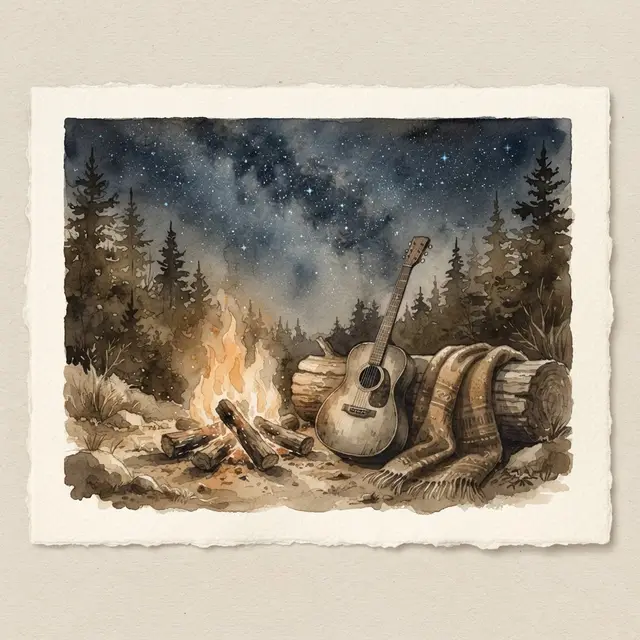
Campfire, warm wood, and one verse at a time. Folk country pulls up a seat and speaks right into your ear.
How it sounds
It is quarter past eleven on a moonless night on a stretch of gravel that never made it onto any map. The pickup engine just died, but the block keeps ticking under the hood, leaking slow heat against the early morning chill. Outside, dry wind whips through the pine needles and the scent of sap burns sharp in the back of your throat. You are sitting on the tailgate, dust-caked boots dangling, holding a lukewarm tin of coffee between both palms. There are no porch lights for miles, just the dull red glowing dot of a dying ember on the dirt below.
Someone pulls an old, beat-up wooden acoustic from the back; the bronze strings strike an open, low chord, pinned down by a heavy thumb. The sound doesn't bounce off walls; it flattens out and sinks into the vast open flatland. A harmonica enters a beat late, a clean, dry sigh that hovers above the grain before settling back into the dark. Nobody is in a hurry because nobody is waiting. The cold creeps right through the seams of a rough wool jacket and stays there, flat against the skin.
Hands are stiff from labor, clumsy at details, yet they stroke the fretboard with absolute, unhurried patience. Every note leaves a massive gap around it, a thick silence where the wind rushes back in before the next string is touched.
Palette: bonfire orange / starry night blue / earth brown coffee brown
- BPM
- 78 BPM
- Family
- Dust and Highway
- Serial
- PLV-27
- Rarity
- Common
- Style strength
- 89
- Experimentation
- 20
Typical structure
[Intro] → [Verse] → [Chorus] → [Verse 2] → [Chorus] → [Whispered bridge] → [Final chorus]
The specs above are just the surface data that fits neatly in a table. What stays hidden is how to keep rustic simplicity from sliding into cheap postcard clichés, or how to balance physical details so they never crowd out the silence. That lives inside an unpublished eight-parameter distillate, and the engine cross-references it with your raw history before a single line is written. When it finishes, an internal judge measures the lyrics against six canons and sends back anything that rings false for repairs. The acoustic guitar is easy to buy. The weight in the pause, not.
How a lyric in this style thinks
A folk country lyric doesn't perform emotion — it witnesses it. The words sit down next to you on a tailgate and speak at the same volume a person uses when they've finally stopped rehearsing what to say. The genre earns its intimacy not through confession as spectacle but through restraint: what gets left out of a line matters as much as what stays in. A verse in folk country carries the weight of a whole life without announcing that fact, and the listener feels it the way you feel cold seeping through a wool jacket — gradually, then completely.
The base tone of folk country is neither sad nor hopeful in any clean sense. It occupies the grey-amber space of acceptance — the emotional register of someone who has already grieved, already forgiven, and now just needs to say the thing out loud once, quietly, before the fire goes out. Emotion arrives sideways, embedded in a concrete image rather than stated directly. You don't write "I miss my father." You write about the particular way he folded a paper bag to use again, or the coffee ring he left on every surface he ever sat near.
The sensory field is narrow and specific: rough-cut timber, tin cups, gravel roads, pine resin, the smell of a truck cab in winter, the sound of a screen door that never latched right. Folk country never reaches for the abstract. It does not live in cities, airports, or anywhere with too much glass and steel.
Rhythm in folk country follows the logic of natural speech under fatigue — lines that breathe unevenly, pause where breath runs short, and occasionally run long because the thought wasn't finished. The syllable count doesn't need to be regular, but the phrasing needs to feel inevitable, as though no other arrangement of those words was possible. Repetition works differently here than in mainstream country. A repeated line in folk country doesn't build to a release; it deepens like a groove worn into a floorboard. The chorus isn't a hook engineered to stick — it's the one truth the verse kept circling without landing on, finally said plainly. When it arrives, it should feel like exhaling.
Structurally, the campfire verse carries most of the narrative load. Two verses do the work of establishing the world and the relationship before the chorus names what that world costs or means. The whispered bridge is not a breakdown or a dramatic turn — it's the moment when the song drops to its lowest register, almost spoken, as though the singer has set down the guitar for a second and is just talking. It's where the most unguarded line of the whole song lives.
The final chorus returns with the same words but a different weight, because the bridge has already shifted something. The intro in folk country is often just two or three fingerpicked bars — enough to set the wooden, open-tuned acoustic tone and let the harmonica place a single dry note in the air before the voice enters.
What separates a genuine folk country lyric from a generic imitation is the absence of performed grit. The genre has no patience for lines that signal toughness or poverty as aesthetic choice. A real folk country lyric doesn't romanticise hard work — it describes the specific exhaustion of it without commentary, trusting the listener to understand. The voice stays close to the microphone and to the listener's ear.
Fingerpicked bronze strings, a thumb-heavy bass note, a harmonica that enters a beat late and never overplays — these are the production details that hold the lyric in place. The tempo sits around 78 BPM, which is slower than a heartbeat at rest, and that unhurried pulse is the contract the song makes with whoever is listening: nobody is going anywhere, and there is nothing to sell.
- CAMPFIRE VERSE
- WARM WOOD
Sample excerpt
Left the porch light burning low for no one Salt on my tongue from the miles behind I set down the kettle on the cold stone floor And let the quiet settle in my mind
Some roads ask for every single dime Some debts take a lifetime just to clear I poured a cup of coffee for the shadows And realized there's nothing left to fear
Workshop note — This sample relies on everyday domestic gestures like setting down a kettle and pouring coffee to ground a heavy emotional shift. Folk country demands absolute plainness, avoiding any poetic ornament so the sparse melody can carry the confession without shouting.
Sample excerpt written by MUSAI Song. Your lyrics are written from scratch, based on your story.
When to choose this style
Choose this card when the story calls for a confession by the fire, without an audience waiting to clap. It works when you walk away from a house that is no longer home and look down a dirt road one last time without bitterness. For thanking a father in silence for everything he swallowed while working his hands to the bone. For a family memory passed down in a low murmur on the porch when the coffee is gone and there is nowhere else to be. For forgiving someone who packed a bag and left no forwarding address.
Do not pick this for a loud celebration, a fast victory, a city-slicker confession, or a grief that needs to scream to stay upright: folk country has no patience for stadium noise or fake grit. If you are looking for sweeping cinematic strings or a heavy, weeping buildup, the card is Country Ballad.
Your story in this style
MUSAI Song writes original lyrics from your story, in the Folk Country style, and delivers the finished sung song, the ready-to-use style recipe, and an illustrated art plate with its numbered certificate, private by default; public only if its owner publishes it.
- Original lyrics written from your story
- A finished sung song, ready to play and share
- Art plate with a unique seal and a numbered certificate, private by default; public only if its owner publishes it
Frequently asked questions
What BPM is Folk Country?
Folk Country usually runs at 78 BPM.
What does Folk Country sound like?
Campfire, warm wood, and one verse at a time. Folk country pulls up a seat and speaks right into your ear.
What song structure does Folk Country use?
[Intro] → [Verse] → [Chorus] → [Verse 2] → [Chorus] → [Whispered bridge] → [Final chorus]
How do I write Folk Country lyrics?
Tell MUSAI Song your story and pick Folk Country: it writes original lyrics for this style at 78 BPM, you edit them word by word, and you get the song sung in Folk Country, with an illustration of the song and its numbered certificate. $19 USD per song, one-time payment.
Explore more styles
- 80s Heartland Rock
- Alt-Country
- Americana
- Appalachian Folk
- Classic Country
- Country Blues
- Country Duet
- Country Gospel
- Country Pop
- Country Rock
- Country Soul
- Country Waltz
- Cowboy Western
- Desert Highway Rock
- Fiddle Hoedown
- First Dance Country
- Front Porch Acoustic
- Hick-Hop
- Honky Tonk
- Jukebox Country Ballad
- Modern Country Anthem
- Mountain Bluegrass
- Nashville Sound
- Outlaw Country
Your idea or story, sung in this style
Card · secure payment via Stripe, charged in USD
If it doesn't move you, we give you your money back · 7 days