Front Porch Acoustic
Officially too relaxed to care about your deadlines.
Get your song in Front Porch Acoustic
Make yours in this styleHear it before you pay.$19 USD · your first song for $5.50 USDIf it doesn't move you, we give you your money back · 7 days.
Front Porch Acoustic is a style from the Dust and Highway family. 70 BPM, Experimentation 18, Style strength 88.
What is Front Porch Acoustic?
Rocking chair, sweet tea, and an afternoon with no clock. Front porch acoustic has nowhere to be and nothing to prove.
How it sounds
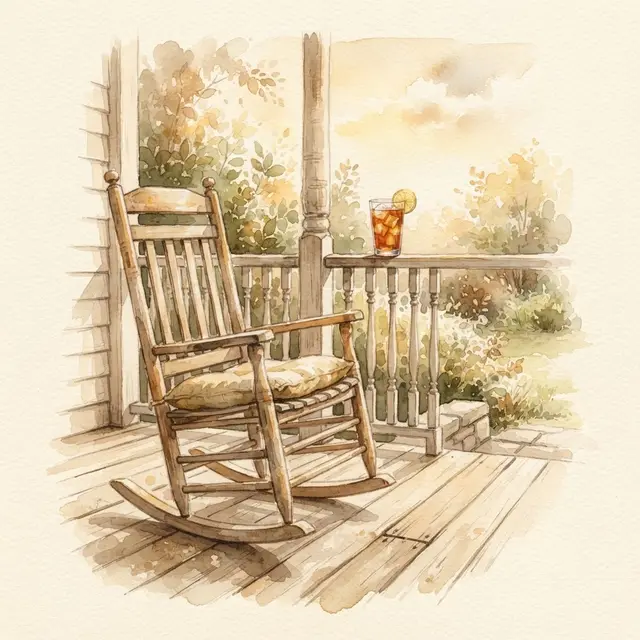
It is half past four on an August afternoon that refuses to hurry anywhere at all. You are sitting in a wicker rocking chair whose seat groans with the exact same rhythm every two seconds, keeping a time that owes nothing to any clock. The porch is made of weathered pine, grayed by years of sun and rain; your bare feet resting on the wide planks still feel the heat trapped from the long afternoon.
Beside you on the low table sits a tall glass of iced tea with floating lemon slices; the glass sweats, leaving a clean circular ring on the dark wood. A dog is curled fast asleep right where the roof's shadow ends, its back legs stretched out toward the warm gravel of the dirt road passing by the yard. Someone nearby is tuning an unamplified acoustic guitar, lazily strumming a couple of open chords that drift through the heavy, still air without demanding a single ounce of your attention. There is no traffic. There are no screens.
Only the distant hum of cicadas in the cottonwoods and the gentle clinking of ice against glass every time you shift your weight. Sunlight filters through the overhead leaves, dappling golden patches across your knees. Time is not passing; it is pooling like warm water, leaving a taste of mint and dry wood in your mouth.
Palette: warm wood / afternoon gold / foliage green / tea amber
- BPM
- 70 BPM
- Family
- Dust and Highway
- Serial
- PLV-29
- Rarity
- Common
- Style strength
- 88
- Experimentation
- 18
Typical structure
[Intro] → [Verse] → [Chorus] → [Verse 2] → [Chorus] → [Humming] → [Soft final chorus]
The four items above are merely the wood you can see from the yard. What remains hidden is the precise craft of making a guitar sound untouched, and how to measure the pauses so the silence carries as much weight as the lyric. That lives in a private distillation of eight unpublished parameters, and the engine crosses it with every detail of your memory before a single line is set down. When it finishes, an internal judge measures the text against six canons and sends back anything that smells of performance. The open chord can be learned in a day. The stillness, not.
How a lyric in this style thinks
A Front Porch Acoustic lyric does not move toward anything. That is the first thing to understand about how it works. Where most song structures build pressure and release it, this genre pools time — it lets a moment thicken and settle the way heat settles into pine boards through a long August afternoon. The lyric's job is not to resolve a story but to make the listener feel the exact weight of staying still, of choosing not to leave, of letting old distances soften without forcing them to disappear. Emotion in this genre arrives sideways, the way the smell of dry wood and iced tea arrives before you notice you're already at ease.
The base tone is warm but unsentimental. Front Porch Acoustic earns its feeling through specificity rather than declaration — a wicker chair that groans on the same beat every two seconds, a glass of sweet tea sweating a clean ring onto dark wood, a dog sleeping precisely where the roof's shadow ends. These are the objects this genre lives inside. What it never uses: skylines, neon, urgency, digital surfaces, or any image that belongs to speed.
The sensory field is tactile and slow — bare feet on sun-warmed planks, the distant hum of cicadas, the lazy clink of ice shifting when you shift your weight. Every concrete detail is doing tonal work. Strip the specifics and you lose the genre entirely.
Line length in Front Porch Acoustic tends to breathe wide and unhurried, matching the fingerpicked guitar underneath — open chords, unamplified, drifting through heavy air without demanding attention. Vocals sit close to the chest, conversational in register, rarely pushed above a gentle middle dynamic. Repetition in this genre is not a hook mechanism; it is a rocking-chair mechanism. A phrase returns the way that two-second creak returns, not for emphasis but because that is simply the rhythm of staying put.
The 70 BPM tempo is not slow in the way of grief or ballad weight — it is slow in the way of an afternoon that refuses to hurry, a clockless drift that feels like warmth pooling rather than time passing.
Structurally, the genre follows a gentle arc: an intro that establishes the scene before a single word is spoken, two verses that observe rather than narrate, choruses that name the feeling without explaining it, and then — crucially — a humming section before the soft final chorus. That hum is not a production afterthought. It is the lyrical argument made without language, the place where the song admits that some of what it means cannot be said directly. The soft final chorus lands quieter than the ones before it, not because energy has been lost but because the song has arrived somewhere it no longer needs to prove.
What separates a real Front Porch Acoustic lyric from a generic acoustic imitation is the absence of resolution hunger. A generic version will push toward a lesson, a reconciliation scene, a moment of clean catharsis. The real thing makes peace with incompleteness — a grandfather's silence that was never explained and no longer needs to be, an absence that still takes up space even though the hurt has gone, a decision to stay that was never announced out loud.
The writing stays in the present tense of the porch, trusting that the accumulated sensory detail carries the emotional truth without the lyric having to spell it out. Nothing shouts here. The front porch has nowhere to hurry, and the lyric that serves it best is the one that has learned the same.
- ROCKER AND TEA
- CLOCKLESS AFTERNOON
Sample excerpt
Grandfather left his wool jacket on the peg by the screen door. I sat in the hickory rocker while the ice melted in the Mason jar. The shadows stretched across the floorboards toward the gravel drive. Nobody drove past all afternoon, and the silence stayed wide open.
There is nothing here that needs fixing today. Just the hum of a screen door catching the wind. Let the sun drop down behind the pines. We can sit right here till the tea turns cold.
Workshop note — This style relies on grounded physical details and sparse phrasing to mirror the unhurried pace of an afternoon with no clock. Notice how the lines breathe without rushing toward a forced rhyme, keeping the focus entirely on ordinary textures like tea amber and warm wood. Avoid big declarations or dramatic twists; the porch speaks in quiet observations.
Sample excerpt written by MUSAI Song. Your lyrics are written from scratch, based on your story.
When to choose this style
Choose this card when you need to make peace with where you come from without holding any old grudges. It works to remember a grandfather who taught you how to wait without rushing, to forgive a long absence that no longer hurts but still takes up space, or to capture the quiet weight of an afternoon when you finally decided to stay put. It fits a return home after years away, when you turn the key and find that the smell of pine and dust hasn't shifted an inch.
Do not pick this for a loud victory, a sudden romantic rush, or city urgency: the front porch does not know how to shout and has nowhere to hurry. It is also wrong for a grief that still burns or a betrayal demanding loud answers. If you are looking for a narrative that moves in long strides and names every wound with sharp edges, the card is Country Ballad.
Your story in this style
MUSAI Song writes original lyrics from your story, in the Front Porch Acoustic style, and delivers the finished sung song, the ready-to-use style recipe, and an illustrated art plate with its numbered certificate, private by default; public only if its owner publishes it.
- Original lyrics written from your story
- A finished sung song, ready to play and share
- Art plate with a unique seal and a numbered certificate, private by default; public only if its owner publishes it
Frequently asked questions
What BPM is Front Porch Acoustic?
Front Porch Acoustic usually runs at 70 BPM.
What does Front Porch Acoustic sound like?
Rocking chair, sweet tea, and an afternoon with no clock. Front porch acoustic has nowhere to be and nothing to prove.
What song structure does Front Porch Acoustic use?
[Intro] → [Verse] → [Chorus] → [Verse 2] → [Chorus] → [Humming] → [Soft final chorus]
How do I write Front Porch Acoustic lyrics?
Tell MUSAI Song your story and pick Front Porch Acoustic: it writes original lyrics for this style at 70 BPM, you edit them word by word, and you get the song sung in Front Porch Acoustic, with an illustration of the song and its numbered certificate. $19 USD per song, one-time payment.
Explore more styles
- 80s Heartland Rock
- Alt-Country
- Americana
- Appalachian Folk
- Classic Country
- Country Blues
- Country Duet
- Country Gospel
- Country Pop
- Country Rock
- Country Soul
- Country Waltz
- Cowboy Western
- Desert Highway Rock
- Fiddle Hoedown
- First Dance Country
- Folk Country
- Hick-Hop
- Honky Tonk
- Jukebox Country Ballad
- Modern Country Anthem
- Mountain Bluegrass
- Nashville Sound
- Outlaw Country
Your idea or story, sung in this style
Card · secure payment via Stripe, charged in USD
If it doesn't move you, we give you your money back · 7 days