Nashville Sound
Country music that owns cufflinks and uses them.
Get your song in Nashville Sound
Make yours in this styleHear it before you pay.$19 USD · your first song for $5.50 USDIf it doesn't move you, we give you your money back · 7 days.
Nashville Sound is a style from the Dust and Highway family. 80 BPM, Experimentation 13, Style strength 88.
What is Nashville Sound?
Velvet-smooth country: silk strings and a voice that knows how to court. Nashville put on a tuxedo and never looked back.
How it sounds
It is three in the morning inside a recording studio where the air smells faintly of cold black coffee and polished mahogany. The tube mixing console glows with amber lights that seem suspended in the dim room. Across the floor, behind a wooden music stand lit by a single tungsten lamp, a sixteen-piece string section tunes in silence; the friction of horsehair against catgut produces a low, dry rustle before a single note is played.
You are sitting in a deep burgundy leather armchair with gold tassels, holding a heavy crystal tumbler with three fingers of bourbon that has long lost its ice. Nobody raises their voice here. The strings enter slowly, a bed of silk where each cello bears the exact weight of a parting that took years to arrive. The vocal does not push or climb; it slides like a tailored white glove over skin, containing an ancient tremor that refuses to break into sobs.
Outside, the rain taps against the tall studio windows with polite persistence, keeping an eighty-beat tempo nobody needs to rush. Someone's perfume still lingers on your lapel, a chemical persistence that hurts far more than a slammed door. There are no furious hooks or electric guitars to rescue the night. Just this surgical precision of velvet, where sorrow dresses so finely it almost resembles an act of pure courtesy.
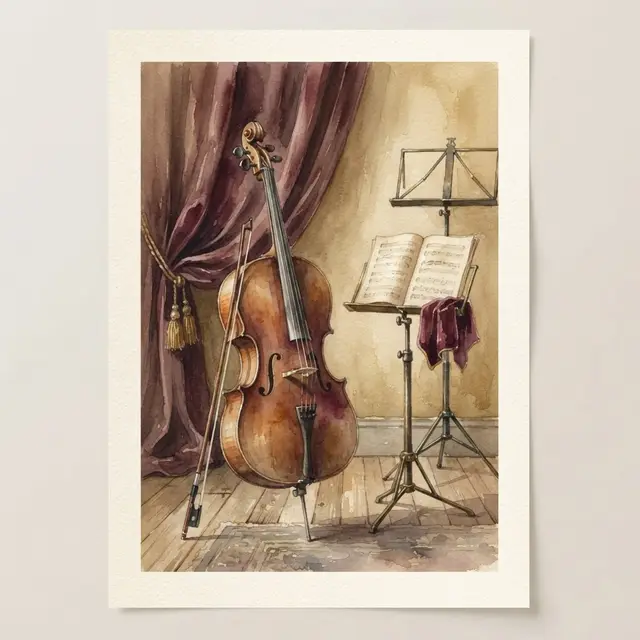
Palette: cello mahogany / curtain burgundy / tassels gold
- BPM
- 80 BPM
- Family
- Dust and Highway
- Serial
- PLV-21
- Rarity
- Common
- Style strength
- 88
- Experimentation
- 13
Typical structure
[String Intro] → [Verse] → [Chorus] → [Verse 2] → [Chorus] → [Bridge] → [Final chorus]
What you see above is the velvet surface. Beneath it lies an invisible balance that refuses a simple table: keeping elegance from sounding aloof while letting the drama breathe beneath the silk without tipping into melodrama. That lives inside an unpublished eight-parameter distillate and the engine crosses it with the story you brought. An internal judge measures the output against six canons and sends back anything that limps for repair. The tuxedo is bought off the rack. The exact pulse of polite heartbreak is not.
How a lyric in this style thinks
A Nashville Sound lyric does not confess — it presents. The emotion arrives already dressed, already composed, already certain of its own weight. Where other country forms let the voice crack or the line stumble into rawness, Nashville Sound maintains a kind of formal dignity that is itself the emotional argument: the restraint is the wound. This is the genre that understood, somewhere in the late 1950s and through the 1960s, that sophistication and sorrow are not opposites. A lyric in this style does not chase catharsis. It holds the door open for grief, nods, and offers it a seat.
The base tone is controlled elegance, and emotion arrives the way rain arrives against studio glass — persistent, polite, impossible to ignore. Lines tend toward the measured and the declarative: short enough to land cleanly, long enough to carry the full shape of a thought. Repetition in Nashville Sound is architectural rather than urgent. When a phrase returns in the chorus, it does not plead; it confirms. The hook is not a release, it is a reckoning. Rhythmically, the genre sits comfortably at eighty beats per minute — a tempo that matches a slow walk down a corridor, a handshake that lasts one beat longer than it should. Nothing rushes. The lyric earns its pace.
The sensory field is specific and interior. Polished mahogany, cold black coffee, a crystal tumbler, the amber glow of tube equipment, the dry rustle of a string section settling before the first note. Perfume on a lapel. A dinner table where nothing was said and everything was decided. Nashville Sound lives inside enclosed, considered spaces — not open highways, not honky-tonk floors. It does not use gravel or dust or broken glass. The textures are silk, leather, wool, the kind of surfaces that absorb rather than reflect.
If you write a lyric that mentions a slammed door or a raised voice, you have left the genre. What happens here happens quietly, which is precisely why it cannot be undone.
Structurally, the form is classical and deliberate: a string introduction that establishes the emotional temperature before a single word is spoken, then two verses that build context without editorializing, choruses that state rather than erupt, a bridge that shifts the harmonic and emotional angle without breaking composure, and a final chorus that returns with the full weight of everything the verses have accumulated. The string section is not decoration — it is a second voice, carrying what the lyric is too composed to say directly.
The backing choir, when it enters, functions as a kind of collective witness: not celebration, but acknowledgment. The vocal itself slides rather than climbs, sitting in a middle register that suggests mastery over something that cost years to master.
What separates a real Nashville Sound lyric from a generic imitation is the absence of self-pity and the presence of self-awareness. A generic lyric in this register mistakes smoothness for emptiness and fills it with vague longing. An authentic one knows exactly what it lost, can name the specific hour and the specific object, and chooses to speak about it with the precision of someone who has had time to understand the full shape of the damage.
The word 'velvet' in the production notes is not decorative — it describes the relationship between surface and pressure. Velvet yields without tearing. That is what the lyric must do: yield to the full weight of the feeling while the surface remains unbroken.
- VELVET COUNTRY
- SILK STRINGS
Sample excerpt
The coffee’s cold in a porcelain cup, I leave the morning paper folded square. You’re still asleep and I don’t wake you up, Just watch the amber light catch in your hair. I’ve packed the heavy trunk beside the door, And left the keys exactly where they stay.
It’s a quiet sort of ending in the hall, No slamming wood, no shadows on the wall. Just a steady hand to guide the way, Before the indigo turns into gray.
Workshop note — The Nashville Sound thrives on restraint and impeccable phrasing, so avoid messy emotional outbursts in favor of precise, mundane details that imply a deeper weight. Use a steady, rhythmic cadence that mirrors the elegance of silk strings, ensuring every word feels measured and deliberate. This genre forbids chaotic imagery, favoring instead a polished, sophisticated perspective on loss.
Sample excerpt written by MUSAI Song. Your lyrics are written from scratch, based on your story.
When to choose this style
Choose this card when you need to confess something grave without losing your composure, when mature love demands measure instead of midnight shouts. It works to bid farewell to a father with the quiet respect of a firm handshake, for a breakup that happened in absolute silence across a dinner table where nobody raised their voice, or to look back on a solitary anniversary knowing time doesn't heal, it only polishes the edges. It is tailored for someone who carries grief like a bespoke suit: immaculate on the outside, immensely heavy within.
Do not choose it for a youthful burst, a loud triumph, or a bitter grudge looking for a fight; velvet does not know how to bite. If you are looking for a raw confession where the voice cracks and tears take over, the card is Country Ballad.
Your story in this style
MUSAI Song writes original lyrics from your story, in the Nashville Sound style, and delivers the finished sung song, the ready-to-use style recipe, and an illustrated art plate with its numbered certificate, private by default; public only if its owner publishes it.
- Original lyrics written from your story
- A finished sung song, ready to play and share
- Art plate with a unique seal and a numbered certificate, private by default; public only if its owner publishes it
Frequently asked questions
What BPM is Nashville Sound?
Nashville Sound usually runs at 80 BPM.
What does Nashville Sound sound like?
Velvet-smooth country: silk strings and a voice that knows how to court. Nashville put on a tuxedo and never looked back.
What song structure does Nashville Sound use?
[String Intro] → [Verse] → [Chorus] → [Verse 2] → [Chorus] → [Bridge] → [Final chorus]
How do I write Nashville Sound lyrics?
Tell MUSAI Song your story and pick Nashville Sound: it writes original lyrics for this style at 80 BPM, you edit them word by word, and you get the song sung in Nashville Sound, with an illustration of the song and its numbered certificate. $19 USD per song, one-time payment.
Explore more styles
- 80s Heartland Rock
- Alt-Country
- Americana
- Appalachian Folk
- Classic Country
- Country Blues
- Country Duet
- Country Gospel
- Country Pop
- Country Rock
- Country Soul
- Country Waltz
- Cowboy Western
- Desert Highway Rock
- Fiddle Hoedown
- First Dance Country
- Folk Country
- Front Porch Acoustic
- Hick-Hop
- Honky Tonk
- Jukebox Country Ballad
- Modern Country Anthem
- Mountain Bluegrass
- Outlaw Country
Your idea or story, sung in this style
Card · secure payment via Stripe, charged in USD
If it doesn't move you, we give you your money back · 7 days