Classic Country
Three chords and the truth — the original data compression.
Get your song in Classic Country
Make yours in this styleHear it before you pay.$19 USD · your first song for $5.50 USDIf it doesn't move you, we give you your money back · 7 days.
Classic Country is a style from the Dust and Highway family. 92 BPM, Experimentation 12, Style strength 92.
What is Classic Country?
A guitar that tells it straight and a voice dusted from the road. Classic country: simple stories that hurt in the best way.
How it sounds
It is six in the evening on a county road outside of Boone and the sun hangs low enough to blind you through the cracked windshield. The cab smells of old gasoline, sun-baked vinyl upholstery, and the fine dust seeping in through the half-rolled window. On the passenger seat sits a worn denim jacket and an empty book of matches. The truck engine rumbles with a heavy, steady pulse, the same sound it has made since before your father taught you how to change the spark plugs.
Along the roadside, wooden utility poles march past in a slow cadence, keeping time while the speedometer needle barely moves. On the AM dial, the signal cuts in and out through static and the distant twang of a Telecaster. The notes are sparse and deliberate, cutting clean through the dry air. When the voice enters, raspy and worn down like a work boot used for years, it doesn't try to convince you of anything. It just states what happened because nobody has the energy left to invent another version.
The pedal steel kicks in underneath, bending a high note that fractures slowly, as if the metal itself were tired of holding the weight of the afternoon. The pavement turns dark gray as the sun drops behind the timberline, and the only thing left in the cab is the glare of your hands on the steering wheel and the echo of a truth spoken quietly, without witnesses or pardon.
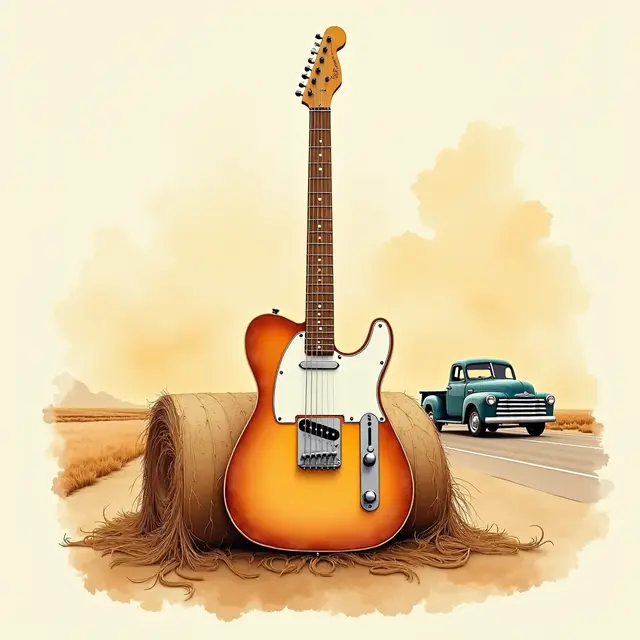
Palette: sunburst orange / guitar neck brown / pickup truck bluish green / straw gold
- BPM
- 92 BPM
- Family
- Dust and Highway
- Serial
- PLV-01
- Rarity
- Common
- Style strength
- 92
- Experimentation
- 12
Typical structure
[Intro] → [Verse] → [Chorus] → [Verse 2] → [Chorus] → [Bridge] → [Final Chorus]
The surface data and visible instruments are not the song. What stays hidden is how to keep plainspoken honesty from sliding into movie-cowboy cliché, and how to make a single simple image—like a key left on bare wood—carry the whole weight of grief without turning sentimental. That lives in the internal distillate of this carta, eight unreleased parameters that the engine crosses with your story before drafting a line. When it finishes, an internal judge measures the lyrics against six dimensions of the canon and sends back anything that sounds fake for repairs. The boots are bought off the shelf. The unvarnished truth, no.
How a lyric in this style thinks
A classic country lyric does not perform grief — it reports it. The voice arrives already worn down, already past the dramatic moment, and what it offers is testimony: this is what happened, this is what was left behind, and no one is being blamed. That restraint is the engine of the form. Classic country earns its emotional weight not by escalating toward a breakdown but by staying level, letting the plain truth accumulate until the listener feels the whole mass of it pressing down. The genre works in the key of quiet aftermath, and every word choice has to honor that quietness or the whole thing collapses into sentiment.
The sensory world of classic country is precise and narrow on purpose. A cracked windshield. A book of matches with the last one gone. The smell of sun-baked vinyl. These are not decorative details — they are the argument. The lyric uses concrete objects the way a good witness uses evidence: to establish that this actually happened, in a real place, to a real person. Abstract language is a warning sign in this genre. Words like heartbreak, forever, or destiny arrive already half-dead from overuse.
What works instead is the callus on a father's hand, the AM signal cutting out, the coffee cup nobody bothered to rinse. The sensory field stays low to the ground — county roads, kitchen tables, tool sheds, the particular gray of old asphalt at dusk. Nothing gleams. Nothing is aspirational. The closest this genre comes to beauty is the Telecaster note hanging clean in dry air before the pedal steel bends it down into something that sounds like structural fatigue.
Line length and rhythm in classic country follow the natural cadence of plain speech, then tighten slightly to ride the groove. At 92 BPM with brushed drums and an upright bass keeping a heartbeat pulse, the lyric has room to breathe but not to ramble. Verses tend to run longer and more narrative, stacking detail the way a man stacks fence posts — one at a time, no hurry, each one placed because it has to hold weight. The chorus strips back to the essential claim, the one true sentence the whole song is working toward.
It doesn't twist or surprise; it confirms. That confirmation is what the listener has been waiting for, and the best classic country choruses feel less like a hook than like a verdict delivered without anger. The bridge earns its place by shifting the angle of view — not reversing the argument, but stepping back to see the larger shape of the loss, the way you might look at an old fence line from a distance and finally understand how many winters it held before it gave.
What separates a genuine classic country lyric from an imitation is the refusal to editorialize. The imitation explains how the narrator feels. The real thing shows what the narrator saw and lets the feeling arrive on its own. There's a discipline to this that's harder than it looks: no irony, no clever subversion, no moment where the writer winks at the listener. The dusty vocal delivery — raspy, worn, unhurried — is the sonic equivalent of that discipline.
The voice doesn't try to convince you of anything because the facts, stated plainly, are convincing enough. Pedal steel underneath bending a high note down is doing the same work as the lyric: stating that something was held up for a long time and is now, slowly, coming down. When the final chorus lands, it should feel like the truck engine going quiet after a long drive — not silence exactly, but the absence of effort, the thing that happens when there's nothing left to prove.
- GUITAR AND TRUTH
- DUSTY VOICE
Sample excerpt
The screen door has a rusted hinge that sighs, I left the keys beside your lukewarm tea. The dust is settling where the porch light dies, And there’s no ghost of us left here for me. I put the silver watch back in the drawer, It’s time to find a road that leads away.
So let the tall grass hide the garden gate, I’m traveling light before the sun turns cold. There’s no use fighting what the seasons state, Just stories left in amber and in gold.
Workshop note — This sample works because it relies on tangible domestic details to ground a heavy emotional parting in physical reality. By using a consistent rhythm and simple, declarative sentences, the lyrics mirror the steady pace of highway travel without resorting to poetic fluff. Avoid metaphors that feel too intellectual; in this genre, the truth is found in the everyday objects you leave behind.
Sample excerpt written by MUSAI Song. Your lyrics are written from scratch, based on your story.
When to choose this style
Choose this carta when you need to put words to a parting that came with no shouting or slamming doors, just silence and a cup of coffee cooling on the kitchen table. It works for when you had to leave behind the house where you grew up because there was nothing left to keep up, or when a father shook your hand for the last time and the calluses on his fingers told you everything his mouth kept back. It fits a broken promise that looks for no villains, only an honest ledger of wear and tear.
Use it to speak of an affection that ended not from a lack of care, but from sheer fatigue, like an old fence line giving way after too many winters. Do not choose it for stories that ask for clever turns, modern irony, or noisy catharsis; classic country rejects sarcasm and doesn't know how to yell. It is also wrong for a quick celebration or a bright reconciliation where everything gets fixed with a single talk. If you are looking for a softer rural grace and a three-step rhythm that lightens the blow, the carta is Country Waltz.
Your story in this style
MUSAI Song writes original lyrics from your story, in the Classic Country style, and delivers the finished sung song, the ready-to-use style recipe, and an illustrated art plate with its numbered certificate, private by default; public only if its owner publishes it.
- Original lyrics written from your story
- A finished sung song, ready to play and share
- Art plate with a unique seal and a numbered certificate, private by default; public only if its owner publishes it
Frequently asked questions
What BPM is Classic Country?
Classic Country usually runs at 92 BPM.
What does Classic Country sound like?
A guitar that tells it straight and a voice dusted from the road. Classic country: simple stories that hurt in the best way.
What song structure does Classic Country use?
[Intro] → [Verse] → [Chorus] → [Verse 2] → [Chorus] → [Bridge] → [Final Chorus]
How do I write Classic Country lyrics?
Tell MUSAI Song your story and pick Classic Country: it writes original lyrics for this style at 92 BPM, you edit them word by word, and you get the song sung in Classic Country, with an illustration of the song and its numbered certificate. $19 USD per song, one-time payment.
Explore more styles
- 80s Heartland Rock
- Alt-Country
- Americana
- Appalachian Folk
- Country Blues
- Country Duet
- Country Gospel
- Country Pop
- Country Rock
- Country Soul
- Country Waltz
- Cowboy Western
- Desert Highway Rock
- Fiddle Hoedown
- First Dance Country
- Folk Country
- Front Porch Acoustic
- Hick-Hop
- Honky Tonk
- Jukebox Country Ballad
- Modern Country Anthem
- Mountain Bluegrass
- Nashville Sound
- Outlaw Country
Your idea or story, sung in this style
Card · secure payment via Stripe, charged in USD
If it doesn't move you, we give you your money back · 7 days