Hick-Hop
Banjo meets 808 — purists faint, everyone else dances.
Get your song in Hick-Hop
Make yours in this styleHear it before you pay.$19 USD · your first song for $5.50 USDIf it doesn't move you, we give you your money back · 7 days.
Hick-Hop is a style from the Dust and Highway family. 96 BPM, Experimentation 55, Style strength 80.
What is Hick-Hop?
Banjo over 808: small-town America learned flow and has no plans to give it back. Controversial, catchy, unstoppable.
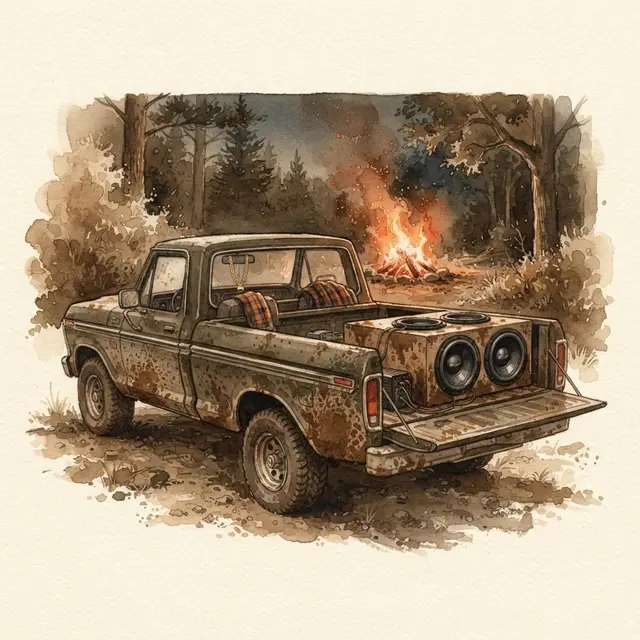
How it sounds
It is ten past dark at a truck stop in the middle of nowhere, under a sky so black it looks like fresh enamel. The tailgate is dropped flat, serving as a workbench for a cooler full of sweating cans icing over in the heavy air. Three feet away, a beaten Fender amp rattles against the gravel, pumping an 808 sub-bass that shoves the dirt downward with every strike, making puddle water ripple in tight, concentric circles.
Right on top of that low-end pressure, a five-string banjo snaps out a fast, wire-sharp roll, picked by calloused fingers that spent ten hours hauling timber. The air smells of gasoline, crushed pine needles under tread, and cheap tobacco lit by a cracked BIC lighter. A gold chain swings against the driver's chest, catching the yellow buzz from the overhead fluorescent tube. Nobody is shouting. There is only the blend: heavy, ruthless southern trap welded directly to a mountain string-bend sawing out of an aging wooden box.
Road dust drifts through the open window and sticks to the sweat on your brow. There is no hesitation in the room, just steel hitting ribs and the stubborn weight of the dirt road outside.
Palette: mud coffee brown / bonfire orange / flannel red / dark pine green
- BPM
- 96 BPM
- Family
- Dust and Highway
- Serial
- PLV-23
- Rarity
- Epic
- Style strength
- 80
- Experimentation
- 55
Typical structure
[Intro] → [Rap verse] → [Sung chorus] → [Rap verse 2] → [Chorus] → [Bridge] → [Final chorus]
Those four details are just the skin. Behind them lie two core traps a spreadsheet cannot fix: keeping the banjo from sounding like a postcard prop when it hits that heavy electronic sub, and maintaining the lazy, backwoods drawl inside a tight trap flow without losing the punch. That balance lives in an internal distillate of eight unreleased parameters that the motor cross-checks with your raw history before a single line drops. When it finishes, a canon judge measures the draft against six fixed dimensions and forces a rewrite on anything that rings hollow. The banjo is off-the-rack. The swagger, not.
How a lyric in this style thinks
A hick-hop lyric does one specific thing from the first bar: it claims ground. Not metaphorically — physically. It names the county road, the truck stop, the gravel lot, the two-lane that dead-ends at a grain elevator. The lyric plants a flag in a place most songs drive past without slowing down, and then it dares anyone to say that place doesn't count. That territorial impulse is the engine of the genre. Everything else — the bragging, the crew loyalty, the defiant pride — runs on that fuel.
Hick-hop is not country music with a beat dropped under it, and it is not rap music with a steel string for atmosphere. It is the collision point where both traditions demand equal standing, and the lyric has to hold that collision without flinching.
The base tone sits somewhere between a boast and a sworn statement. Emotion arrives through accumulation of specific detail rather than direct confession. You do not write 'I struggled.' You write the ten-hour timber haul, the cracked BIC lighter, the cooler sweating through the cardboard. The listener feels the weight because the weight is described with precision, not because the song asks them to feel it.
Repetition in hick-hop operates at the phrase level: a hook line comes back harder each time because the verses have been stacking evidence in its favor. By the time the sung chorus lands, it should feel inevitable, like a verdict after testimony. Line lengths in the rap verses are asymmetric and conversational, mimicking the cadence of someone making a point face to face — not performing, just stating. The sung chorus tends to open up, stretching vowels over the 808 swell, giving the banjo room to breathe between the hits.
The sensory field of hick-hop is narrow and deliberate. Gasoline, pine resin, tobacco smoke, road dust, fluorescent light on a gold chain — these are the textures the genre lives in. The beat centers on an 808 sub-bass that hits low enough to move standing water, and a banjo roll picked sharp and fast on top, wire-bright against that deep pressure. Around 96 BPM, the groove locks into a swagger that is neither too rushed for the drawl nor too slow for the flow to land with weight.
Production-wise, the banjo is usually sampled or looped dry, letting it sit close to the ear while the 808 pushes from below. The vocal sits mid-forward, with enough room reverb to suggest open air rather than a studio booth. What hick-hop never uses: polished strings, ambient pads, urban skyline imagery, anything that smells of apology or aspiration toward somewhere else. The genre has no interest in leaving.
Structurally, hick-hop follows a logic that mirrors its attitude. The intro establishes the sonic landscape — that banjo-over-808 signature — before any words arrive, so the listener knows exactly where they are standing. The first rap verse builds the case: who you are, where you come from, what was said about you and by whom. The sung chorus delivers the verdict in a form people can carry with them. The second verse tightens the argument, often bringing in crew or community to widen the claim.
The bridge is the one moment of genuine reflection, the pause before the final chorus drives the point home without softening it. That final chorus should feel louder even if the mix hasn't changed — earned volume.
What separates a real hick-hop lyric from a generic imitation is the specificity of the pride and the refusal to smooth the edges for an outside audience. Generic versions reach for the symbols — the truck, the dirt road, the drawl — without earning them through detail. A genuine hick-hop lyric knows the difference between a county road and a state highway, knows what the air smells like at ten past dark at a truck stop, and trusts that precision to carry the emotion without underlining it. The stubborn weight of the place has to be present in the language itself, not just referenced. Write from inside the location, not from a postcard of it.
- BANJO WITH 808
- SMALL TOWN FLOW
Sample excerpt
Got a rusted tailgate dragging on the gravel track Two-lane blacktop waiting, never looking back Got that amber moon rising o'er the pine tree line Sipping lukewarm coffee, yeah, I’m doing just fine Spit the sunflower seeds at the stop sign post I’m the ghost in the county that the city hates most
Deep in the mud where the banjo strings snap Got the bass hitting hard like a thunderclap Raised in the dirt but we run this grid Built a tall empire just like we did
Workshop note — Hick-hop thrives on the contrast between rhythmic, syncopated rap verses and a melodic, anthemic sung chorus that anchors the track. This sample works because it balances gritty, rural imagery with an aggressive cadence that demands attention over the heavy 808 beat. Avoid over-complicating the rhyme scheme; keeping the meter steady and punchy allows the signature banjo-trap fusion to drive the energy forward.
Sample excerpt written by MUSAI Song. Your lyrics are written from scratch, based on your story.
When to choose this style
Choose this track when your story needs to brag about its roots without asking for permission or apologizing for the mud on the boots. It works to tell how a tight crew made it out of a dead-end county, or to celebrate carving out a place in the city without losing your drawl or your footing. It fits a hard-earned reconciliation, a late-night tailgate toast with people who knew you when, or marking your territory against anyone who wrote you off. Use it when stubborn pride beats out simple nostalgia.
Do not pick this for fragile romances, quiet grief, or high-rise confessions; hick-hop has no room for urban subtlety and demands physical ground to stand on. If you want a clean, acoustic story without the heavy bottom-end, the card is Country Ballad.
Your story in this style
MUSAI Song writes original lyrics from your story, in the Hick-Hop style, and delivers the finished sung song, the ready-to-use style recipe, and an illustrated art plate with its numbered certificate, private by default; public only if its owner publishes it.
- Original lyrics written from your story
- A finished sung song, ready to play and share
- Art plate with a unique seal and a numbered certificate, private by default; public only if its owner publishes it
Frequently asked questions
What BPM is Hick-Hop?
Hick-Hop usually runs at 96 BPM.
What does Hick-Hop sound like?
Banjo over 808: small-town America learned flow and has no plans to give it back. Controversial, catchy, unstoppable.
What song structure does Hick-Hop use?
[Intro] → [Rap verse] → [Sung chorus] → [Rap verse 2] → [Chorus] → [Bridge] → [Final chorus]
How do I write Hick-Hop lyrics?
Tell MUSAI Song your story and pick Hick-Hop: it writes original lyrics for this style at 96 BPM, you edit them word by word, and you get the song sung in Hick-Hop, with an illustration of the song and its numbered certificate. $19 USD per song, one-time payment.
Explore more styles
- 80s Heartland Rock
- Alt-Country
- Americana
- Appalachian Folk
- Classic Country
- Country Blues
- Country Duet
- Country Gospel
- Country Pop
- Country Rock
- Country Soul
- Country Waltz
- Cowboy Western
- Desert Highway Rock
- Fiddle Hoedown
- First Dance Country
- Folk Country
- Front Porch Acoustic
- Honky Tonk
- Jukebox Country Ballad
- Modern Country Anthem
- Mountain Bluegrass
- Nashville Sound
- Outlaw Country
Your idea or story, sung in this style
Card · secure payment via Stripe, charged in USD
If it doesn't move you, we give you your money back · 7 days