Truckin Country
Ten-four, good buddy: this song has cruise control.
Get your song in Truckin Country
Make yours in this styleHear it before you pay.$19 USD · your first song for $5.50 USDIf it doesn't move you, we give you your money back · 7 days.
Truckin Country is a style from the Dust and Highway family. 106 BPM, Experimentation 19, Style strength 86.
What is Truckin Country?
Diesel, CB radio, and a thousand miles ahead. The trucker's anthem that never stops rolling.
How it sounds
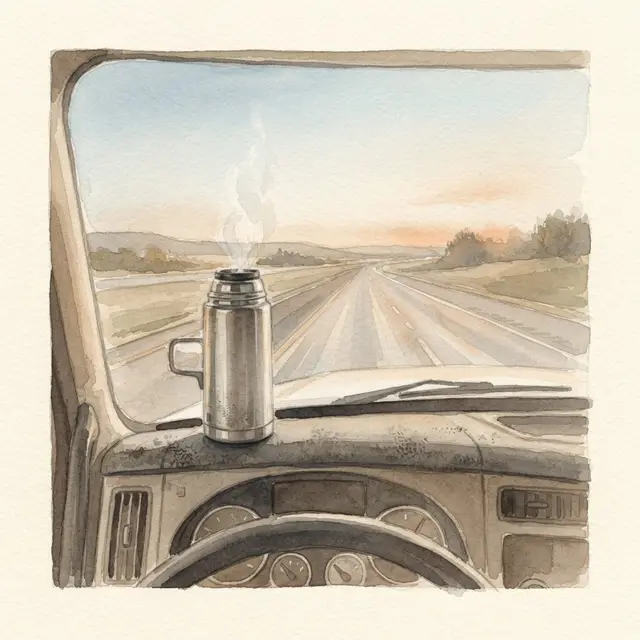
It is four in the morning and the cab smells of stale coffee and cheap tobacco. Outside, a cold drizzle turns Interstate 80 into a dark mirror that reflects only the green glow of the dashboard gauges. There is no commercial music on the stereo, just the dry hiss of channel nineteen on the CB radio and a distant voice warning of a scale house fifty miles ahead. Beneath your palms, the three-spoke steering wheel thrums with the steady pulse of four hundred diesel horses.
The eighteen-speed shifter rests for a fraction of a second before the next pull, a mechanical motion you make without looking, reading the weight of the freight through the seat while the engine note deepens on a long grade. The chrome on the left mirror vibrates against the fender. On the passenger seat, a dog-eared map holds an empty thermos that no longer warms your hands. You are past tiredness; you carry the hum of the block right behind your eyes, that steady metallic drone that started before the sun went down and will outlast the dawn.
The dashed white line hits the front tires with a dull, rhythmic thud, an asphalt metronome measuring the only distance that matters between where you were and the next state line. The lights of a rest stop slide past the passenger window and vanish behind you. Nobody is waiting up with a warm plate and that is fine: the highway is just a straight line you have to keep swallowing until the sky turns grey.
Palette: silver chrome / soft sky blue / asphalt gray / dawn ochre
- BPM
- 106 BPM
- Family
- Dust and Highway
- Serial
- PLV-24
- Rarity
- Common
- Style strength
- 86
- Experimentation
- 19
Typical structure
[Engine Intro] → [Verse] → [Chorus] → [Verse 2] → [Chorus] → [Solo] → [Final chorus]
What you see above is the surface of the genre, the chrome and asphalt visible to anyone passing by. What remains hidden is how to keep the listing of truck parts from sounding like a repair manual or the pride of the highway from falling into cheap advertising clichés. That lives in an unpublished internal distillate of eight parameters, and the engine crosses it with the exact data of your history before drafting every line. When finished, an internal judge measures the lyrics against six canonical dimensions and sends back anything that leans too sentimental for repairs. The pedal tempo is easily copied. The actual weight of the cab is not.
How a lyric in this style thinks
A truckin country lyric does one specific thing: it converts physical endurance into emotional proof. The feeling is never stated directly — it arrives through the weight of a load, the count of miles, the smell of a cab at four in the morning. This is a genre built on the premise that a man driving Interstate 80 in cold drizzle is making an argument about love and loyalty without ever using either word. Truckin country earns its emotional power through accumulation — detail by detail, gear change by gear change — until the listener feels the fatigue and understands, without being told, what it costs.
The base tone is stoic and unhurried, and that stoicism is structural, not accidental. Lines tend to be long enough to breathe but short enough to land with the rhythm of the road itself. The dominant rhythmic logic at 106 BPM is a steady rolling pulse — think of the white dashes hitting the front axle at highway speed — and the lyric should sync to that internal metronome. Repetition in this genre is cumulative rather than decorative.
When a phrase returns, it carries more weight than the first time because the miles between its appearances are felt. The chorus doesn't arrive as a release; it arrives as a confirmation, the same truth restated with a few more thousand feet of pavement behind it.
The sensory field is narrow and specific, and that specificity is the craft. Channel nineteen on the CB radio. The three-spoke steering wheel. A thermos that stopped being warm two hours ago. Asphalt gray, dawn ochre, the green glow of dashboard gauges. These are the objects that populate a real truckin country lyric, and they are chosen because they are exact. The genre never reaches for drawing-room metaphors or soft interior monologue. It stays outside, in the cab, on the road, in the body. What it excludes is as important as what it includes: no urban textures, no abstract emotions, no comfort. If a line could have been written inside a house, cut it.
Structurally, truckin country earns its solo. The engine intro establishes the road before any words arrive — production often opens with a diesel rumble or a dry guitar figure that sets the tempo like an idling rig. Verses do the narrative work: they move through time and geography, stacking concrete images. The chorus names the central truth plainly, without ornamentation.
The solo, typically a chicken-pickin electric guitar passage, functions as the miles that pass without words — it is the instrumental equivalent of a long grade where the engine note deepens and you just hold the wheel. The final chorus lands differently from the earlier ones because the journey has accumulated underneath it.
What separates a genuine truckin country lyric from a generic imitation is the absence of self-pity and the absence of resolution. The driver does not want sympathy and the song does not offer redemption. Distance is not a wound; it is the job. The baritone vocal delivery should feel like a man talking to himself in a dark cab, not performing for a room. When you write in this genre, trust the concrete detail to carry the emotion and resist the urge to explain what it means. The highway is just a straight line you have to keep swallowing until the sky turns grey — and a good truckin country lyric stops right there, engine still running.
- DIESEL AND CB RADIO
- MILE AFTER MILE
Sample excerpt
Left the diner in Tulsa with a cup of burnt brew, Tracing amber lines on the map that I already knew. My knuckles are white on the wheel of this rusted-out rig, The load is heavy and the payment is hardly that big. Fog hides the shoulder as I pass by the sleeping state line, Just static on the radio saying the weather is fine.
Keep the diesel burning until the dawn turns gray, I’m trading my miles for another two hours of pay. It’s a long road home and the asphalt is etched in my soul, With nothing but white paint to keep me in control.
Workshop note — This style relies on simple, punchy imagery tied directly to the physical labor of the road, avoiding poetic fluff for concrete mechanics like engine noise and shift patterns. The chorus functions as a steady, repetitive mantra that mirrors the rhythm of a spinning tire, focusing on the trade-off between labor and distance. Keep lines strictly metered to simulate the constant, droning pulse of an eighteen-wheeler humming across pavement.
Sample excerpt written by MUSAI Song. Your lyrics are written from scratch, based on your story.
When to choose this style
Choose this carta when you want to tell a story of a life sustained by constant motion, without parlor dramas or easy apologies. It works for a father who spent half his life behind the wheel crossing state lines so the table stayed full, never asking for a single round of applause. For someone who understands that distance is not absence, but the price paid for loyalty to a hard trade. To honor a person whose greatest proof of love was always turning the rig back toward home, even if only for a few hours.
It fits a promise kept through sheer physical endurance and dead hours facing a wet windshield. Do not choose it for a romantic breakup looking for consolation, a domestic reconciliation, or an office victory: truckin country has no room for urban nuances or happy endings on red carpets. If you need a story where pain is spoken in drawing-room metaphors or where melancholy is soft and contemplative, this carta will not work. If you are looking for a slow acoustic ballad for an intimate family memory, the carta is Country Ballad.
Your story in this style
MUSAI Song writes original lyrics from your story, in the Truckin Country style, and delivers the finished sung song, the ready-to-use style recipe, and an illustrated art plate with its numbered certificate, private by default; public only if its owner publishes it.
- Original lyrics written from your story
- A finished sung song, ready to play and share
- Art plate with a unique seal and a numbered certificate, private by default; public only if its owner publishes it
Frequently asked questions
What BPM is Truckin Country?
Truckin Country usually runs at 106 BPM.
What does Truckin Country sound like?
Diesel, CB radio, and a thousand miles ahead. The trucker's anthem that never stops rolling.
What song structure does Truckin Country use?
[Engine Intro] → [Verse] → [Chorus] → [Verse 2] → [Chorus] → [Solo] → [Final chorus]
How do I write Truckin Country lyrics?
Tell MUSAI Song your story and pick Truckin Country: it writes original lyrics for this style at 106 BPM, you edit them word by word, and you get the song sung in Truckin Country, with an illustration of the song and its numbered certificate. $19 USD per song, one-time payment.
Explore more styles
- 80s Heartland Rock
- Alt-Country
- Americana
- Appalachian Folk
- Classic Country
- Country Blues
- Country Duet
- Country Gospel
- Country Pop
- Country Rock
- Country Soul
- Country Waltz
- Cowboy Western
- Desert Highway Rock
- Fiddle Hoedown
- First Dance Country
- Folk Country
- Front Porch Acoustic
- Hick-Hop
- Honky Tonk
- Jukebox Country Ballad
- Modern Country Anthem
- Mountain Bluegrass
- Nashville Sound
Your idea or story, sung in this style
Card · secure payment via Stripe, charged in USD
If it doesn't move you, we give you your money back · 7 days