Texas Country
Everything is bigger here, especially the fiddle solos.
Get your song in Texas Country
Make yours in this styleHear it before you pay.$19 USD · your first song for $5.50 USDIf it doesn't move you, we give you your money back · 7 days.
Texas Country is a style from the Dust and Highway family. 112 BPM, Experimentation 17, Style strength 87.
What is Texas Country?
Twin fiddles and lone-star pride. Texas country dances with its head held high.
How it sounds
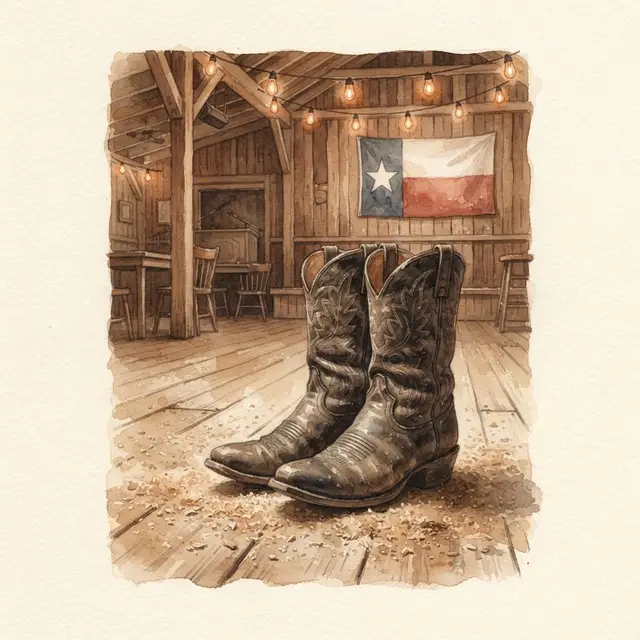
It is half past nine on a Friday night in Kerrville County. Outside, gravel crunches beneath the tires of an eighty-nine Ford that still smells of engine oil and last summer's dry pasture. Inside the dancehall, the air carries a heavier weight: a dense mixture of damp sawdust scattered across pine flooring, boot wax, and the cold condensation of long-neck bottles sliding across the wooden bar. String lights crisscross the low ceiling in diagonal lines, casting a trembling yellow glow over the brims of passing Stetson hats.
Right in the middle of the floor, the shift of two bodies marks the exact beat before a single word is sung. Then the twin fiddles strike. They do not sound distant or mournful; they chase each other with a sharp clarity, climbing the scale with the steady pace of a horse finding its stride in open country. The bow catches the string and cuts through the room like a fresh blade sliding through tanned leather. There is no hesitation in the movement.
Whoever dances here knows the floor because their grandfather helped nail it down, and the music demands no permission to fill every grain of the aged timber. The red dust stays at the threshold, but inside everything is precision, quiet pride, and the friction of denim brushing against cotton. The tempo holds firm at one hundred twelve beats per minute, anchored by a rhythm guitar keeping time like a reliable clock. Nobody shouts. Nobody forces the celebration.
There is only the clean turn, the fiddle rounding the corner of the melody, and the heavy certainty that this room, for this exact hour, is the center of the map.
Palette: amber brown / flag blue and red / lights gold
- BPM
- 112 BPM
- Family
- Dust and Highway
- Serial
- PLV-14
- Rarity
- Common
- Style strength
- 87
- Experimentation
- 17
Typical structure
[Fiddle Intro] → [Verse] → [Chorus] → [Verse 2] → [Chorus] → [Solo] → [Final chorus]
What you see above is just the dancehall backdrop and the tuning of the bows. Two writing problems specific to this style refuse to fit into any table: how to hold onto pride without sounding boastful, and how to use local geography so it reads like deep roots instead of a postcard. That lives inside an unpublished eight-parameter distillate that the engine cross-checks with the exact history you bring. When it finishes, an internal judge measures the lyrics against six dimensions of the canon and repairs any line that feels forced. The fiddle can be rented. Texas dignity cannot.
How a lyric in this style thinks
A Texas Country lyric does not describe emotion so much as it demonstrates character. The words arrive upright, the way a person stands when they know exactly whose land they are on and exactly what their name means. Where other country forms might let a narrator dissolve into feeling, Texas Country keeps its speaker on their feet, chin level, eyes forward. The lyric earns its sentiment through restraint: joy lands harder here because the voice never begs for it, never underlines it. Emotion moves the way heat moves across open pasture, slow and wide and impossible to ignore once you feel it on your skin.
The structural logic of Texas Country is efficient and unapologetic. The fiddle intro is not decorative; it is a declaration, establishing key and tempo before a single word is spoken. Verses in this genre carry the weight of specificity. Concrete nouns do the work that adjectives cannot: a 1989 Ford with engine oil still in the cab, a gravel lot in Kerrville County, a handshake that closes a deal without a word.
Line length tends toward the conversational, four to five beats that mirror natural speech, but the rhythm guitar underneath holds everything to a dancehall shuffle at around 112 BPM, so the lyric has to land on the beat with the same confidence the dancer has on the floor. Choruses in Texas Country are declarative, not confessional. They state rather than plead.
The final chorus often carries a small lift, a raised fiddle line or an added voice, but lyrically it repeats nearly intact, because the point was right the first time and does not need revision.
The sensory field of Texas Country is precise and bounded. You are working with pine flooring, boot leather, long-neck glass, sawdust, string lights throwing amber across a low ceiling, and the particular silence of open highway at dusk. Twin fiddles define the sonic register, chasing each other up the scale with the clarity of a fresh cut rather than the moan of a blues bow. Rhythm guitar keeps time like a reliable clock. Steel guitar appears but does not weep; it underscores without pleading.
What this genre never uses: vague atmospheric softness, rain as a metaphor for grief, darkness as emotional shelter. The night in a Texas Country song is wide and lit by something, even if it is only the light above a dancehall door.
Repetition in Texas Country works through return rather than accumulation. The chorus does not build by adding new information; it builds by arriving again with more certainty than it had the first time. Hooks are short and declarative, often six words or fewer, phrased so they could be said aloud to a stranger without embarrassment. The solo section, typically fiddle or steel, is structural breathing room, not emotional climax. It gives the listener a moment to feel what the verses set up before the final chorus makes the claim permanent.
What separates a genuine Texas Country lyric from a generic imitation is the refusal to explain. Generic country tells you how to feel. Texas Country shows you a specific place, a specific gesture, a specific tool or vehicle or stretch of road, and trusts the listener to arrive at the feeling without a guide. The voice is male by convention in the canonical form, confident without being loud, proud without being ornamental. If your lyric is reaching for sympathy through vulnerability alone, you have drifted toward a different card.
Texas Country celebrates the person who built something, held something together, or covered ground without complaint, and it does so with the same upright posture it demands of everyone dancing on that pine floor.
- LONE STAR
- TEXAS DANCEHALL
Sample excerpt
I pulled the rusted truck off the shoulder near Brady, Checking the fence line where the mesquite grows tall. My daddy’s old belt buckle is still holding steady, Marking the years since he answered the call. Dust on my windshield, gold light on the hood, I’m back where the roots hold the earth like they should.
And the fiddle sings sharp like a red-tailed hawk, With pride in the rhythm of the way that we walk. Under that amber sky, miles from the coast, I’m raising a glass to the ones I love most.
Workshop note — This sample works by grounding the emotion in specific geography, using the fiddles to mirror the upward lift of the melody rather than dwelling on melancholy. The lines prioritize rhythmic stability and concrete landmarks, ensuring the tone remains resolute and upright. Avoid overly poetic metaphors; keep your language as honest and unvarnished as a fence post.
Sample excerpt written by MUSAI Song. Your lyrics are written from scratch, based on your story.
When to choose this style
Choose this card when you want to honor someone who carries their land in the way they walk, no matter how many miles they have moved away. It works to celebrate fifty years of marriage for grandparents who still hold each other with the same upright posture they had on day one. It fits a father who built everything with calloused hands and whose greatest pride is spoken through a firm handshake and a steady gaze toward the 281 highway. Use it when a story asks for celebration with the chin held high, where joy is as tough as western oak.
Do not choose it for a bitter breakup or a quiet, late-night confession; Texas country does not sit in the dark to weep, it puts on its boots and walks out into the wide open. If you are looking for an intimate, fragile fireside confession, the card is Country Ballad.
Your story in this style
MUSAI Song writes original lyrics from your story, in the Texas Country style, and delivers the finished sung song, the ready-to-use style recipe, and an illustrated art plate with its numbered certificate, private by default; public only if its owner publishes it.
- Original lyrics written from your story
- A finished sung song, ready to play and share
- Art plate with a unique seal and a numbered certificate, private by default; public only if its owner publishes it
Frequently asked questions
What BPM is Texas Country?
Texas Country usually runs at 112 BPM.
What does Texas Country sound like?
Twin fiddles and lone-star pride. Texas country dances with its head held high.
What song structure does Texas Country use?
[Fiddle Intro] → [Verse] → [Chorus] → [Verse 2] → [Chorus] → [Solo] → [Final chorus]
How do I write Texas Country lyrics?
Tell MUSAI Song your story and pick Texas Country: it writes original lyrics for this style at 112 BPM, you edit them word by word, and you get the song sung in Texas Country, with an illustration of the song and its numbered certificate. $19 USD per song, one-time payment.
Explore more styles
- 80s Heartland Rock
- Alt-Country
- Americana
- Appalachian Folk
- Classic Country
- Country Blues
- Country Duet
- Country Gospel
- Country Pop
- Country Rock
- Country Soul
- Country Waltz
- Cowboy Western
- Desert Highway Rock
- Fiddle Hoedown
- First Dance Country
- Folk Country
- Front Porch Acoustic
- Hick-Hop
- Honky Tonk
- Jukebox Country Ballad
- Modern Country Anthem
- Mountain Bluegrass
- Nashville Sound
Your idea or story, sung in this style
Card · secure payment via Stripe, charged in USD
If it doesn't move you, we give you your money back · 7 days