Triple-Guitar Southern Rock
Three guitars, one porch, the sun going down. Nobody is in a hurry to finish.
Get your song in Triple-Guitar Southern Rock
Make yours in this styleHear it before you pay.$19 USD · your first song for $5.50 USDIf it doesn't move you, we give you your money back · 7 days.
Triple-Guitar Southern Rock is a style from the Dust and Highway family. 118 BPM, Experimentation 24, Style strength 88.
What is Triple-Guitar Southern Rock?
Three sister guitars and deep-south pride. Rock with swamp humidity and hot blood running through it.
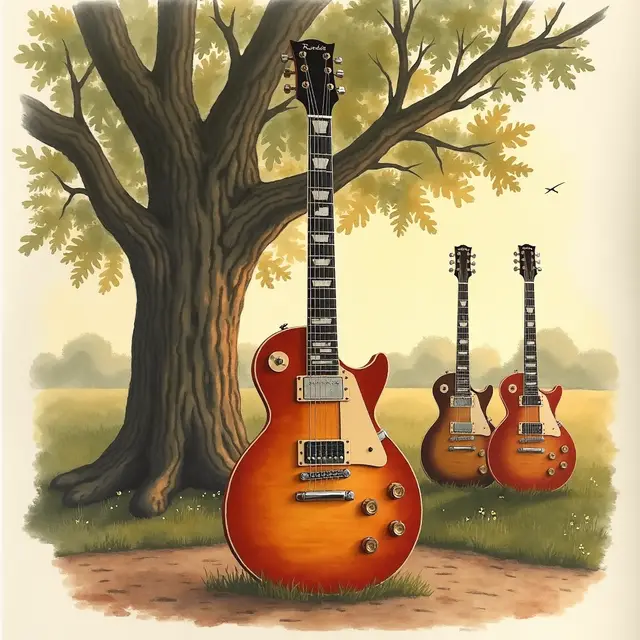
How it sounds
It’s seven in the evening at a derelict gas station on the county line, right where nobody comes unless they’re running from something or heading home. The cracked asphalt bleeds back the day’s heat in shimmering waves that distort the tree line. You smell hickory smoke, dried sweat, and the faint metallic tang of gear grease on your knuckles. You’re leaning against the hood of an old pickup, holding a cold bottle whose crown cap just popped against the chrome bumper.
Through the screen door of a house across the two-lane road, a Hammond B3 organ hums a low, resonant drone—a storm brewing in the swamp that refuses to break. Then the guitars hit. It isn't just one instrument speaking: it’s three humbucker-loaded Gibson electrics pushed through overdriven tube amps, fighting for the same square foot of air.
One lays down a heavy, rhythmic pulse; the second bites in with a glass slide that whines like a slipping fan belt; the third slips in sideways, weaving a lead line like a brother who argues with you at dinner but bleeds beside you by midnight. The voice comes straight from a chest full of red clay and cheap bourbon, offering no apologies for the drawl or the dirt on its boots. The groove doesn't rush; it moves with the deliberate weight of heavy machinery on dirt roads. The sky turns the color of a dying coal.
Nothing here is polished, only three guitars trading fire and the quiet refusal to bend.
Palette: gradient amber red / dark wood / olive green
- BPM
- 118 BPM
- Family
- Dust and Highway
- Serial
- PLV-09
- Rarity
- Rare
- Style strength
- 88
- Experimentation
- 24
Typical structure
[Intro] → [Verse] → [Chorus] → [Verse 2] → [Chorus] → [Triple guitar Solo] → [Final chorus]
The figures above are just the surface parameters. What a table cannot hold is the precise arrangement of three competing guitar leads so they reinforce rather than clutter, or how much a line must drag behind the beat before hitting the chorus. That lives inside an internal distillation of eight unpublished parameters that the engine crosses with your story. When finished, an internal judge evaluates the lyrics against six dimensions of the southern rock canon and sends back anything that lacks weight. The amp settings can be copied. The grit cannot.
How a lyric in this style thinks
A Southern Rock lyric does not describe a place — it inhabits one. From the first line, the song plants its boots on cracked asphalt and refuses to move until the story is told. The genre works through declaration, not confession. Where other styles might approach emotion sideways, Southern Rock comes straight at it: a man's worth is in his hands, loyalty is measured in miles driven, and belonging is not a feeling but a fact carved into red clay.
The emotional register runs from amber pride to dark-wood grief, but neither ever tips into sentimentality. The voice — and this is crucial — does not ask permission for its drawl, its volume, or its certainty. Vulnerability exists here, but it arrives wearing work boots, not bare feet.
Repetition in this genre carries structural weight. The chorus is not a summary of the verse; it is the load-bearing wall the whole song leans against. Lines tend to be long and declarative in the verse, building evidence like a closing argument, then the chorus strips down to a single blunt truth repeated with increasing conviction. Rhythm follows the same logic: the groove at 118 BPM moves with the deliberate momentum of heavy machinery, not the urgency of panic.
There is no rushing because rushing would suggest doubt, and Southern Rock does not do doubt. The drum pattern locks in with the bass and the rhythm guitar into something that feels less like a tempo and more like a heartbeat that has been beating since before you were born.
The sensory field is specific and non-negotiable. Southern Rock lives in gear grease and hickory smoke, in the hum of a Hammond B3 warming up through a cracked speaker cabinet, in the particular weight of a cold bottle on a hot evening. Concrete nouns do the emotional work that adjectives would ruin: a screen door, a two-lane county road, a chrome bumper, forty years of calluses. The genre never reaches for the abstract when the physical will do.
What it never uses is metropolitan irony, fragile imagery, or anything that implies the singer might be embarrassed by where he comes from. Olive green treelines and amber-turning skies are the backdrop; the foreground is always a person who has earned the right to be standing in that landscape.
Structurally, the genre follows a logic of accumulation. The intro lets the three guitars establish their separate voices before the vocal enters — this is not decoration but introduction, because in Southern Rock the guitars are characters, not accompaniment. The first verse lays the foundation fact: who this person is, where they come from, what they have carried. The second verse deepens the stakes.
Then comes the triple guitar solo, and this is where most imitations fail: the solo section is not a break from the story, it is the story continuing in a language that words cannot reach. One guitar sustains the argument, one bites in with slide-driven emotion like a slipping fan belt finding purchase, and the third weaves between them the way a brother argues with you at dinner and bleeds beside you at midnight. After the solo, the final chorus lands differently — heavier, earned, almost a verdict.
What separates a real Southern Rock lyric from a generic imitation is the refusal to explain itself. A weak imitation lists Southern signifiers — trucks, dirt roads, a family name — without giving them weight. A genuine Southern Rock song makes you feel that the dirt road is the only road that matters, that the family name carries decades of specific consequence. The gritty male vocal delivery, pushed through overdriven tube amps into a swampy, whiskey-soaked swagger, demands lyrics that meet it at that level of commitment.
If your lyric could be sung quietly by candlelight and still work, it is not Southern Rock. If it needs the full wall of humbucker-loaded Gibsons to hold its meaning together, you are writing in the right tradition.
- THREE GUITARS
- SOUTHERN PRIDE
Sample excerpt
Oil-stained knuckles on a rusted chrome bumper Shift the gear heavy while the heat haze curls Found my daddy’s wrench by the creek at the sawmill Back when the valley still belonged to the ghosts. Black coffee burning in a cracked ceramic mug Tracing the map till the ink turns to gray.
Give me the gravel road that bites back at the tires Three guitars screaming through the humid night air We ain't looking for mercy, just enough road to roll To prove we still belong to this heavy red clay.
Workshop note — Southern Rock relies on a rugged cadence that mimics the physical grit of manual labor. This sample uses concrete, tactile imagery—like oil stains and creek beds—to anchor the listener in a specific geography rather than abstract emotion. The chorus functions as a defiant declaration, utilizing short, punchy phrases that command the listener’s attention against the heavy, layered guitar instrumentation.
Sample excerpt written by MUSAI Song. Your lyrics are written from scratch, based on your story.
When to choose this style
Choose this card when your story is about belonging, unyielding roots, and loyalty forged in hard work and shared miles. It works to honor a father who spent forty years with grease under his fingernails and never asked for credit. For returning to a small town where every backroad has a story and people still know your family name. For celebrating a lifelong friendship built on late-night highway breakdowns and silent understanding. For a hard-won victory that cost sweat and calluses, earned the long way round.
Do not pick it for a tender love song, a quiet apology, or a fragile sorrow that demands silence. Southern Rock does not whisper or make soft concessions. If your story needs acoustic nostalgia, quiet porch contemplation, and simple stripped-back storytelling without the wall of amplified guitars, the card is Country Ballad.
Your story in this style
MUSAI Song writes original lyrics from your story, in the Triple-Guitar Southern Rock style, and delivers the finished sung song, the ready-to-use style recipe, and an illustrated art plate with its numbered certificate, private by default; public only if its owner publishes it.
- Original lyrics written from your story
- A finished sung song, ready to play and share
- Art plate with a unique seal and a numbered certificate, private by default; public only if its owner publishes it
Frequently asked questions
What BPM is Triple-Guitar Southern Rock?
Triple-Guitar Southern Rock usually runs at 118 BPM.
What does Triple-Guitar Southern Rock sound like?
Three sister guitars and deep-south pride. Rock with swamp humidity and hot blood running through it.
What song structure does Triple-Guitar Southern Rock use?
[Intro] → [Verse] → [Chorus] → [Verse 2] → [Chorus] → [Triple guitar Solo] → [Final chorus]
How do I write Triple-Guitar Southern Rock lyrics?
Tell MUSAI Song your story and pick Triple-Guitar Southern Rock: it writes original lyrics for this style at 118 BPM, you edit them word by word, and you get the song sung in Triple-Guitar Southern Rock, with an illustration of the song and its numbered certificate. $19 USD per song, one-time payment.
Explore more styles
- 80s Heartland Rock
- Alt-Country
- Americana
- Appalachian Folk
- Classic Country
- Country Blues
- Country Duet
- Country Gospel
- Country Pop
- Country Rock
- Country Soul
- Country Waltz
- Cowboy Western
- Desert Highway Rock
- Fiddle Hoedown
- First Dance Country
- Folk Country
- Front Porch Acoustic
- Hick-Hop
- Honky Tonk
- Jukebox Country Ballad
- Modern Country Anthem
- Mountain Bluegrass
- Nashville Sound
Your idea or story, sung in this style
Card · secure payment via Stripe, charged in USD
If it doesn't move you, we give you your money back · 7 days