Red Dirt
Unpolished on purpose — the dirt is the point.
Get your song in Red Dirt
Make yours in this styleHear it before you pay.$19 USD · your first song for $5.50 USDIf it doesn't move you, we give you your money back · 7 days.
Red Dirt is a style from the Dust and Highway family. 110 BPM, Experimentation 22, Style strength 86.
What is Red Dirt?
Oklahoma red dirt and bands that sound like a packed small-town bar. Rough around the edges, full of heart.
How it sounds
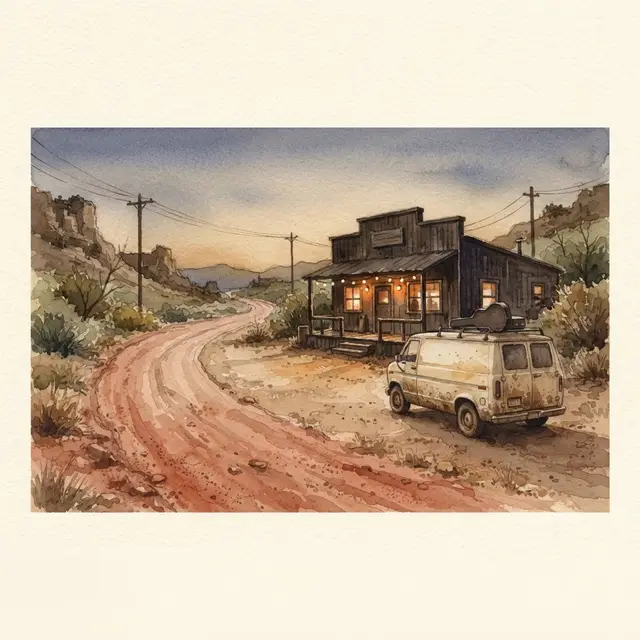
It’s seven in the evening at a roadside joint just off Route 66 outside Stillwater. The air carries the charge of a storm that refuses to break and the dry scent of red dirt caked onto truck fenders. Inside, the floorboards groan with every footstep. You are leaning against the worn wooden bar, holding a longneck bottle with a label peeling from condensation, feeling the day’s heat sitting heavy on your shoulders.
Up on the two-inch riser that passes for a stage, a battered Telecaster plugs straight into a cranked Peavey tube amp that hums in the quiet spaces. A fiddle cuts through the room like rusted fence wire, sharp and unvarnished. There are no studio tricks here: just a four-string bass locking into a deep wood-shell kick drum at a steady hundred and ten beats per minute. The lead singer pulls close to the mic with a voice scraped raw by prairie wind and highway dust.
Nobody in the crowd is jumping or shouting; they just nod, eyes fixed on the dim amber bulbs strung across the rafters. You feel the low end vibrating straight through the soles of your boots. There’s a folded road map sitting on a corner table, and the quiet realization that every mile it took to get here left a dent in the frame.
Palette: earth red / warm amber / dust beige / twilight blue
- BPM
- 110 BPM
- Family
- Dust and Highway
- Serial
- PLV-13
- Rarity
- Common
- Style strength
- 86
- Experimentation
- 22
Typical structure
[Intro] → [Verse] → [Chorus] → [Verse 2] → [Chorus] → [Solo] → [Final chorus]
The basic tempo and chord structure are just the visible surface. What doesn't fit in a table are the two critical writing challenges of this genre: naming a real highway or town landmark without sounding like a tourist gimmick, and letting the fiddle carry genuine grief without slipping into melodrama. That balance lives inside an internal set of eight distilled parameters that our engine crosses directly with your story. Once drafted, an internal judge evaluates the lyrics against six dimensions of the canon to refine every edge. The road rhythm can be copied. The red clay under the boots cannot.
How a lyric in this style thinks
A Red Dirt lyric does not announce its feelings — it earns them through accumulated physical detail. The genre works by grounding every emotional weight in something you can touch or smell or hear: the peel of a beer label, the hum of a tube amp warming up, the particular way a two-lane highway looks at dusk when the sky goes amber and the asphalt goes violet. The listener is not asked to feel something. They are placed inside a scene until the feeling arrives on its own. That is the central discipline of Red Dirt writing, and it separates a real song in this tradition from a generic country imitation that gestures at hardship without ever making contact with it.
The emotional register runs dry and warm at the same time. Sentiment exists here, but it is delivered without ornament — no swelling declarations, no manufactured vulnerability. The persona in a Red Dirt song respects plain talk and distrusts pity, which means the lyric must carry grief or longing the way a working person carries it: quietly, in the body, with the jaw set.
Verses tend to be long and narrative, building a scene beat by beat at the genre's natural tempo of around 110 BPM — steady enough to feel like highway miles accumulating, never hurried. Chorus sections compress that accumulated weight into a phrase or two that feels inevitable rather than clever. The hook in Red Dirt is not a pop hook; it is a recognition. When it lands, the crowd nods rather than sings along at first.
Line length in the verse follows the natural rhythm of spoken Oklahoma or North Texas speech — phrases that breathe in four- and five-beat measures, with room for the fiddle to answer between lines. Repetition is used sparingly but deliberately. When a word or image returns, it carries more weight than it did the first time, because the verses have done the work of loading it.
The sensory field is specific and narrow: red dirt roads, worn wood, rusted metal, diesel, dust, amber light, cracked leather, the particular loneliness of a cell signal dropping on a two-lane. This genre does not use ocean imagery, skyline imagery, or the vocabulary of luxury. It does not use irony or distance. Everything is close and earnest and a little road-worn.
Structurally, Red Dirt follows a logic that mirrors the shape of a long drive. The intro establishes the instrument texture — a Telecaster running straight into a cranked amp, a fiddle entering like rusted fence wire, bass and kick drum locked into the low end — before the first word is sung. This is not decoration; it is scene-setting that primes the listener's body before the lyric begins. The two verses accumulate story.
The solo section, usually a fiddle or guitar break, functions as the emotional exhale the lyric has been building toward — it says what the singer cannot quite put into words. The final chorus lands differently than the earlier ones because the verses have changed what those words mean.
What makes a Red Dirt lyric feel genuine rather than imitative is the quality of its restraint. The genre lives in the gap between what is said and what is meant. A song about a father teaching someone to drive is not really about driving. A song about a van full of friends and half-baked plans is not really about the plans. The concrete detail is always a door into something larger that the lyric refuses to name directly. If you find yourself explaining the emotion, you have stepped outside the genre. Trust the image. Let the fiddle and the cranked amp carry what the words leave open.
- RED DIRT
- SMALL-TOWN BAND
Sample excerpt
Drained the oil pan behind the grain elevator at nine. My knuckles still carry the grease from the rusted Ford line. Daddy said a man keeps his word the same as his tools. We didn't learn much sitting out behind the country school.
We built this town with calloused palms and red dirt in our teeth. Running on stale black coffee and a rusted Dodge beneath. If you want a polished story go looking down the coast. Here we just hold on tight to what we love the most.
Workshop note — This sample leans on heavy local textures like oil pans and grain elevators to establish authenticity without resorting to worn-out poetry. The chorus uses a steady, driving rhythm that mimics a pickup truck hitting a gravel road, while completely avoiding abstract emotional filler.
Sample excerpt written by MUSAI Song. Your lyrics are written from scratch, based on your story.
When to choose this style
Pick this card when your story is about roots you carry in your hands, towns you left behind that never quite left you, or hard labor that built character without making a scene. It works for a father who taught you how to drive on a cracked two-lane, a crew of friends who shared a van full of gear and half-baked plans, or a highway romance that burned out between gas station stops. Use it for someone who respects plain talk and hates pity. Do not pick this for polished city romance, formal apologies, or high-energy pop celebrations. If your story calls for the quiet solitude of a front porch sunset without the full weight of a bar band behind it, the card is Prairie Ballad.
Your story in this style
MUSAI Song writes original lyrics from your story, in the Red Dirt style, and delivers the finished sung song, the ready-to-use style recipe, and an illustrated art plate with its numbered certificate, private by default; public only if its owner publishes it.
- Original lyrics written from your story
- A finished sung song, ready to play and share
- Art plate with a unique seal and a numbered certificate, private by default; public only if its owner publishes it
Frequently asked questions
What BPM is Red Dirt?
Red Dirt usually runs at 110 BPM.
What does Red Dirt sound like?
Oklahoma red dirt and bands that sound like a packed small-town bar. Rough around the edges, full of heart.
What song structure does Red Dirt use?
[Intro] → [Verse] → [Chorus] → [Verse 2] → [Chorus] → [Solo] → [Final chorus]
How do I write Red Dirt lyrics?
Tell MUSAI Song your story and pick Red Dirt: it writes original lyrics for this style at 110 BPM, you edit them word by word, and you get the song sung in Red Dirt, with an illustration of the song and its numbered certificate. $19 USD per song, one-time payment.
Explore more styles
- 80s Heartland Rock
- Alt-Country
- Americana
- Appalachian Folk
- Classic Country
- Country Blues
- Country Duet
- Country Gospel
- Country Pop
- Country Rock
- Country Soul
- Country Waltz
- Cowboy Western
- Desert Highway Rock
- Fiddle Hoedown
- First Dance Country
- Folk Country
- Front Porch Acoustic
- Hick-Hop
- Honky Tonk
- Jukebox Country Ballad
- Modern Country Anthem
- Mountain Bluegrass
- Nashville Sound
Your idea or story, sung in this style
Card · secure payment via Stripe, charged in USD
If it doesn't move you, we give you your money back · 7 days