Prairie Ballad
Big sky energy for feelings that need acreage.
Get your song in Prairie Ballad
Make yours in this styleHear it before you pay.$19 USD · your first song for $5.50 USDIf it doesn't move you, we give you your money back · 7 days.
Prairie Ballad is a style from the Dust and Highway family. 66 BPM, Experimentation 26, Style strength 90.
What is Prairie Ballad?
Endless sky, wind, and wheat: the prairie ballad sounds like a horizon that never runs out.
How it sounds
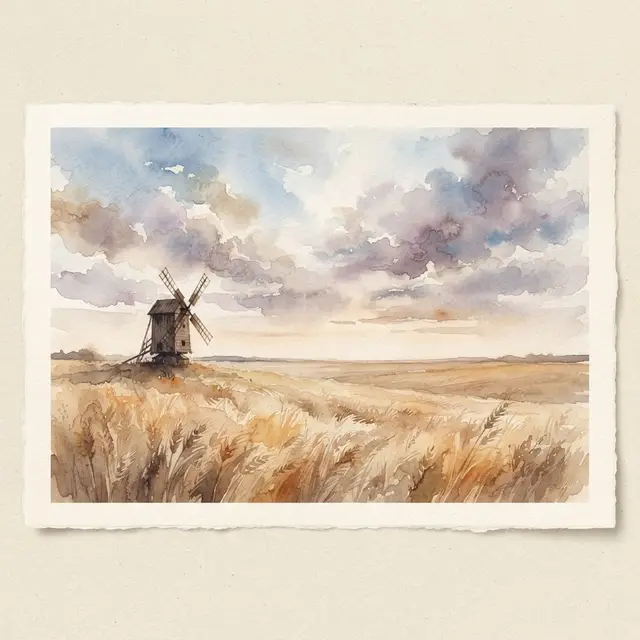
It is six in the evening on an unpaved stretch of road, right in the middle of a flatland where the dirt and the sky touch without making a sound. The light turns low and golden, staining the wheat stalks a color that looks tired of watching the sun go down. The wind rolls in from the horizon line, kicking up a fine cloud of dry dust that sticks to your lips and to the hot metal of the truck bed. Far off, the skeleton of a windmill turns with a steady, metallic, lazy creak, measuring out time with a stubborn slowness.
There is not another soul for ten miles in any direction. The sound of the steel guitar drifts in from way out, washed in a deep reverb that lets it float like it is coming from the bottom of a dry creek bed, in no hurry to get anywhere. The notes stretch out, bending a half-step down, matching that heavy pull in your chest when you look at a space too wide to ever walk across by yourself. You cut the truck engine and the only noise left is the wind hitting the open windows, a constant hum filling the room between your ribs.
The world is huge and you take up very little space in it, and for the first time all day, that does not sting, it just presses down gently on your shoulders.
Palette: wheat gold / sky gray blue / clouds violet mauve
- BPM
- 66 BPM
- Family
- Dust and Highway
- Serial
- PLV-31
- Rarity
- Epic
- Style strength
- 90
- Experimentation
- 26
Typical structure
[Wind Intro] → [Verse] → [Chorus] → [Verse 2] → [Prairie interlude] → [Open final chorus]
What you see up top is just the dust on the road. Behind this sheet lie a couple of hidden traps: keeping the vast landscape from turning into a postcard cliché, and making sure the slow, heavy meter does not bore the listener before the chorus hits. That lives in an unpublished set of eight parameters, and the engine cross-checks it all with your raw history. When it finishes, an internal judge grades the lyrics against six canonical dimensions and sends back anything that moves too fast. The horizon is wide open. The exact weight of it, no.
How a lyric in this style thinks
A prairie ballad lyric does not confess — it measures. It holds a feeling up against the flatness of an open landscape and lets the scale do the emotional work that a direct statement never could. The genre earns its name: this is music that belongs to the Great Plains in the way a fence post belongs to a field, rooted in specific, weathered ground.
The lyric's primary function is to make distance feel like a physical weight, to translate the silence between two people, or between a person and the place they came from, into something the listener can press a hand against. When a prairie ballad works, you do not feel sad in a general way — you feel the particular sadness of standing somewhere vast and realizing you have become very small without anyone noticing.
The base tone is restraint, and emotion arrives sideways. A lyric in this genre never announces grief; it describes the color of light on wheat stalks at six in the evening, the metallic creak of a windmill turning in no hurry, the dust that settles on your lips and on the hot metal of a truck bed. The sensory field is tight and specific: unpaved roads, open windows, the hum of wind filling a cab after the engine cuts. What the prairie ballad never uses is abstraction without a physical anchor.
You do not write about loss in this genre — you write about an open hand at an empty station. You do not write about loneliness — you write about ten miles of flat ground with no other soul in it. The concrete image carries the full weight, and the lyric trusts the listener to feel what it does not say.
Line length and rhythm behave like the landscape: wide, unhurried, with long vowels that stretch before they resolve. At 66 BPM, the syllables have room to breathe, and the best lines in this genre feel like they are arriving from a distance before they land. Repetition is structural rather than emotional — the chorus does not repeat to intensify feeling but to confirm it, the way the horizon confirms itself every time you look up. The rhyme scheme tends toward the loose and unforced, often half-rhyme or slant rhyme, because a perfect rhyme in this context would feel too tidy, too resolved, too unlike the actual experience of standing in a flatland where nothing quite closes.
The structure follows the geography of the genre. The wind intro is not ornamental — it is the landscape establishing itself before the lyric arrives, the steel guitar drifting in with deep reverb, bending a half-step down, giving the ear a horizon line to fix on. The two verses carry the accumulation of detail and quiet revelation. The prairie interlude is the moment the lyric steps back and lets the sound carry what words have been building toward — a space that earns the open final chorus, which does not escalate so much as widen.
The final chorus is not louder; it is broader. The vocal delivery here is soaring but not strained, the reverb pulling it slightly away from the body, as if the voice itself is being absorbed into the sky.
What separates a real prairie ballad lyric from an imitation is the willingness to let nothing happen and trust that the nothing is the point. Generic country writing in this register reaches for emotion too quickly, names the feeling before the image has had time to grow it. A genuine prairie ballad sits with the open space — the wide-sky atmosphere, the slow burn of wheat-field light — and understands that the prairie does not yell. It shrinks everything to its true size, and in that compression, the ordinary detail becomes the most precise instrument available. Write the fence post. Write the dust on the lip. Let the steel guitar do the crying.
- ENDLESS SKY
- WIND AND WHEAT
Sample excerpt
The rusted pump handles grease in the sun And nobody walks where the furrows are done I left a blue coat on the back of the chair For a brother to find when he looks for a prayer Six miles of gravel behind the old ford With nothing to carry except for the cord
Keep the wind on your left as you cross through the line Where the timber is gone and the grass is too fine There is no one to wave from the edge of the town Just an open horizon to swallow you down
Workshop note — This sample relies on physical landmarks—a rusted pump, a blue coat, six miles of gravel—to anchor the vast emptiness of the landscape without relying on abstract emotional declarations. The lines move at a slow, deliberate pace matching a walker's stride, avoiding any quick rhymes or modern slang that would break the timeless rural tone. Notice how the chorus treats isolation not as a tragedy, but as a vast, unmeasured expanse.
Sample excerpt written by MUSAI Song. Your lyrics are written from scratch, based on your story.
When to choose this style
Choose this card when you need to measure a distance that is no longer counted in miles, but in quiet. It works for leaving behind a small town where everyone knew your name and walking down a sidewalk where no one turns to look. For the exact second you look back and realize the landscape of your early years dried up just like an old fence post under an August sun. For a goodbye at an empty station where nobody shouted, just an open hand letting go.
Do not pick this for an angry split, a loud reunion, or a victory celebrated with crashing glasses. The prairie does not yell; it shrinks everything down to its true size. If you are looking for a direct, upbeat confession, the card is Country Pop.
Your story in this style
MUSAI Song writes original lyrics from your story, in the Prairie Ballad style, and delivers the finished sung song, the ready-to-use style recipe, and an illustrated art plate with its numbered certificate, private by default; public only if its owner publishes it.
- Original lyrics written from your story
- A finished sung song, ready to play and share
- Art plate with a unique seal and a numbered certificate, private by default; public only if its owner publishes it
Frequently asked questions
What BPM is Prairie Ballad?
Prairie Ballad usually runs at 66 BPM.
What does Prairie Ballad sound like?
Endless sky, wind, and wheat: the prairie ballad sounds like a horizon that never runs out.
What song structure does Prairie Ballad use?
[Wind Intro] → [Verse] → [Chorus] → [Verse 2] → [Prairie interlude] → [Open final chorus]
How do I write Prairie Ballad lyrics?
Tell MUSAI Song your story and pick Prairie Ballad: it writes original lyrics for this style at 66 BPM, you edit them word by word, and you get the song sung in Prairie Ballad, with an illustration of the song and its numbered certificate. $19 USD per song, one-time payment.
Explore more styles
- 80s Heartland Rock
- Alt-Country
- Americana
- Appalachian Folk
- Classic Country
- Country Blues
- Country Duet
- Country Gospel
- Country Pop
- Country Rock
- Country Soul
- Country Waltz
- Cowboy Western
- Desert Highway Rock
- Fiddle Hoedown
- First Dance Country
- Folk Country
- Front Porch Acoustic
- Hick-Hop
- Honky Tonk
- Jukebox Country Ballad
- Modern Country Anthem
- Mountain Bluegrass
- Nashville Sound
Your idea or story, sung in this style
Card · secure payment via Stripe, charged in USD
If it doesn't move you, we give you your money back · 7 days