Outlaw Country
For when the rules were more of a suggestion anyway.
Get your song in Outlaw Country
Make yours in this styleHear it before you pay.$19 USD · your first song for $5.50 USDIf it doesn't move you, we give you your money back · 7 days.
Outlaw Country is a style from the Dust and Highway family. 98 BPM, Experimentation 22, Style strength 90.
What is Outlaw Country?
The country that broke out of the pen: beard, whiskey, and a rebellious streak that doesn't ask for permission.
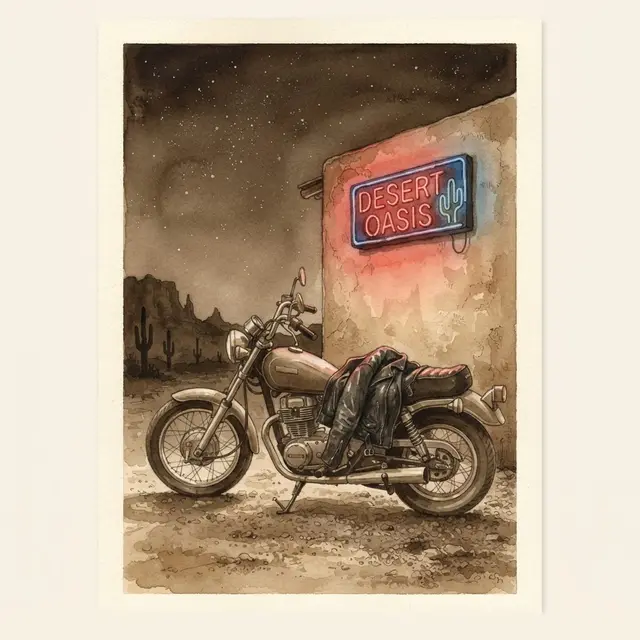
How it sounds
It is half past three in the morning at an unbranded gas station fifty miles north of Abilene. The outdoor AC compressor hums with a steady, metallic drone while a leaking fuel hose drips onto the black pavement. You are sitting on the bench seat of an eighty-two Ford pickup; the steering wheel is stripped to the metal core and the cracked leather smells of stale tobacco and dried sweat.
Outside, the Texas plains are a blind mass under a moonless sky, and the only light comes from a yellow bulb above the restroom door, drawing heavy moths against the glass. An acoustic guitar hits hard in the background, picked with a heavy flatpick against old strings that are fractionally sharp, just enough to grate. Then the harmonica cuts through, dry and long, stretching across the flat air like a freight train crossing an idle track two miles off.
The engine is not off; it vibrates beneath your boots with a low, gravelly thrum, the exact frequency that crawls up your shins and settles at the base of your spine. Nobody is coming because nobody knows where you parked, and that is the only certainty left in your pockets. Dust drifts through the half-cracked window and sticks to the salt on your tongue. The world out there is still waiting for receipts you never intend to pay, and the tachometer measures the exact revolutions of an engine that only knows how to burn fuel forward.
Palette: leather black / neon red / neon blue / earth ochre
- BPM
- 98 BPM
- Family
- Dust and Highway
- Serial
- PLV-02
- Rarity
- Rare
- Style strength
- 90
- Experimentation
- 22
Typical structure
[Intro] → [Verse] → [Chorus] → [Verse 2] → [Chorus] → [Solo] → [Final chorus]
The four points above fit on any spec sheet, but they are only the dust kicked up by the tread. Behind them lie two knots no table can untie: how to make defiance sound like genuine exhaustion rather than poster-board posturing, and how to cram raw grit into a steady meter without turning it into a drill. That lives inside an unpublished eight-parameter distillate, which the engine collides with the bones of your story before a single line is set. Once finished, an internal judge measures the lyrics against six canons and orders the demolition of anything that smells like a lie. The tempo can be found anywhere. The backbone cannot.
How a lyric in this style thinks
A lyric in Outlaw Country does one specific thing: it states the terms of a person's refusal and then drives away without looking back. It does not ask for sympathy, and it never explains itself twice. The genre earns its name honestly — outlaw country broke away from the polished machinery of mainstream Nashville in the 1970s and built its own grammar, one that favored grit over gloss, lived-in specificity over sentiment, and the hard declarative sentence over the pleading melody. The emotional temperature is leather black and earth ochre, not tearful. The singer is not broken; the singer has decided, and the song is the document of that decision.
Emotion in outlaw country arrives through accumulation of physical fact, not through stated feeling. You do not write that your narrator feels trapped; you write that the steering wheel is stripped to bare metal and the cab smells of tobacco that belongs to someone who stopped caring about appearances six months ago. The sensory field is specific and blue-collar: cracked vinyl, diesel, highway asphalt still warm from the afternoon sun, the particular hum of a flatbed engine at idle.
What this genre refuses is softness of any kind — no candles, no rain used as metaphor for tears, no imagery that could appear in a greeting card. The acoustic guitar sits at the center, picked hard with a flatpick against slightly sharp strings that grate just enough to signal tension without resolution. The harmonica enters dry and long, stretching phrases the way empty plains stretch a two-lane road into the distance. The electric guitar carries swagger, not polish; there is dirt in the tone.
Line length in outlaw country tends to be mid-to-long in the verse and blunt in the chorus. Verses carry the story — the exact Tuesday, the single bag, the gas station fifty miles from anywhere — with the patience of someone who has driven all night and has the mileage to prove it. The rhythm leans into a driving, train-beat pulse, around 98 BPM, that pushes forward without urgency, the way a truck maintains speed on a flat interstate. There is repetition in the chorus, but it functions as a statement of position rather than an emotional release. The hook does not soar; it lands. It says the thing plainly and means it both times.
Structurally, the genre follows a logic that mirrors the arc of leaving: the intro establishes the engine running, the first verse sets the scene and the reason, the chorus states the terms, the second verse deepens the history without reversing the decision, the solo — guitar or harmonica — takes the place of the emotional confession the narrator refuses to make in words, and the final chorus lands harder because by then you know what it cost. The solo is not decoration; it is the grief the lyric will not name. If you write a bridge that softens the narrator's position or introduces doubt, you have left the genre. Outlaw country has no room for clean remorse.
What separates a real outlaw country lyric from a generic imitation is specificity of pride. Generic country rebellion sounds like a slogan. Real outlaw country sounds like a man or woman who has done the math and accepted the cost. The vocal delivery — a gritty baritone with rebellious swagger — has to feel like it was earned rather than performed. Every concrete detail in the lyric should do double duty: the unbranded gas station is not just a location, it is proof that your narrator exists outside the economy of receipts and records.
The tachometer measures revolutions forward, not backward. That is the whole philosophy of the genre in one image, and the lyric that finds its own version of that image — functional, unglamorous, pointing away from everything familiar — is the one that works.
- REBEL WITH CAUSE
- BEARD AND WHISKEY
Sample excerpt
The transmission gave out on the edge of the county line, I left the keys in the dirt near an amber-stained pine. My boots are heavy with grit from the factory floor, I don't owe the foreman a greeting or a chore anymore. The sun is dragging its feet across the jagged ridge, I’m tossing the match toward the timber of the bridge.
I’m tracing a path where the asphalt turns to grey, Letting the ink black horizon swallow the day. No map in the pocket, no ghost in the rear view glass, Just the wind and the gravel and the time left to pass.
Workshop note — Outlaw country relies on hard consonants and short, punchy sentences that mirror the mechanical rhythm of a highway drive. The chorus works by grounding the rebellion in physical displacement—leaving the map and the mirror behind—rather than abstract emotional declarations. Avoid flowery metaphors; keep the focus on tangible objects like boots, keys, and gravel to maintain that gritty, unyielding tone.
Sample excerpt written by MUSAI Song. Your lyrics are written from scratch, based on your story.
When to choose this style
Choose this track when your personal history is about burning the bridge and refusing to look at the flames. It works for chronicling the exact Tuesday someone packed a single bag and left a small town behind without a forwarding address. For the moment you walked out of a job that was rotting your hands, or the decision to draw a thick line in the dust between you and everyone who tried to hand you a leash. It fits the hard-won pride of standing alone on the shoulder while the main highway belongs to someone else.
Do not pick this for weddings, gentle anniversaries, or tearful family reunions where someone has to apologize: outlaw country has no room for clean remorse or soft edges. It fails for quiet nostalgia or losses that need community comfort. If you are looking for a farewell that leaves the back door unlocked, the card is Country Ballad.
Your story in this style
MUSAI Song writes original lyrics from your story, in the Outlaw Country style, and delivers the finished sung song, the ready-to-use style recipe, and an illustrated art plate with its numbered certificate, private by default; public only if its owner publishes it.
- Original lyrics written from your story
- A finished sung song, ready to play and share
- Art plate with a unique seal and a numbered certificate, private by default; public only if its owner publishes it
Frequently asked questions
What BPM is Outlaw Country?
Outlaw Country usually runs at 98 BPM.
What does Outlaw Country sound like?
The country that broke out of the pen: beard, whiskey, and a rebellious streak that doesn't ask for permission.
What song structure does Outlaw Country use?
[Intro] → [Verse] → [Chorus] → [Verse 2] → [Chorus] → [Solo] → [Final chorus]
How do I write Outlaw Country lyrics?
Tell MUSAI Song your story and pick Outlaw Country: it writes original lyrics for this style at 98 BPM, you edit them word by word, and you get the song sung in Outlaw Country, with an illustration of the song and its numbered certificate. $19 USD per song, one-time payment.
Explore more styles
- 80s Heartland Rock
- Alt-Country
- Americana
- Appalachian Folk
- Classic Country
- Country Blues
- Country Duet
- Country Gospel
- Country Pop
- Country Rock
- Country Soul
- Country Waltz
- Cowboy Western
- Desert Highway Rock
- Fiddle Hoedown
- First Dance Country
- Folk Country
- Front Porch Acoustic
- Hick-Hop
- Honky Tonk
- Jukebox Country Ballad
- Modern Country Anthem
- Mountain Bluegrass
- Nashville Sound
Your idea or story, sung in this style
Card · secure payment via Stripe, charged in USD
If it doesn't move you, we give you your money back · 7 days