Street Orchestral
The block got a string section — cinema achieved.
Get your song in Street Orchestral
Make yours in this styleHear it before you pay.$19 USD · your first song for $5.50 USDIf it doesn't move you, we give you your money back · 7 days.
Street Orchestral is a style from the Asphalt and Diamonds family. 138 BPM, Experimentation 50, Style strength 85.
What is Street Orchestral?
Cinematic strings over concrete: the epic of the block deserves its own full symphony orchestra.
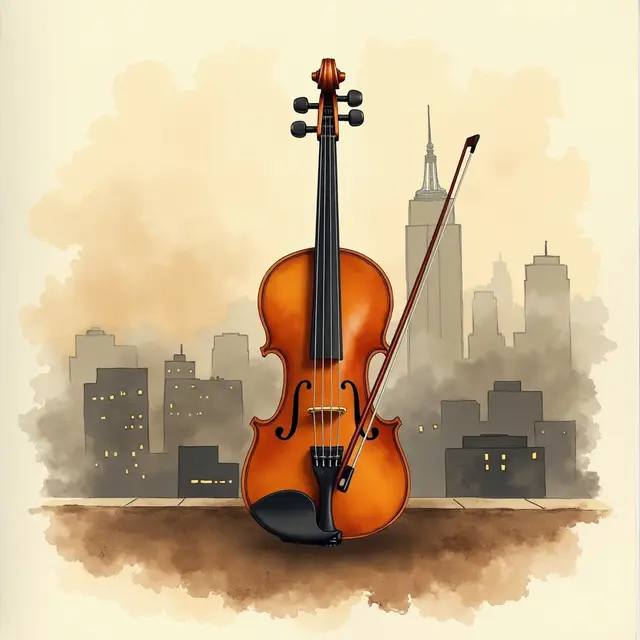
How it sounds
It is three in the morning on the roof access landing of a concrete tenement where the freight door has been bolted shut for years. You are leaning against the painted green railing, the chill biting through the fabric of your sleeves. Down below, the beltway traffic sounds like an ocean tide that refuses to recede, but up here the wind carries the smell of wet pavement and coal smoke drifting from the rail yards.
Suddenly, the sub-bass hits with a dry, physical impact that rattles the windowpanes in their frames, and right over that heavy low end a string section cuts through the air, violins playing with the bows pressed hard against the horsehair, raw and sharp enough to leave a taste of rosin on the tongue. This is not chamber music; it is a battle hymn scored with the desperation of someone who has no backup plan.
The contrast hits you right behind the breastbone: the blunt force of the drum machine pushing against the tragic elegance of a cinematic arrangement. You look out at the silhouette of television antennas against a leaden sky, the yellow headlights crawling across the overpass, and you know that every grueling shift and missed paycheck leading to this moment deserves to sound exactly this vast, heavy, and undeniable.
Palette: amber orange / black / fog gray / muted gold
- BPM
- 138 BPM
- Family
- Asphalt and Diamonds
- Serial
- ASF-32
- Rarity
- Legendary
- Style strength
- 85
- Experimentation
- 50
Typical structure
[String Intro] → [Verse] → [Epic hook] → [Verse 2] → [Hook] → [Orchestral bridge] → [Cinematic final hook]
The data above is just the blueprint. Beneath this card lie two specific writing hurdles that no table can solve: keeping the symphonic swells from burying the grit of the low end, and writing street narratives that never sound like they are wearing a tuxedo they cannot afford. That lives inside a hidden eight-parameter distillate that cross-references your exact history. When it finishes, an internal judge measures the result against six dimensions of the canon and recalibrates every line until the concrete and the orchestra hold equal weight. The strings are easy to sample. The gravity, no.
How a lyric in this style thinks
A Street Orchestral lyric does not describe hardship — it indicts it. The writing operates at documentary scale, placing the listener inside a sequence of years rather than a single night, and every image has to carry the weight of accumulated time. This is the genre where forty years of grease-stained shifts become a movement, not a verse. The emotional architecture is built on contrast: the bluntness of concrete experience pressed against the tragic elegance of a full string arrangement.
When the sub-bass hits at 138 BPM with the dry physical force of a freight door slamming, and the violins answer with bows pressed hard into the horsehair, the lyric has to be worthy of that collision. Small, fragile confessions collapse under brass. Only wide-angle scope survives.
The base tone in Street Orchestral sits somewhere between elegy and proclamation. Grief arrives late, after the facts have already been established. You do not open with how something felt — you open with what it cost. Debt figures, missed wages, the specific weight of a family business held together with decisions nobody else wanted to make. Emotion enters through accumulation: by the time the epic hook lands over the cinematic string section, the listener has already walked the math. The hook itself is not a confession; it is a verdict. The language should be declarative and irrevocable, as though the outcome has already been carved into something permanent.
Rhythm in this genre is architectural. Line lengths tend to be long in the verses — dense, compound sentences that mirror the 808 slides underneath, phrases that feel like they are still moving even after they land. The hook contracts sharply into short, hammer-blow statements, often just four to six syllables per bar, letting the orchestral arrangement fill the space the words vacate. Repetition functions as reinforcement rather than variation: the hook does not evolve across the song, it deepens.
The orchestral bridge is where the lyric steps back from narrative and lets the brass and strings carry the emotional argument alone, which means the lines entering that section must set up the silence with enough tension that the instruments can resolve it.
The sensory field of Street Orchestral lives in amber and ink black: wet pavement under sodium light, coal smoke drifting from rail yards, the yellow crawl of headlights across an overpass, the painted green railing of a rooftop landing no one uses anymore. Television antennas against a leaden sky. The friction of horsehair on violin strings. These textures are not decorative — they are the evidence. What the genre never uses is the domestic interior, the bedroom, the kitchen table.
It does not use weather as metaphor; it uses weather as location. Rain is not sadness here — rain is the thing that was falling when the decision got made. Avoid anything that softens the exterior world into feeling. The exterior world is the argument.
The structural logic follows the canon precisely because the sections perform distinct emotional functions. The string intro establishes scale before a single word is spoken, training the ear to expect something larger than a personal story. Verse one lays the factual record. Verse two deepens the stakes and introduces the cost paid by people other than the speaker — the family, the neighborhood, the hands that built alongside.
The orchestral bridge is the moment of silence before the final verdict, and the cinematic final hook delivers that verdict over the fullest arrangement in the song. What separates a real Street Orchestral lyric from a generic imitation is that the generic version treats the strings as atmosphere. The real version treats them as a second narrator — one that confirms, contradicts, or overwhelms what the words are saying, and the lyric is written knowing exactly which of the three it needs.
- STRINGS AND CONCRETE
- BLOCK EPIC
Sample excerpt
Cold rain hits the asphalt on Fifth and Grand We kept the diesel engines humming through the freeze Forty years of grease baked into the brick walls While the city planners drew their lines in ink black But the mortgage is paid, the final deed is won
Now let the violins sweep the gravel from the floor We rise in amber light above the elevated track We forged a kingdom from a single iron door And we are never turning back
Workshop note — To match the heavy, cinematic sweep of Street Orchestral, the lines use concrete nouns like 'diesel' and 'iron' to anchor the soaring strings in real-world grit. The chorus operates like a panoramic camera movement, shifting from the workshop floor to a widescreen view of the city. To maintain the genre's epic scale, the lyrics avoid soft, internal monologues in favor of physical labor, architectural weight, and triumphant declarations.
Sample excerpt written by MUSAI Song. Your lyrics are written from scratch, based on your story.
When to choose this style
Choose this card when your story demands wide-angle scope rather than bedroom confession. It fits when someone carried a struggling family business through years of crushing debt, and that survival deserves to be filmed with the scale of a feature-length epic. Use it to mark an exit from a hard neighborhood that feels less like an escape and more like a conquest. It works for the mechanic or the mason who worked forty years in the dark until their hands built an actual future.
Do not pick this for an indoor heartbreak or a quiet acoustic confession: cinematic strings demand space and weight, and small, fragile moments get crushed beneath the brass section. If you need a stripped-down, intimate street chronicle where the vocal stays close to the microphone, the card is Modern Boom Bap.
Your story in this style
MUSAI Song writes original lyrics from your story, in the Street Orchestral style, and delivers the finished sung song, the ready-to-use style recipe, and an illustrated art plate with its numbered certificate, private by default; public only if its owner publishes it.
- Original lyrics written from your story
- A finished sung song, ready to play and share
- Art plate with a unique seal and a numbered certificate, private by default; public only if its owner publishes it
Frequently asked questions
What BPM is Street Orchestral?
Street Orchestral usually runs at 138 BPM.
What does Street Orchestral sound like?
Cinematic strings over concrete: the epic of the block deserves its own full symphony orchestra.
What song structure does Street Orchestral use?
[String Intro] → [Verse] → [Epic hook] → [Verse 2] → [Hook] → [Orchestral bridge] → [Cinematic final hook]
How do I write Street Orchestral lyrics?
Tell MUSAI Song your story and pick Street Orchestral: it writes original lyrics for this style at 138 BPM, you edit them word by word, and you get the song sung in Street Orchestral, with an illustration of the song and its numbered certificate. $19 USD per song, one-time payment.
Explore more styles
- 90s R&B Revival
- Alt-R&B
- Atlanta Dirty South
- Bedroom Emo Rap
- Candlelight Slow Jam
- Crunk Revival
- Detroit Rap
- Drumless Rap
- G-Funk Revival
- Gospel Trap
- Hip-Hop Love Song
- Icy Drill
- Incense Neo-Soul
- Introspective Hip-Hop
- Jersey Club Rap
- Lo-Fi Cloud Rap
- Melodic Trap
- Memphis Phonk
- Memphis Rap
- Modern Boom Bap
- Modern R&B
- New Orleans Bounce
- NY Drill
- Pluggnb
Your idea or story, sung in this style
Card · secure payment via Stripe, charged in USD
If it doesn't move you, we give you your money back · 7 days