Modern Boom Bap
Bars measured in karats, drums aged like vinyl.
Get your song in Modern Boom Bap
Make yours in this styleHear it before you pay.$19 USD · your first song for $5.50 USDIf it doesn't move you, we give you your money back · 7 days.
Modern Boom Bap is a style from the Asphalt and Diamonds family. 90 BPM, Experimentation 26, Style strength 88.
What is Modern Boom Bap?
Vinyl, dry snare, and golden bars. Modern boom bap honors the old school with today's low end.
How it sounds
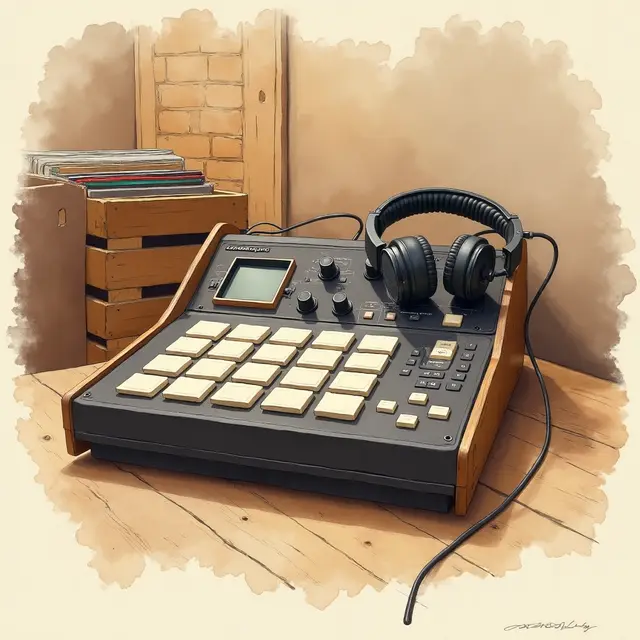
It’s three in the morning in a windowless room where the air smells like cold black coffee and the damp cardboard of record sleeves dug out from the bottom of a crate. The only light comes from the blue LCD of an MPC and the red power diode on the amplifier. You drop the needle on a 1974 jazz LP bought for three dollars; the surface crackle lasts two seconds before a muted trumpet cuts through, and that static alone carries more weight than a speech. You chop the sample, pitch it down three semitones, and lock it to the grid.
The snare has zero reverb: it’s a dry, brutal smack of wood against skin that lands straight in your sternum. Beneath it, there is no thin vintage kick, but a modern sub-bass pushing eighty hertz, rattling the empty aluminum cans on the desk and vibrating through the soles of your shoes. Your headphones rest around your neck, transmitting the low end directly into your collarbones. Your lips don't move, but inside your head the rhyme scheme has already snapped into place on the third beat, binding internal assonance to the click of the snare.
There is no room here for decoration or haste. This music doesn't ask you to jump or smile: it forces a slow, heavy nod of the head, eyes half-closed, recognizing the quiet authority of pure craftsmanship in the dark.
Palette: vinyl black / warm wood / pads cream
- BPM
- 90 BPM
- Family
- Asphalt and Diamonds
- Serial
- ASF-09
- Rarity
- Common
- Style strength
- 88
- Experimentation
- 26
Typical structure
[Scratch Intro] → [Verse] → [Hook] → [Verse 2] → [Hook] → [Verse 3] → [Outro]
The specifications above are just the visible frame. What stays hidden are the specific craft challenges of the genre: maintaining intricate internal rhyme schemes without sounding like a technical exercise, and pairing a dusty sample with modern low-end weight without muddying the pocket. Those mechanics live inside our internal eight-parameter engine, which crosses your personal history with the genre's strict code. Once drafted, an internal judge measures the verse against six dimensions of the canon and orders rewrites on anything that lacks gravity. The samples are easy to find. The authority of the bar is not.
How a lyric in this style thinks
A lyric in modern boom bap does one thing above everything else: it makes the listener feel the weight of time spent. Not time wasted, not time celebrated — time invested, brick by brick, in something that will last. The genre earns its density from that premise. Every bar arrives with the expectation that it carries something real, something that took longer to live than it took to write. When the hook lands at ninety beats per minute over a dry snare and a pitched-down jazz loop, the listener is not being invited to dance. They are being asked to nod slowly and recognize the truth of what just hit them.
The emotional register sits low and warm, like the amber glow off a lamp in a back room at two in the morning. Modern boom bap does not announce its feelings — it buries them in the middle of a compound sentence, inside an internal rhyme that only reveals itself on the second listen. Emotion arrives through accumulation rather than confession. You do not say you are proud of your father; you describe the cracked knuckles, the lunch pail left by the door, the thirty years of punching in without complaint. The image does the emotional work. Sentimentality is a structural weakness in this genre — the lyric trusts the listener to feel without being told what to feel.
Rhythm in modern boom bap is architectural. Lines run long, often extending past the obvious landing point, because the meaning is in the overflow. Internal assonance locks syllables together mid-bar — the rhyme scheme does not wait for the end of the line to resolve. Multisyllabic rhymes stack across beats, binding to the snare's smack on the two and four with a precision that sounds casual but is anything but. Repetition is used sparingly and deliberately: when a phrase returns, it has earned its return.
The hook in this genre is not a chorus built for maximum surface area — it is a single idea, stated with authority, that the verses have been building toward. Three to four bars of concentrated clarity, nothing more.
The sensory field of modern boom bap is specific and non-negotiable. Crate-dug vinyl, cold coffee, concrete, sub-bass felt in the sternum rather than heard through speakers, the dry crack of an unprocessed snare — these are the textures the lyric inhabits. The genre lives in windowless rooms, shop floors, corner stores, early mornings before anyone else is awake. It does not live in bottle service, stadium light rigs, or synthetic shimmer. What it never uses is gloss.
No auto-tuned melodic runs in the hook, no synthetic reverb padding the snare, no lyrical shorthand borrowed from club rap. The production anchor — a dusty sample loop pitched into the low mid-range, a punchy kick pushing eighty hertz of sub, a snare with zero tail — demands that the words above it carry equal density.
Structurally, the genre gives you room to breathe and room to build. The scratch intro signals to any listener who knows the form that something considered is coming. Three full verses allow an argument to develop — each one should advance the narrative or deepen the perspective, not restate it. The outro is where the genre allows its only moment of quiet reflection, a place where the beat can thin out and the final image can sit in the air.
What separates a genuine modern boom bap lyric from a generic imitation is exactly that: the imitation rushes to the punchline, stacks references, and mistakes complexity for craft. The real thing is patient. It knows that the snare will land again in two seconds, and it is not afraid of the space before it does.
- VINYL AND SNARE
- GOLDEN BARS
Sample excerpt
4 AM on 5th Street, thermos full of black drip Grease under the nails, thirty winters on the same shift No megaphones, no cameras in the grease pit Just a wet stone sharpening the iron till the sparks hit Built this house out of pine boards and straight spine Never took a handout, never begged a punchline Let the clock tick, let the young men chase noise We measure timber by the grain, not the loud boys.
Hands full of calluses, pocket full of clean gold Doing heavy work that doesn't need to be sold Let the drums knock heavy on the wet street Every single brick laid down beneath my own feet.
Workshop note — Modern boom bap demands tight internal rhymes and dense, conversational cadence anchored firmly to the kick and snare. This verse relies on tactile, grounded imagery rather than flashy metaphors, establishing weight through detail before the hook locks into a steady cadence. The genre rejects empty flexes and synthetic rush, requiring every syllable to hit with deliberate, earned authority.
Sample excerpt written by MUSAI Song. Your lyrics are written from scratch, based on your story.
When to choose this style
Choose this card when a personal story is built on quiet labor, earned respect, and unyielding self-worth. It belongs to the father who spent thirty years on a shop floor without ever raising his voice, letting the work speak for itself. It fits the self-made story—the business or craft built brick by brick in silence, refusing shortcuts and glossy handouts. It works for honoring a mentor who taught you discipline over clout, or for brothers who survived hard years and measure loyalty in actions rather than cheap promises.
Do not choose it for a soft love letter, a quick apology, or lightweight nostalgia: modern boom bap carries too much density to play gentle. It is not built for manic party energy, instant social flexes, or sudden reconciliations. If your narrative demands high-bpm club adrenaline or synthetic shine, this is the wrong frame. If you want the heavy energy of a night in the club, the card is Trap Anthem.
Your story in this style
MUSAI Song writes original lyrics from your story, in the Modern Boom Bap style, and delivers the finished sung song, the ready-to-use style recipe, and an illustrated art plate with its numbered certificate, private by default; public only if its owner publishes it.
- Original lyrics written from your story
- A finished sung song, ready to play and share
- Art plate with a unique seal and a numbered certificate, private by default; public only if its owner publishes it
Frequently asked questions
What BPM is Modern Boom Bap?
Modern Boom Bap usually runs at 90 BPM.
What does Modern Boom Bap sound like?
Vinyl, dry snare, and golden bars. Modern boom bap honors the old school with today's low end.
What song structure does Modern Boom Bap use?
[Scratch Intro] → [Verse] → [Hook] → [Verse 2] → [Hook] → [Verse 3] → [Outro]
How do I write Modern Boom Bap lyrics?
Tell MUSAI Song your story and pick Modern Boom Bap: it writes original lyrics for this style at 90 BPM, you edit them word by word, and you get the song sung in Modern Boom Bap, with an illustration of the song and its numbered certificate. $19 USD per song, one-time payment.
Explore more styles
- 90s R&B Revival
- Alt-R&B
- Atlanta Dirty South
- Bedroom Emo Rap
- Candlelight Slow Jam
- Crunk Revival
- Detroit Rap
- Drumless Rap
- G-Funk Revival
- Gospel Trap
- Hip-Hop Love Song
- Icy Drill
- Incense Neo-Soul
- Introspective Hip-Hop
- Jersey Club Rap
- Lo-Fi Cloud Rap
- Melodic Trap
- Memphis Phonk
- Memphis Rap
- Modern R&B
- New Orleans Bounce
- NY Drill
- Pluggnb
- R&B Empowerment
Your idea or story, sung in this style
Card · secure payment via Stripe, charged in USD
If it doesn't move you, we give you your money back · 7 days