Icy Drill
Ice in the veins, slide in the bass.
Get your song in Icy Drill
Make yours in this styleHear it before you pay.$19 USD · your first song for $5.50 USDIf it doesn't move you, we give you your money back · 7 days.
Icy Drill is a style from the Asphalt and Diamonds family. 142 BPM, Experimentation 32, Style strength 87.
What is Icy Drill?
Bass that slides like black ice. Drill doesn't raise its voice — it drops the temperature.
How it sounds
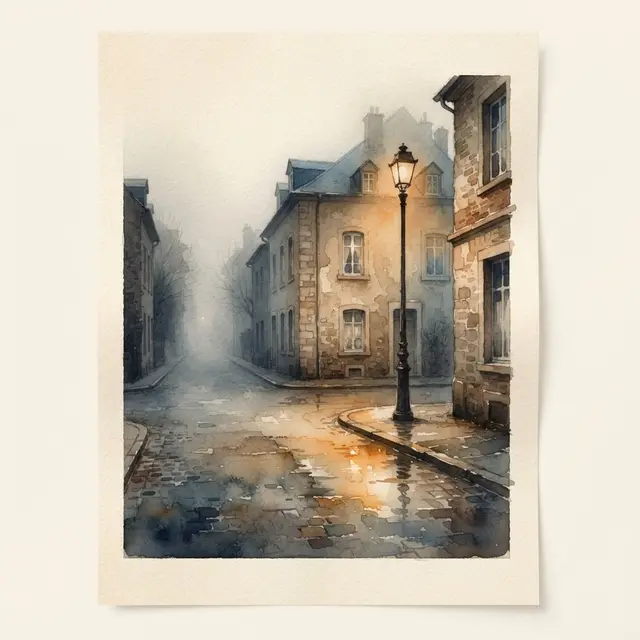
It is half past three in the morning on a corner where the asphalt gleams like an oil slick. There is no wind, only the thick plume of breath leaving your mouth and the steady flicker of a sodium streetlight washing everything in dirty amber. Six blocks away, an emergency siren rounds a corner, but the sound dies out among the precast concrete blocks. The 808 begins to slide beneath the floorboards: not a sharp punch, but a low-end mass dropping in pitch slowly, stretching out like black ice underfoot.
The hi-hats fall with surgical precision, staying just ahead of the grid, marking a mathematical time signature that forgives nothing. Right down the middle of the mix, the voice enters with zero room for pity. No vibrato, no vocal lifts begging for approval. Just a dry inventory of facts, a list of coordinates and hard objects where every syllable carries its exact weight. Your hood is up, hands buried deep inside your pockets, brushing against the edge of a key and a banknote folded in fours. Nobody yells. Nobody throws their hands around.
The cold creeps up your shins and settles in your chest like an old certainty. There is no redemption waiting at the end of the track, only the relentless accuracy of someone who already learned never to look back.
Palette: fog gray / cold blue / streetlight warm amber
- BPM
- 142 BPM
- Family
- Asphalt and Diamonds
- Serial
- ASF-03
- Rarity
- Rare
- Style strength
- 87
- Experimentation
- 32
Typical structure
[Intro] → [Verse] → [Hook] → [Verse 2] → [Hook] → [Outro]
The visible parameters are just the surface of the mix. What remains hidden is the exact calculation of how many concrete objects to pack into a single bar before tension breaks, or how to maintain a flat delivery without sounding monotone. That control lives inside an unpublished internal distillate of eight parameters that the engine cross-references with your story before assembling the first syllable. When it finishes, an internal judge measures the lyrics against six dimensions of the canon and forces a rewrite on anything falling short. The beat can be found anywhere. The millimeter-level coldness, cannot.
How a lyric in this style thinks
A drill lyric does not confess and does not plead. It documents. Where other genres reach for the listener's sympathy, drill delivers a cold inventory — coordinates, objects, conditions — and trusts the weight of those facts to do all the emotional work. The genre operates at roughly 142 BPM, but that tempo never feels rushed; the sliding 808 bass stretches beneath every bar like black ice, pulling time slightly downward, and the icy hi-hats land just ahead of the grid with a precision that sounds almost punitive. The voice enters dry, no vibrato, no upward inflection hunting for approval. Drill announces, and then it waits for you to catch up.
The emotional temperature in drill is never warm. The palette runs from fog gray to cold blue, occasionally lit by the amber of a sodium streetlight, but that amber is never comfort — it is surveillance. Emotion arrives not through declaration but through accumulation. You stack hard objects: a key, a folded banknote, a siren dying six blocks away. You name streets not to invoke nostalgia but to mark territory. The feeling builds in the reader's chest because the lyric refuses to name it, and that refusal is the entire technique. If you write a drill lyric and find yourself explaining why something hurts, you have already left the genre.
Line length in drill tends toward the dense and unbroken. Internal rhyme carries more weight than end rhyme, and multisyllabic chains — three or four syllables locking against each other mid-bar — create a kind of forward pressure that end-stopped lines alone cannot achieve. The flow is aggressive but controlled, closer to mathematical accounting than to freestyle improvisation. Repetition in the hook is minimal and functional: a phrase returns not for emotional reinforcement but because it is a fact worth logging twice. The hook in drill does not open up melodically; it compresses. It is a hard boundary stated once, restated, and then the verse resumes its inventory.
The sensory field drill works inside is strictly urban and strictly cold. Precast concrete, oil-slick asphalt, the low flicker of failing streetlights, the thick plume of breath at three in the morning — these are the textures the genre lives in. Drill never reaches for pastoral images, domestic warmth, or metaphors borrowed from nature unless that nature is hostile: black ice, dead air, the specific silence after a siren fades.
The ominous bell melody that sits in the upper register of the production is not decorative; it functions like a clock, marking duration without sentiment. What drill never uses is artificial heat. Forced warmth sounds like a costume on this beat, and listeners who know the genre will clock it immediately.
Structurally, drill follows a clean arc: intro, verse, hook, second verse, hook, outro. The outro does not resolve. It stops. There is no earned warmth waiting at the end of the track, no redemption cue in the production. The bass slide simply continues until the track cuts, and the silence that follows carries the same temperature as everything before it. What separates a real drill lyric from a generic imitation is that discipline at the end — the refusal to soften, to summarise, to offer the listener an exit. The genre chronicles.
It maps where you came from without asking you to feel anything in particular about the route. It draws the hard boundary, logs the impact, and moves on. That restraint is not coldness for its own sake. It is the specific authority of someone who already learned never to explain themselves twice.
- BASS SLIDE
- URBAN COLD
Sample excerpt
Three A.M. on the transit line, breath frosting the glass. I watch the amber streetlight flicker over the wet asphalt. Two jackets deep, pockets heavy with the things I don't say. The turnstile clicked twice when they followed me through. Keep the blade hidden, eyes locked on the reflection in the window. No one asks for a reason when the shadows move this fast.
Deep blue pulses under the floorboards of this city. Cold air, sharp talk, silence is the only currency left. We count the exits, we never check the rearview mirror.
Workshop note — Drill relies on a staccato rhythm where every syllable lands like a stone dropped into a dark well. The verse stays grounded in specific, low-stakes physical movements to build tension, while the chorus acts as a cold, rhythmic anchor rather than an emotional release. Avoid metaphors and long-winded explanations; in this style, if it cannot be observed on the street, it does not exist.
Sample excerpt written by MUSAI Song. Your lyrics are written from scratch, based on your story.
When to choose this style
Choose this track when your personal narrative demands strict chronicling rather than confession. It works to map out where you came from without asking for sympathy, to draw a hard boundary no one crosses twice, or to outline a betrayal processed entirely in silence without wasting breath on arguments. It fits when a hard-fought achievement left no room for celebration, only the quiet verification that you are still standing.
Use it to chart a hostile territory, a city built of worn street names, or an unspoken code where excess words are trimmed away. Do not pick this for family reunions, weddings, tearful tributes, or stories driven by warmth: drill rejects artificial heat and sounds like a costume when forced to be sweet. It also fails if you need to explain why an absence hurts, because this style does not comfort or judge—it simply logs the impact. If you are looking for emotional confession and warmth, the card is Modern Boom Bap.
Your story in this style
MUSAI Song writes original lyrics from your story, in the Icy Drill style, and delivers the finished sung song, the ready-to-use style recipe, and an illustrated art plate with its numbered certificate, private by default; public only if its owner publishes it.
- Original lyrics written from your story
- A finished sung song, ready to play and share
- Art plate with a unique seal and a numbered certificate, private by default; public only if its owner publishes it
Frequently asked questions
What BPM is Icy Drill?
Icy Drill usually runs at 142 BPM.
What does Icy Drill sound like?
Bass that slides like black ice. Drill doesn't raise its voice — it drops the temperature.
What song structure does Icy Drill use?
[Intro] → [Verse] → [Hook] → [Verse 2] → [Hook] → [Outro]
How do I write Icy Drill lyrics?
Tell MUSAI Song your story and pick Icy Drill: it writes original lyrics for this style at 142 BPM, you edit them word by word, and you get the song sung in Icy Drill, with an illustration of the song and its numbered certificate. $19 USD per song, one-time payment.
Explore more styles
- 90s R&B Revival
- Alt-R&B
- Atlanta Dirty South
- Bedroom Emo Rap
- Candlelight Slow Jam
- Crunk Revival
- Detroit Rap
- Drumless Rap
- G-Funk Revival
- Gospel Trap
- Hip-Hop Love Song
- Incense Neo-Soul
- Introspective Hip-Hop
- Jersey Club Rap
- Lo-Fi Cloud Rap
- Melodic Trap
- Memphis Phonk
- Memphis Rap
- Modern Boom Bap
- Modern R&B
- New Orleans Bounce
- NY Drill
- Pluggnb
- R&B Empowerment
Your idea or story, sung in this style
Card · secure payment via Stripe, charged in USD
If it doesn't move you, we give you your money back · 7 days