Memphis Phonk
The cowbell has entered its villain era.
Get your song in Memphis Phonk
Make yours in this styleHear it before you pay.$19 USD · your first song for $5.50 USDIf it doesn't move you, we give you your money back · 7 days.
Memphis Phonk is a style from the Asphalt and Diamonds family. 134 BPM, Experimentation 54, Style strength 82.
What is Memphis Phonk?
Ghost cowbell and dark Memphis tapes: phonk drives at night with the headlights off.
How it sounds
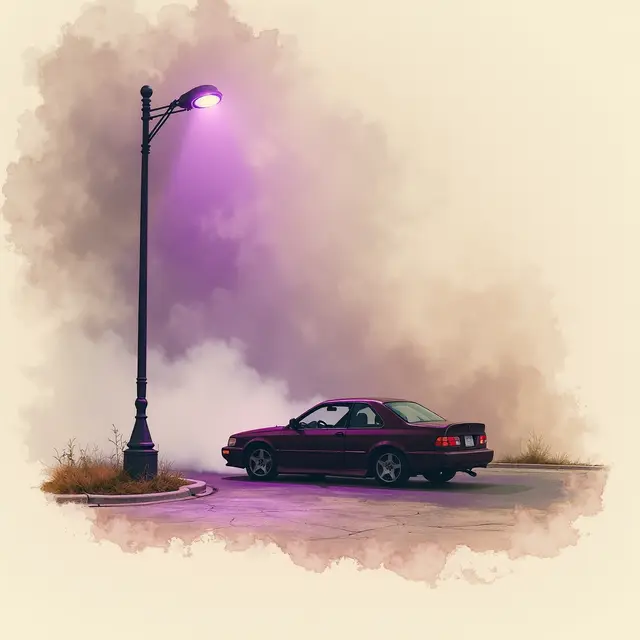
It is half past three in the morning on an unlit bypass where sodium-vapor fixtures cast a harsh violet glare over worn asphalt. There is no traffic. The only sound is the low, steady drone of a six-cylinder engine vibrating hard against the floorboard. You have the windows cracked an inch, letting in a thick odor of hot rubber and damp cold.
The tape in the dashboard deck has been looping for thirty years, a cassette recorded in a nameless basement featuring vocal samples buried beneath layers of magnetic hiss and frequencies dragging just above the floorboards. Suddenly, the phantom cowbell cuts through the mix. It is not an instrument keeping time; it is a metallic, bone-dry strike bouncing off the door panels as if someone were hitting the chassis from the inside with a crowbar. The headlights sweep across a blind curve before the tires even begin to turn.
The steering wheel grows heavy in your palms. The tachometer needle creeps higher, brushing the redline without anyone lifting a foot. The night swallows the windshield and the air smells like an impact you are trying to outrun. Outside this metal box, the rest of the world stops existing, replaced by the relentless drive of a distorted sub-bass that pushes you back into the seat and leaves your thoughts hanging in the cabin like white exhaust against dark sheet metal.
Palette: intense violet / dark garnet / black / grayish white smoke
- BPM
- 134 BPM
- Family
- Asphalt and Diamonds
- Serial
- ASF-14
- Rarity
- Rare
- Style strength
- 82
- Experimentation
- 54
Typical structure
[Intro] → [Verse] → [Cowbell drop] → [Verse 2] → [Drop] → [Drift Outro]
The metadata above can be copied in a minute. What cannot be copied is the hidden rigor: how to weigh a lo-fi Memphis sample so it never swallows the vocal, and the exact millisecond where the cowbell must strike so the hit punches the chest without breaking the sub-bass groove. All of that sits in an unpublished eight-parameter distillate that the motor crosses with your raw history before writing a single line. When it finishes, an internal judge measures the lyrics against six canonical dimensions and sends back anything that misses the mark for repairs. The cassette is bought. The vibration, not.
How a lyric in this style thinks
A phonk lyric does not confess. It observes, announces, and then locks the door. Where other genres invite the listener into an emotional interior, phonk places them outside, watching through glass streaked with exhaust and condensation. The words arrive flat and certain, delivered as statements of fact about a world where sentiment is a liability and the engine never idles. This is the genre's first law: no explanation is owed. The narrator left, the decision was made, and the night absorbed everything else.
The emotional architecture of phonk sits in a narrow register — not cold exactly, but mechanically controlled. Intensity arrives through repetition and density, not through melodic uplift or lyrical vulnerability. Lines are short and declarative, often falling just below the beat's natural stress point so they feel slightly dragged, slightly late, as if the words themselves are being pulled back by the sub-bass underneath them. This rhythmic drag is not sloppiness; it is precision.
The cowbell drop — that bone-dry metallic strike that defines the genre's structural hinge — is the moment where the lyric should say the least. Let the percussion carry the weight. One clipped phrase, maybe two syllables, lands harder than a full line ever could at that moment.
The sensory field phonk inhabits is specific and non-negotiable. Worn asphalt, sodium-vapor light, vinyl crackle, the smell of hot rubber, a cassette that has been looping since a decade you cannot name. These are the genre's native textures. Concrete nouns work; abstraction does not. The lyric should never reach for warmth or natural imagery — no open fields, no morning light, no childhood touchstones. What it can use: bypass roads, dashboard glow, magnetic hiss, tachometers, the specific weight of a steering wheel at speed. Vocal samples, when referenced in lyrics, function as memory fragments rather than quotation — half-heard, degraded, impossible to fully verify.
Structurally, phonk follows a logic of accumulation and release. The intro establishes the loop and the atmosphere before any human voice enters; the first verse lays the situation without editorializing. The cowbell drop is not a chorus — it is a rupture, a moment where the production overrides the lyric and the words step back. Verse two can push further into detail or compress further into silence.
The drop that follows is the genre's emotional peak, but it is a physical peak, not an emotional one: the bass distortion intensifies, the pacing locks tighter, and the lyric, if it speaks at all, speaks in fragments. The drift outro lets the loop decay, the vocal samples sink back into the hiss, and the narrative ends not with resolution but with distance — the car still moving, the destination irrelevant.
What separates a genuine phonk lyric from a generic imitation is restraint in the face of pressure to over-explain. The temptation is to narrate the backstory, to justify the departure, to soften the mechanical coldness with context. Resist it. Phonk earns its authority by treating the listener as someone who already understands — who has also driven at 3 a.m. on an unlit bypass with the windows cracked an inch and the decision already made. The lyric does not explain why you never called back. It only confirms that you did not, and that the tachometer kept climbing regardless.
- GHOST COWBELL
- DARK MEMPHIS
Sample excerpt
Ink black shadow on the interstate line. Left the keys on the counter, took what was mine. No text, no call, just a cold exhaust pipe. Violet dashboard glowing in the dead of the night. Tires bite concrete, cutting through the haze. Three hundred miles in a mechanical daze.
Headlights off, shifting gears in the shade. Watch the whole town fade. Headlights off, shifting gears in the shade. Watch the whole town fade.
Workshop note — Phonk demands short, percussive lines designed to ride the heavy drift beat rather than tell a complex story. Notice how the chorus relies on hypnotic, looped repetition instead of melodic variation, mimicking the mechanical drone of a midnight drive. The genre strictly forbids emotional warmth, requiring cold, concrete actions and a detached, rhythmic delivery.
Sample excerpt written by MUSAI Song. Your lyrics are written from scratch, based on your story.
When to choose this style
Choose this track when the story is about a moment when running away was the only sane response. It works for telling the night you decided never to call someone back, for a quiet victory celebrated alone behind the wheel on an empty highway, or for that friend who packed up and left town without saying goodbye. It serves to record a silent loyalty between people who grew up tough and no longer trade promises. It fits a long night drive where the landscape blurs past and the mind finally dumps all unnecessary static.
Do not choose it for a family reconciliation, a wedding, or a sorrow that requires tears and warm comfort. Phonk holds no sweet tones and offers no bright resolutions. It fails for nostalgic memories filled with sunlight or childhood afternoons in a backyard. If your historia demands tenderness, an embrace, or an honest conversation, this card will fail because its tone is mechanical and distant. If you are after a narrative where the emotion softens with time, the card is Cloud Rap.
Your story in this style
MUSAI Song writes original lyrics from your story, in the Memphis Phonk style, and delivers the finished sung song, the ready-to-use style recipe, and an illustrated art plate with its numbered certificate, private by default; public only if its owner publishes it.
- Original lyrics written from your story
- A finished sung song, ready to play and share
- Art plate with a unique seal and a numbered certificate, private by default; public only if its owner publishes it
Frequently asked questions
What BPM is Memphis Phonk?
Memphis Phonk usually runs at 134 BPM.
What does Memphis Phonk sound like?
Ghost cowbell and dark Memphis tapes: phonk drives at night with the headlights off.
What song structure does Memphis Phonk use?
[Intro] → [Verse] → [Cowbell drop] → [Verse 2] → [Drop] → [Drift Outro]
How do I write Memphis Phonk lyrics?
Tell MUSAI Song your story and pick Memphis Phonk: it writes original lyrics for this style at 134 BPM, you edit them word by word, and you get the song sung in Memphis Phonk, with an illustration of the song and its numbered certificate. $19 USD per song, one-time payment.
Explore more styles
- 90s R&B Revival
- Alt-R&B
- Atlanta Dirty South
- Bedroom Emo Rap
- Candlelight Slow Jam
- Crunk Revival
- Detroit Rap
- Drumless Rap
- G-Funk Revival
- Gospel Trap
- Hip-Hop Love Song
- Icy Drill
- Incense Neo-Soul
- Introspective Hip-Hop
- Jersey Club Rap
- Lo-Fi Cloud Rap
- Melodic Trap
- Memphis Rap
- Modern Boom Bap
- Modern R&B
- New Orleans Bounce
- NY Drill
- Pluggnb
- R&B Empowerment
Your idea or story, sung in this style
Card · secure payment via Stripe, charged in USD
If it doesn't move you, we give you your money back · 7 days