Crunk Revival
Volume knob found dead — crunk suspected.
Get your song in Crunk Revival
Make yours in this styleHear it before you pay.$19 USD · your first song for $5.50 USDIf it doesn't move you, we give you your money back · 7 days.
Crunk Revival is a style from the Asphalt and Diamonds family. 148 BPM, Experimentation 38, Style strength 83.
What is Crunk Revival?
Battle cry with synths in the red: crunk, a high-energy Southern rap style, doesn't show up to the party — it takes it hostage.
How it sounds
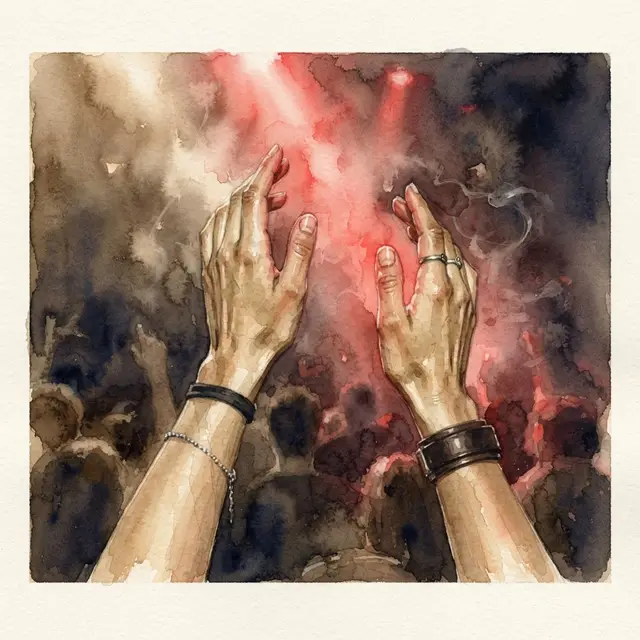
It’s three in the morning and the venue has no windows. Condensation drips from the ceiling, landing heavy on your forehead. The air smells of spilled draft beer, sweat, and cold machine fog. You are pinned in the center of a mosh pit that expands and contracts like a panicked lung. There are no white lights here: only red flashes carving up the dark so fast that the bodies around you move in violent, stop-motion snaps.
The 808 sub doesn’t hit your ears; it punches straight through the soles of your sneakers, climbs your shins, and rattles your ribcage with a dry thud that leaves no room for air. Over the top, a sharp, detuned sawtooth synth stabs through the room on every fourth beat, sounding like a factory alarm going off inside a war zone. Then the voice comes in. It’s not singing; it’s a command barked into a red-lined microphone—a raw, guttural battle cry that tears through the throat right before the entire room roars it back in unison.
The wave pushes you forward. You hit shoulders with a stranger, their silver chain catching the flash for a split second, while the collective weight of a thousand people stomping makes the floorboards groan.
Then comes a single second of absolute dead silence—a brutal pause where the drum machine holds its breath and your mouth goes dry. And then the drop lands again, heavier than before, demanding every last drop of oxygen you have left.
Palette: intense red / dark black / bracelet silver
- BPM
- 148 BPM
- Family
- Asphalt and Diamonds
- Serial
- ASF-18
- Rarity
- Common
- Style strength
- 83
- Experimentation
- 38
Typical structure
[Intro shout] → [Verse] → [Shouted hook] → [Verse 2] → [Hook] → [Breakdown] → [Final hook]
The specs above are just the surface of the recipe. What isn't listed is spatial control: writing three-word chants so the crowd can scream them back without running out of breath, and calibrating synth stabs so the aggression feels like a shared victory rather than pure chaos. That lives inside an internal profile of eight parameters that the engine matches against your story. Once finished, an internal judge evaluates the lyrics across six dimensions of the canon and sends back anything that falters. Anyone can set a clock to 148 BPM. Building a riot, you can't copy.
How a lyric in this style thinks
A Crunk Revival lyric doesn't tell a story — it detonates one. The words arrive as commands, declarations, and war cries, stripped of subordinate clauses and interior reflection. Where other genres coax emotion from a listener, crunk revival extracts it by force: the crowd doesn't feel the lyric so much as they are conscripted by it. The genre operates on collective identity above all else. Every line is written for a room full of people who already know why they're angry, already know what they survived, and just need the exact moment to release it. Your job as a lyricist is to hand them the match.
The base tone sits at the intersection of triumph and aggression — not the clean triumph of a victory lap, but the raw, adrenaline-soaked kind that comes from outlasting something that tried to break you. Emotion doesn't build gradually in crunk revival; it arrives at full pressure from the first syllable and never retreats. Vulnerability is not absent from the genre, but it has been calcified into defiance.
Whatever pain existed before the night of the song has been converted into fuel, and the lyric's entire architecture exists to burn that fuel in public, with witnesses. The red-hot energy the genre demands is not performed excitement — it's the genuine physiological state of someone who has been holding something back for a very long time and has finally decided not to.
Line length in crunk revival is short and percussive, built to land on the kick and the 808 sub rather than float above them. Syllables are weapons, not ornaments. Repetition is structural, not lazy: the shouted hook exists to be learned in real time by people who have never heard the song before, which means it must be simple enough to absorb in two bars and visceral enough to demand immediate participation. The call-and-response logic embedded in the canon structure — intro shout into verse into shouted hook — is not a formality.
It is a rehearsal. By the time the final hook arrives, the room already owns the words, and the lyric's job is simply to remind them of that ownership at maximum volume. Internal rhyme and hard consonants do the heavy lifting; soft vowel sounds and sibilance belong to a different genre entirely.
The sensory world of a crunk revival lyric is concrete and physical: the floor underfoot, the fog machine, the silver chain catching a red strobe, the 808 climbing through the soles of your shoes. Detuned sawtooth synths and factory-alarm stabs are not background texture — they are characters in the lyric's world, and the writing should acknowledge that sonic violence rather than ignore it. What the genre never uses: pastoral imagery, metaphors of light and warmth, anything that evokes stillness or domesticity.
The lyric lives in closed rooms, in collective bodies, in the single brutal second of silence before the drop returns heavier than before. That pause — the drum machine holding its breath — is perhaps the most important structural moment in any crunk revival track, and the lyric written around it must earn the silence by making what comes after feel inevitable.
What separates a genuine crunk revival lyric from a generic imitation is specificity of grievance and specificity of victory. A crowd can roar along with vague aggression for about thirty seconds before it feels hollow. The real lyric names something — a dead-end routine, a brutal year, a score that needed settling — concretely enough that the listener can project their own version onto it.
The breakdown section exists precisely for this: a moment of rhythmic reduction where the lyric can land a harder, more specific blow before the final hook reclaims the room. Write the breakdown like a verdict, not a reflection. Crunk revival doesn't whisper its conclusions. It stamps them into the floorboards and makes them groan.
- BATTLE CRY
- RED-HOT ENERGY
Sample excerpt
Third shift ended, punch the clock out Concrete parking lot, hear the bass shout Gold teeth gleam under amber street lights We ain't waiting round for better nights Drop the tailgate, turn the volume max No more running on the beaten tracks
Red light flashing, bass hit hard We own the asphalt, we own the yard Jump in the circle, tear it apart That's how you launch a brand new start
Workshop note — This sample uses aggressive, short punchlines and explosive rhyming pairs to maintain the heavy 148 BPM momentum. The lyrics avoid abstract emotional filler, focusing instead on physical actions and harsh concrete settings that match the red-hot energy of the genre.
Sample excerpt written by MUSAI Song. Your lyrics are written from scratch, based on your story.
When to choose this style
Pick this card when your story isn't looking to heal or reflect, but to blow the doors off everything you’ve been holding back. Choose this style when you or your crew finally crossed the finish line after months of grinding, and the only acceptable celebration is tearing the night apart. It works for that collective win against all odds, for settling the score with a brutal year, or for the exact moment you decided to burn down a dead-end routine. This is the anthem for the pack, for the wild reunion, for turning heavy impact into pure, explosive counter-strike energy.
Do not pick it if your story requires nuance, quiet vulnerability, or a soft reconciliation. Crunk revival doesn't know how to whisper or guide a nostalgic farewell; forcing it onto a warm family tribute or a quiet period of grief will only result in meaningless noise. If you want street storytelling with narrative weight and room to breathe without the screaming, the card is Modern Boom Bap.
Your story in this style
MUSAI Song writes original lyrics from your story, in the Crunk Revival style, and delivers the finished sung song, the ready-to-use style recipe, and an illustrated art plate with its numbered certificate, private by default; public only if its owner publishes it.
- Original lyrics written from your story
- A finished sung song, ready to play and share
- Art plate with a unique seal and a numbered certificate, private by default; public only if its owner publishes it
Frequently asked questions
What BPM is Crunk Revival?
Crunk Revival usually runs at 148 BPM.
What does Crunk Revival sound like?
Battle cry with synths in the red: crunk, a high-energy Southern rap style, doesn't show up to the party — it takes it hostage.
What song structure does Crunk Revival use?
[Intro shout] → [Verse] → [Shouted hook] → [Verse 2] → [Hook] → [Breakdown] → [Final hook]
How do I write Crunk Revival lyrics?
Tell MUSAI Song your story and pick Crunk Revival: it writes original lyrics for this style at 148 BPM, you edit them word by word, and you get the song sung in Crunk Revival, with an illustration of the song and its numbered certificate. $19 USD per song, one-time payment.
Explore more styles
- 90s R&B Revival
- Alt-R&B
- Atlanta Dirty South
- Bedroom Emo Rap
- Candlelight Slow Jam
- Detroit Rap
- Drumless Rap
- G-Funk Revival
- Gospel Trap
- Hip-Hop Love Song
- Icy Drill
- Incense Neo-Soul
- Introspective Hip-Hop
- Jersey Club Rap
- Lo-Fi Cloud Rap
- Melodic Trap
- Memphis Phonk
- Memphis Rap
- Modern Boom Bap
- Modern R&B
- New Orleans Bounce
- NY Drill
- Pluggnb
- R&B Empowerment
Your idea or story, sung in this style
Card · secure payment via Stripe, charged in USD
If it doesn't move you, we give you your money back · 7 days