Hip-Hop Love Song
Romeo upgraded the balcony scene with a beat.
Get your song in Hip-Hop Love Song
Make yours in this styleHear it before you pay.$19 USD · your first song for $5.50 USDIf it doesn't move you, we give you your money back · 7 days.
Hip-Hop Love Song is a style from the Asphalt and Diamonds family. 92 BPM, Experimentation 22, Style strength 87.
What is Hip-Hop Love Song?
Bars straight to the heart with a honey-sweet chorus: the neighborhood serenade rhymes too.
How it sounds
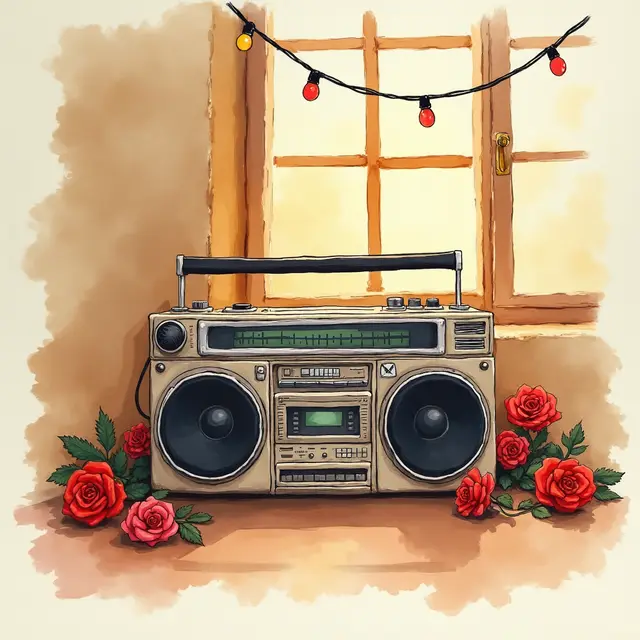
It is half past eleven on a Tuesday on the third-floor fire escape, right as the traffic on the main avenue thins out enough to let you hear the hum of bodega refrigerators down below. The asphalt still holds the heavy heat of the afternoon, and the air smells like damp concrete and fresh bread venting from the corner bakery. You are leaning against the rusted iron railing, the one with chipped paint on the third bar, holding a cracked cassette shell because you refuse to trust screens with this.
On the concrete floor between your feet, a dual-speaker boombox pushes a dry ninety-two BPM kick drum, a dusty upright bass loop that scratches with every revolution, and a chorus-drenched guitar floating like warm oil over a puddle. No cinematic special effects or staged backdrops here: just a bare yellow bulb hanging from a frayed cord and the silhouette of your worn leather jacket cut against the brick wall across the alley. Someone leans out of an inner courtyard window and snuffs out a cigarette in a tin ashtray.
The low end vibrates right through the soles of your sneakers, traveling up your calves to remind you exactly where you stand and who you are about to address without a script.
Palette: warm amber / roses pink red / speakers black / foliage green
- BPM
- 92 BPM
- Family
- Asphalt and Diamonds
- Serial
- ASF-25
- Rarity
- Common
- Style strength
- 87
- Experimentation
- 22
Typical structure
[Intro] → [Rap verse] → [Sung chorus] → [Rap verse 2] → [Chorus] → [Duet bridge] → [Final chorus]
The table data is just the surface finish. Beneath it lie two core songwriting hurdles: how to keep the swagger in your verses without sounding defensive in front of the person you love, and how to make a soulful sung chorus sit right on top of gritty street percussion. That lives inside an unpublished internal distillate of eight parameters, and the engine cross-references all of it with your specific story. When the draft finishes, an internal judge grades the lyrics against six canon dimensions and sends back anything that rings false. The beat is easy to find. The precise friction between concrete and honey is not.
How a lyric in this style thinks
A hip-hop love song does not describe affection — it delivers it as evidence. The lyric builds a case, line by line, the way someone might pull receipts from a jacket pocket: the exact Tuesday, the specific fire escape, the boombox with the scratched bass loop. This genre earns its emotional weight by refusing abstraction. When the rap verse lands, it is not saying "I love you" in general; it is saying here is what I noticed about you at the bus stop three years ago, and here is what I still notice now, and those two observations are the proof. The hip-hop love song works because it treats devotion as something you can document, not just feel.
The base tone sits at a controlled 92 BPM — unhurried enough to let syllables breathe, tight enough to keep the narrative moving forward. The kick is dry and close, the bass loop slightly dusty, the kind of warmth that comes from a sample that has already lived a life before you found it. Over that, a chorus-drenched guitar floats just above the low end like heat rising off blacktop. Emotionally, the genre operates in amber registers: warm but not saccharine, honest without veering into confession-booth vulnerability. The hardness of the street production is what gives the tenderness permission to exist. Without the concrete underneath, the honey collapses.
In the rap verses, line length tends to be medium-to-long, packed but not breathless. The rhythm follows conversational cadence with deliberate internal rhymes rather than end-rhyme chains that would feel too tidy for the subject matter. Repetition is used sparingly in the verses and heavily in the chorus — the sung hook lands the same phrase two or three times because that is how the body processes what the mind keeps circling.
The duet bridge is where the lyric stops arguing and simply stands still: two voices, close intervals, the kind of harmony that sounds like two people who have been in the same small apartment long enough to finish each other's sentences. Structurally, the sections fall where they do because the song is mimicking a real conversation — the verse makes its point, the chorus confirms the feeling, and the bridge is the moment when neither person is performing anymore.
The sensory field is specific and urban and tactile. Chipped paint on an iron railing. The hum of a bodega refrigerator. Damp concrete and bread from a corner bakery vent. These are not decorative details; they are the coordinates that prove this story happened to real people in a real place. The hip-hop love song never reaches for vague natural imagery — no open fields, no starlit horizons. It stays on the block, inside the building, on the fire escape.
The worn leather jacket is more romantic here than any formal wear, because it carries history in its creases. What the genre never uses: pristine settings, generic milestone language, or metaphors that could appear in a greeting card without alteration.
What separates a real hip-hop love song from a generic imitation is shared history encoded as inside language. A lyric that could apply to anyone applies to no one. The genre demands specificity that functions as a private signal — a detail only one other person would recognize as theirs. If a listener who was not in that relationship could claim the lyric as their own story without changing a word, the lyric has not done its job.
The vocal delivery in the rap sections should feel like speaking directly to one person in a room, not performing for a crowd. The sung chorus then opens outward, universal enough to resonate, but anchored by everything the verses already established. That tension — between the intimate and the communal, between the bar and the hook — is where the genre actually lives.
- BARS TO THE HEART
- STREET AND HONEY DUET
Sample excerpt
Kitchen linoleum still has the coffee stain from the Tuesday we screamed over overdue bills again. You reached for your jacket, I gripped the door frame, both of us stubborn, too proud to name the real terror: losing the life we built in a third-floor box thick with winter guilt. I left my pride on the radiator grate, came back up before it got too late.
You are the heavy truce in a noisy war, the only key that fits my floor. When the city grinds us down to bone, with you here, I am not alone.
Workshop note — This verse anchors deep emotion in specific domestic objects like the linoleum stain and the radiator grate rather than vague sentiment. The rhythm stays conversational yet tight, letting a melodic chorus provide the honey-sweet contrast without ever softening into a greeting card cliché.
Sample excerpt written by MUSAI Song. Your lyrics are written from scratch, based on your story.
When to choose this style
Choose this card when you need to say something heavy to someone you love without sounding like a greeting card. It works for apologizing after a loud argument in a cramped kitchen. For reminding your long-term partner that rent hikes and exhaustion have not worn out what started at the bus stop. For celebrating an anniversary without expensive dinners, trading reservations for a tape played on the curb. For when your daily armor needs to drop its guard and admit that one specific person is your only real truce.
Do not pick this for brand-new flings or polite workplace milestones; street hip-hop requires shared history and inside codes. It also fails for pure heartbreak or spite, because asphalt hardness here always bends toward soulfulness. If you are looking for a gentle acoustic campfire ballad, the letter is Modern Boom Bap.
Your story in this style
MUSAI Song writes original lyrics from your story, in the Hip-Hop Love Song style, and delivers the finished sung song, the ready-to-use style recipe, and an illustrated art plate with its numbered certificate, private by default; public only if its owner publishes it.
- Original lyrics written from your story
- A finished sung song, ready to play and share
- Art plate with a unique seal and a numbered certificate, private by default; public only if its owner publishes it
Frequently asked questions
What BPM is Hip-Hop Love Song?
Hip-Hop Love Song usually runs at 92 BPM.
What does Hip-Hop Love Song sound like?
Bars straight to the heart with a honey-sweet chorus: the neighborhood serenade rhymes too.
What song structure does Hip-Hop Love Song use?
[Intro] → [Rap verse] → [Sung chorus] → [Rap verse 2] → [Chorus] → [Duet bridge] → [Final chorus]
How do I write Hip-Hop Love Song lyrics?
Tell MUSAI Song your story and pick Hip-Hop Love Song: it writes original lyrics for this style at 92 BPM, you edit them word by word, and you get the song sung in Hip-Hop Love Song, with an illustration of the song and its numbered certificate. $19 USD per song, one-time payment.
Explore more styles
- 90s R&B Revival
- Alt-R&B
- Atlanta Dirty South
- Bedroom Emo Rap
- Candlelight Slow Jam
- Crunk Revival
- Detroit Rap
- Drumless Rap
- G-Funk Revival
- Gospel Trap
- Icy Drill
- Incense Neo-Soul
- Introspective Hip-Hop
- Jersey Club Rap
- Lo-Fi Cloud Rap
- Melodic Trap
- Memphis Phonk
- Memphis Rap
- Modern Boom Bap
- Modern R&B
- New Orleans Bounce
- NY Drill
- Pluggnb
- R&B Empowerment
Your idea or story, sung in this style
Card · secure payment via Stripe, charged in USD
If it doesn't move you, we give you your money back · 7 days