Drumless Rap
No drums. No net. Just bars walking the tightrope.
Get your song in Drumless Rap
Make yours in this styleHear it before you pay.$19 USD · your first song for $5.50 USDIf it doesn't move you, we give you your money back · 7 days.
Drumless Rap is a style from the Asphalt and Diamonds family. 80 BPM.
What is Drumless Rap?
No drums, no safety net — just a bare loop and bars walking the tightrope.
How it sounds
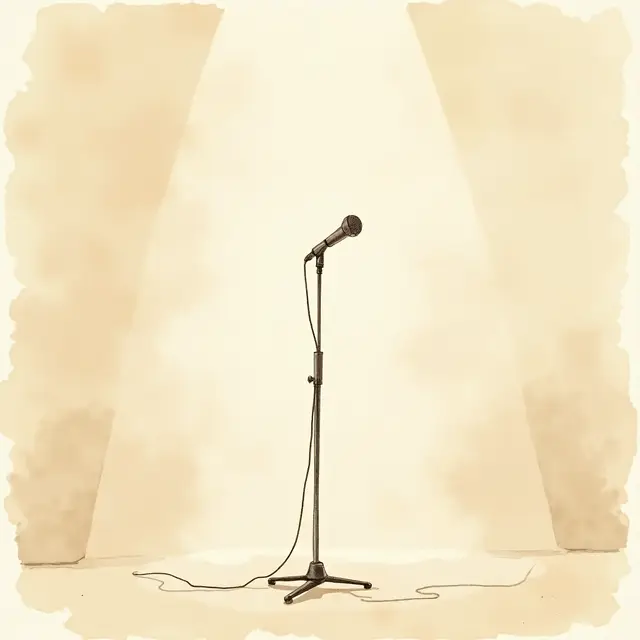
A single spotlight cuts through the dim air of the rehearsal room. The linoleum floor bears dry boot tracks, and a worn Shure SM7B rests on a heavy iron stand. There is no drum kit in the corner, no percussion hidden in the monitors. Only a soul sample from 1973 plays, chopped and looped on an MPC 2000XL sampler running endlessly. The virtual needle scrapes against magnetic tape with every cycle, releasing a muffled piano note and a horn chord that breathes like an old lung. You stand in the center, hands clasped, chin down.
Your voice enters clean, with no snare to mark the cadence and no kick drum to keep your pace. Every syllable hits the void with the weight of a stone dropped into a dry well. You must measure the distance between phrases using only instinct and the air left in your lungs. If you rush, the melody leaves you behind; if you hesitate, the absence of a beat exposes you like an actor forgetting a line under bright lights. The spotlight warms the microphone metal while dust floats suspended in the white beam.
Outside, steady rain wets the deserted asphalt, but inside there is only this bare loop, your breath counting invisible measures, and the physical realization that no rhythm section exists to break your fall if your phrasing falters.
Palette: dark sepia / charcoal gray / warm beige
- BPM
- 80 BPM
- Family
- Asphalt and Diamonds
- Serial
- ASF-28
- Rarity
- Legendary
Typical structure
[Loop Intro] → [Long verse] → [Breath] → [Verse 2] → [Breath] → [Final verse]
The loop frequency and eighty BPM tempo are merely the visible frame. What stays off this card are the invisible rules for holding tension without drum support: balancing blank space so the voice never crowds the sample, and resolving complex imagery before the loop resets. That judgment resides in an internal distillate of eight parameters that the engine crosses with your story details. Upon completion, an internal judge evaluates the text against six canon dimensions, mandating repairs if density drops. The loop can be copied. The gravity cannot.
How a lyric in this style thinks
A drumless rap lyric does not perform emotion — it exposes it. Without a kick drum to anchor cadence or a snare to mark the bar, every word lands in open air, and the listener hears exactly how much weight you are carrying or exactly how little you have left. The genre strips rap down to its oldest obligation: a voice accounting for something. That accounting can be a reckoning with years wasted, a quiet inventory of what a person left behind, or the slow reconstruction of a single decision made in a room no one else entered.
Whatever the subject, the lyric must justify its own existence syllable by syllable, because drumless rap offers no rhythmic shelter and no hook to catch a wandering listener's attention.
The emotional register sits in dark sepia and charcoal gray — not despair exactly, but the specific gravity of retrospect. Feeling arrives through accumulation rather than declaration. You do not write "I was broken"; you write the linoleum floor, the dry boot tracks, the dust floating in a white beam. Concrete objects carry the emotional charge that a snare hit would otherwise deliver. The sensory field of this genre is interior and worn: old fabric, fluorescent light, the smell of a room that has been closed too long, rain on deserted asphalt.
It never reaches for spectacle. There are no crowd sounds, no horns swelling for triumph, no imagery of open skies or wide horizons. The world of a drumless rap lyric is close, specific, and slightly airless.
Line length and rhythm behave differently here than in any other rap form. Because there is no percussion marking the grid, the writer controls perceived tempo entirely through phrase weight and breath placement. Long, dense lines that push against the loop's cycle create pressure; a short, three-syllable line dropped into that pressure creates a silence louder than any snare crack.
The structure — a loop intro, two or three long verses separated by deliberate breath pauses, and a final verse that does not resolve so much as arrive — reflects this pacing logic. The breath sections are not interludes; they are structural beats, the equivalent of a rest in a musical score. Writing them means knowing exactly where the voice needs to stop so the loop can breathe alone for a moment before the next confession begins.
The sample underneath is typically a soul loop from the early 1970s, chopped and played back on hardware that leaves the texture of magnetic tape audible — a muffled piano note, a horn chord that opens and closes like a slow lung. The production is intentionally static. There is no build, no drop, no filter sweep arriving to signal a chorus. The loop runs and the voice runs over it, and the relationship between them is the entire composition. This means the lyric cannot rely on a beat change to signal a shift in emotional register.
Transitions between verses must be carried by the writing itself: a shift in tense, a change in address from third person to second, a line that suddenly shortens when every previous line has been long.
What separates a real drumless rap lyric from a generic imitation is the discipline to resist decoration. The temptation when writing without percussion is to compensate with elaborate internal rhyme schemes or dense metaphor stacking, as if complexity can substitute for the rhythmic momentum that is missing. It cannot. The best writing in this genre is almost austere — precise word choices, direct syntax, and a willingness to let an uncomfortable thought sit in the open without a rhyme to close it off neatly.
The voice delivery follows the same logic: clean into the microphone, no affectation, no melodic run to soften the landing. The SM7B captures breath and room tone along with the words, and that ambient detail is part of the record. If your story is genuinely heavy enough to need no drums, trust the weight of it, and write accordingly.
- NO NET
- BARE LOOP
Sample excerpt
Table lamp flickering at four in the morning. Dust on the mantelpiece, cold coffee pouring. I found his ledger beneath the floorboards, written in ink black, summing up rewards. No inheritance left, just a pair of pliers, and the quiet truth hiding behind liars.
Walking the line with no drum to keep time. Just the weight of the floorboards and words turning prime.
Workshop note — Without any percussion to carry the momentum, the lines must rely entirely on internal rhyme and hard consonants to maintain forward motion. We avoid traditional melodic hooks here, opting instead for a conversational cadence that sounds like thinking aloud in an empty room. The vocabulary stays grounded in tangible objects like pliers and ledgers rather than abstract emotions.
Sample excerpt written by MUSAI Song. Your lyrics are written from scratch, based on your story.
When to choose this style
Choose this card when your story requires no decoration or catchy hook, but a raw, direct confession. It suits a personal reckoning years in the making, a quiet tribute to a father who taught hard work through silence, or the recollection of a tough choice made alone in an empty room. It is the right style when honoring the passage of time, an old scar, or the weight of an unseen responsibility.
Do not choose it if you want to celebrate a party victory, tell a passionate romance, or light up a dance floor. Drumless rap offers no rhythmic shelter or space for spectacle; if your story calls for street energy, collective urgency, or a heavy kick driving straight through the chest, the right card is Modern Boom Bap.
Your story in this style
MUSAI Song writes original lyrics from your story, in the Drumless Rap style, and delivers the finished sung song, the ready-to-use style recipe, and an illustrated art plate with its numbered certificate, private by default; public only if its owner publishes it.
- Original lyrics written from your story
- A finished sung song, ready to play and share
- Art plate with a unique seal and a numbered certificate, private by default; public only if its owner publishes it
Frequently asked questions
What BPM is Drumless Rap?
Drumless Rap usually runs at 80 BPM.
What does Drumless Rap sound like?
No drums, no safety net — just a bare loop and bars walking the tightrope.
What song structure does Drumless Rap use?
[Loop Intro] → [Long verse] → [Breath] → [Verse 2] → [Breath] → [Final verse]
How do I write Drumless Rap lyrics?
Tell MUSAI Song your story and pick Drumless Rap: it writes original lyrics for this style at 80 BPM, you edit them word by word, and you get the song sung in Drumless Rap, with an illustration of the song and its numbered certificate. $19 USD per song, one-time payment.
Explore more styles
- 90s R&B Revival
- Alt-R&B
- Atlanta Dirty South
- Bedroom Emo Rap
- Candlelight Slow Jam
- Crunk Revival
- Detroit Rap
- G-Funk Revival
- Gospel Trap
- Hip-Hop Love Song
- Icy Drill
- Incense Neo-Soul
- Introspective Hip-Hop
- Jersey Club Rap
- Lo-Fi Cloud Rap
- Melodic Trap
- Memphis Phonk
- Memphis Rap
- Modern Boom Bap
- Modern R&B
- New Orleans Bounce
- NY Drill
- Pluggnb
- R&B Empowerment
Your idea or story, sung in this style
Card · secure payment via Stripe, charged in USD
If it doesn't move you, we give you your money back · 7 days