Memphis Rap
Recorded on a cursed cassette, remastered by legend.
Get your song in Memphis Rap
Make yours in this styleHear it before you pay.$19 USD · your first song for $5.50 USDIf it doesn't move you, we give you your money back · 7 days.
Memphis Rap is a style from the Asphalt and Diamonds family. 128 BPM, Experimentation 62, Style strength 80.
What is Memphis Rap?
The underground's cursed tape: Memphis rap recorded the future on cassettes that still whisper.
How it sounds
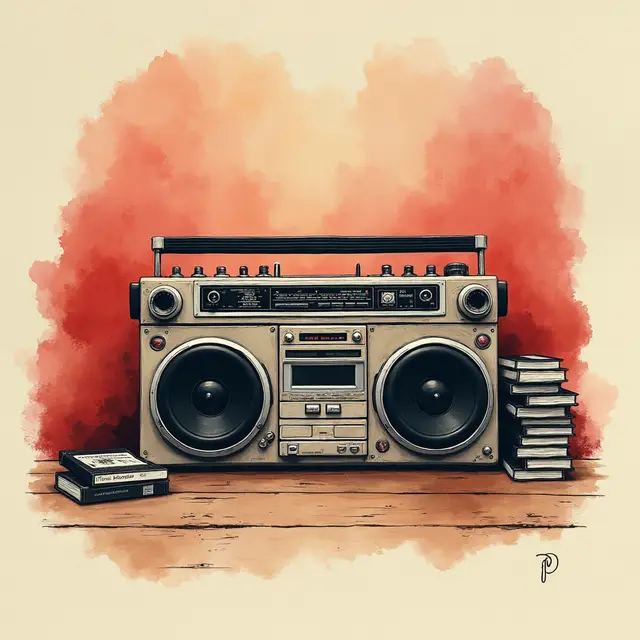
It is three in the morning in a room where the only light comes from a bare red bulb dangling by a frayed wire from the ceiling. The air is thick, smelling of old dampness and hot asphalt still releasing the steam from a storm an hour ago. On a scarred wooden table sits a worn four-track recorder with stripped knobs and a stack of magnetic cassettes dubbed over so many times the tape oxide is starting to flake off.
The sound crawls out of two car speakers wired directly to the floor, their cones torn, vibrating with a bass so saturated that dust grains jump off the metal surface with every kick drum impact. It is a three-note piano loop pulled from a scratched soul record, repeating endlessly until it becomes a heavy physical presence pressing against the back of your neck. There are no clean vocals; what emerges is a dense murmur, doubled over itself, repeated so many times it sounds like it is leaking from the next room or another decade.
You are wearing a leather jacket smelling of stale tobacco, your fingers smudged with magnetic dust. Outside, the street is empty, but you can feel the dull rattle of a passing car with the system pushed to the limit, rattling the locked windowpanes. There is no clear narrative, only the hypnotic loop of a worn-out tape pulling you inward, where time flattens and the only certainty is the tape hiss eating the silence.
Palette: intense red / black / silver gray / wood brown
- BPM
- 128 BPM
- Family
- Asphalt and Diamonds
- Serial
- ASF-15
- Rarity
- Legendary
- Style strength
- 80
- Experimentation
- 62
Typical structure
[Lo-fi Intro] → [Verse] → [Hypnotic hook] → [Verse 2] → [Hook] → [Tape Outro]
The details above are just the visible surface of the tape. What remains hidden is how to keep the loop repetition hypnotic instead of monotonous, or how to make the vocal presence carry that dull menace without sliding into theatrical exaggeration. That lives in an unpublished internal distillate of eight parameters that the engine crosses with your story before writing a single line. When finished, an internal judge measures the lyrics against six canon dimensions and sends back anything that sounds too polished for repairs. The four-track gear can be bought anywhere. The tape decay, no.
How a lyric in this style thinks
A Memphis Rap lyric does not tell a story so much as it holds a pressure. The words exist to sustain a psychic weight, not to move toward resolution, and the listener is meant to feel that weight accumulating in the chest the way humid air accumulates before a storm that never fully breaks. This is a genre built on the proposition that some realities do not need explaining, only witnessing, and the lyric writer's job is to stand inside the atmosphere and report back without flinching and without asking for sympathy.
The emotional register runs along a narrow band between cold certainty and barely suppressed dread, and anything warmer than that — any flicker of hope or softness — collapses the whole structure. Memphis Rap earns its authority by never reaching for comfort.
The sonic architecture matters enormously to how the lyric is written. The instrumental is almost always a two- or three-note piano loop pulled from a degraded soul sample, running at a tempo that sits around 128 BPM but feels slower because the low end is so saturated it physically slows perception. The kick drum hits like something dropped on concrete, not struck. Vocals are murmured rather than projected, often doubled or tripled so the voice sounds like it is bleeding through a wall from another room, another year.
When you write for this genre, you are writing for a voice that does not perform emotion — it emits it, the way old cassette tape emits noise. Line delivery is deliberate and monotone in the best recordings, which means the lyric has to carry all its own internal tension without relying on vocal melodrama. Every syllable lands because it has nowhere to hide.
Repetition is the central structural tool, and it functions differently here than in hook-driven pop. The hypnotic hook in Memphis Rap is not a summary of the verse — it is a mantra that the verse orbits. It typically consists of one or two short declarative lines, sometimes only a phrase, that return unchanged after each verse and gradually acquire weight through sheer accumulation. The lo-fi intro establishes the loop before a word is spoken, conditioning the listener's nervous system.
The verses themselves run long and low, with lines that spill past a natural breath point, the rhythm loose against the beat rather than locked to it. There is no bridge, no lift, no moment of release. The tape outro lets the loop continue past the last word until it fades or simply cuts, as if the recorder ran out of tape or someone walked away.
The sensory field of this genre is precise and non-negotiable. The concrete world it inhabits includes bare bulbs, car speakers with torn cones, magnetic dust, wet asphalt, leather that smells of tobacco, rooms with no windows or windows painted shut. The imagery is tactile and specific to physical decay — surfaces that are worn, stripped, flaking, or scarred. What this genre never uses: natural light, open space, warmth as comfort, anything that implies forward motion or possibility. Time in a Memphis Rap lyric is flat.
Events are referenced as already settled, already absorbed. The grammar tends toward the simple past or a timeless present that makes no distinction between what happened and what always happens. Avoid complex metaphor and ornate language; the power comes from plain words in an atmosphere so thick they sound like confessions.
What separates a real Memphis Rap lyric from a generic imitation is the quality of stillness. Imitators reach for menace through violent imagery and end up with a caricature — a Halloween version of something that was never theatrical in the first place. The genuine article is quieter and more certain. The narrator is not angry; anger would suggest something could still change. The narrator has already accepted the terms. Loyalty in this genre is not celebrated — it is simply stated, the way you state the temperature.
If your lyric is straining for effect, reaching for dark imagery as decoration, Memphis Rap will reject it. The atmosphere has to be the premise, not the conclusion. Write from inside the red-bulb room, not from outside looking in at how ominous it seems.
- CURSED TAPE
- UNDERGROUND 90S
Sample excerpt
Triple beam scale on the warped linoleum floor Locked the deadbolt, triple turn on the kitchen door I see your shadow shifting past the flickering street lamp Cold ink black night, static hum, heavy stamp We counting stacks while the porch light burns amber Keep the burner tucked, keep the silence in the chamber
Static on the tape, spinning in the dark Loyal to the cut, leaving not a mark Cold silver gray, watching how the pavement shift Just us and the ghosts, catching every drift
Workshop note — This style relies on repetitive, hypnotic cadences and internal rhyme schemes that mirror the loop of a worn-out cassette. Keep your lines dense and focus on specific physical movements rather than emotional declarations, as the atmosphere is built through the weight of the mundane details. Avoid melodic choruses; the hook should feel like a chant that pulls the listener deeper into the grit.
Sample excerpt written by MUSAI Song. Your lyrics are written from scratch, based on your story.
When to choose this style
Choose this card when your story needs to capture a heavy atmosphere of quiet loyalty in the margins, without seeking redemption or clean resolutions. It works to recount standing by someone through hard years without asking questions, or to portray a gray neighborhood where the rules are never debated, only followed. It is the right choice for a brother you lost touch with but still share an unspoken code with, or for a breaking point where the only option was accepting the consequences without raising your voice.
Do not use this for family celebrations, bright birthdays, tender love stories, or sweet reconciliations; Memphis Rap holds no warmth or room for soft nostalgia, and forcing it turns the lyric into a dark caricature. If you want a dense atmosphere with a more modern, less magnetic pulse, the card is Modern Boom Bap.
Your story in this style
MUSAI Song writes original lyrics from your story, in the Memphis Rap style, and delivers the finished sung song, the ready-to-use style recipe, and an illustrated art plate with its numbered certificate, private by default; public only if its owner publishes it.
- Original lyrics written from your story
- A finished sung song, ready to play and share
- Art plate with a unique seal and a numbered certificate, private by default; public only if its owner publishes it
Frequently asked questions
What BPM is Memphis Rap?
Memphis Rap usually runs at 128 BPM.
What does Memphis Rap sound like?
The underground's cursed tape: Memphis rap recorded the future on cassettes that still whisper.
What song structure does Memphis Rap use?
[Lo-fi Intro] → [Verse] → [Hypnotic hook] → [Verse 2] → [Hook] → [Tape Outro]
How do I write Memphis Rap lyrics?
Tell MUSAI Song your story and pick Memphis Rap: it writes original lyrics for this style at 128 BPM, you edit them word by word, and you get the song sung in Memphis Rap, with an illustration of the song and its numbered certificate. $19 USD per song, one-time payment.
Explore more styles
- 90s R&B Revival
- Alt-R&B
- Atlanta Dirty South
- Bedroom Emo Rap
- Candlelight Slow Jam
- Crunk Revival
- Detroit Rap
- Drumless Rap
- G-Funk Revival
- Gospel Trap
- Hip-Hop Love Song
- Icy Drill
- Incense Neo-Soul
- Introspective Hip-Hop
- Jersey Club Rap
- Lo-Fi Cloud Rap
- Melodic Trap
- Memphis Phonk
- Modern Boom Bap
- Modern R&B
- New Orleans Bounce
- NY Drill
- Pluggnb
- R&B Empowerment
Your idea or story, sung in this style
Card · secure payment via Stripe, charged in USD
If it doesn't move you, we give you your money back · 7 days