Bedroom Emo Rap
Diary entries with 808s — crying is cardio.
Get your song in Bedroom Emo Rap
Make yours in this styleHear it before you pay.$19 USD · your first song for $5.50 USDIf it doesn't move you, we give you your money back · 7 days.
Bedroom Emo Rap is a style from the Asphalt and Diamonds family. 80 BPM, Experimentation 42, Style strength 82.
What is Bedroom Emo Rap?
Sad guitar over trap beats: emo rap turned the personal diary into a headphone anthem.
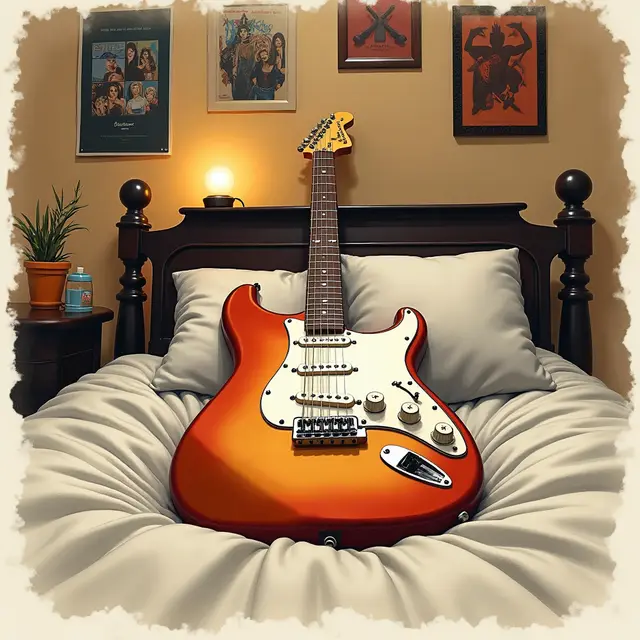
How it sounds
It is three-fifteen in the morning. The phone screen paints your bedroom ceiling in a harsh blue glare, flickering every time a notification arrives that you have no intention of opening. You are sitting on the edge of the mattress, wrapped in a hoodie three sizes too big, headphones pressed hard against your ears. At your feet, a coiled cable runs up to a beat-up Fender Stratocaster plugged straight into a Boss DD-3 delay pedal, repeating three clean, fractured notes drowned in wet reverb.
There is no amp: the signal feeds direct into the audio interface, melting into an 808 drum machine pushing a thick, low-end sub bass line at a steady one hundred twenty beats per minute. The hi-hats roll in thirty-second-note triplets, rapid as a nervous twitch, but the guitar takes its time, dragging itself forward like someone re-reading text messages from three months ago. Then the vocal enters—wrapped in a thin layer of pitch correction that does not hide the lump in your throat, but exposes it.
It starts conversational, almost spoken, before snapping into a cracked, strained hook. On the desk sits a warm soda can, a jacket that still holds a scent that no longer belongs to you, and a voice memo app open with four minutes of unsent audio. The room smells of stale air and radiator dust. Your chest sinks with every kick drum hit. You are not looking for a way out or a moral to the story; you are just letting the loop play until your body gets used to the weight.
Palette: early dawn blue / black / screen pink
- BPM
- 80 BPM
- Family
- Asphalt and Diamonds
- Serial
- ASF-11
- Rarity
- Rare
- Style strength
- 82
- Experimentation
- 42
Typical structure
[Guitar Intro] → [Verse] → [Hook] → [Verse 2] → [Hook] → [Raw bridge] → [Final hook]
The settings above take ten seconds to read. What does not show up in the table is the actual craft: how to write bare-wire vulnerability without slipping into melodramatic posture, or how to bridge a spoken conversational verse into a strained, melodic hook without shattering the bedroom intimacy. That lives inside this card's internal distillate—eight parameters that cross your story with the genre's canon. Once finished, an internal judge evaluates the lyrics against six dimensions and sends back anything that feels performative for repairs. The guitar loop can be copied. The unarmored honesty cannot.
How a lyric in this style thinks
A lyric in emo rap does not explain grief — it re-enters it. The writing drops you back inside a specific, suffocating moment and refuses to let you observe it from a safe distance. That is the core mechanic: the song does not narrate what happened, it reconstructs the exact temperature of the room where it happened. The genre lives in the gap between what you meant to say and what you actually sent, and the best lines in emo rap feel like reading a deleted voice memo out loud — imprecise, circular, too honest to be comfortable.
Emotion in this genre arrives through accumulation rather than declaration. You do not write "I am devastated." You write about the hoodie, the soda can going warm, the three notes on a guitar that keep repeating because stopping feels like a decision you are not ready to make. The sensory field is narrow and very specific: bedroom ceilings, phone screens, the smell of someone else's jacket, the physical weight of a kick drum in your chest. Emo rap does not use open skies, wide vistas, or crowd imagery. Its world is close-walled — a mattress edge, a coiled cable, a notification you will not open. Concrete domestic objects carry the emotional load that more theatrical genres give to metaphor.
Rhythm in emo rap is deliberately uneven, and the lyrics should follow that instinct. Verses tend to run long and conversational, almost spoken, the line lengths varying because the thought is still forming while the words come out. Syllables pile up against the beat rather than sitting neatly inside it. Then the hook snaps into something shorter, more melodic, almost strained — the moment where the voice cracks and the pitch correction stops hiding the lump in the throat and starts exposing it.
That contrast between the rambling verse and the compressed, cracked hook is structural: the verse is processing, the hook is the thing you cannot stop thinking. Repetition is intentional and heavy. A phrase returns not because the writer ran out of ideas but because the feeling has not resolved and the loop is the point.
The guitar sits at the centre of the production and the lyric should honour that. A melancholic guitar loop running over trap drums — rolling hi-hats, a thick 808 sub, a kick that lands like a held breath — creates a tension between the organic and the mechanical that the words need to mirror. The vocal delivery is conversational until it is not: it starts almost like talking to yourself at three in the morning, then breaks into something closer to a held-back scream. Writing for this genre means leaving room for that break. Do not resolve the syntax too cleanly. Let a line end mid-thought. The production will absorb the silence.
What separates a real emo rap lyric from a generic imitation is specificity of shame. Generic versions of the genre reach for universal sadness; the actual craft reaches for the particular embarrassing detail — the four minutes of unsent audio, the half-returned belonging sitting by the door, the year you pulled back so far that stepping outside required preparation. The listener does not need to have lived your exact story. They need to recognise the precision of the feeling.
The structural logic of the genre — verse building pressure, hook releasing it without resolving it, a raw bridge that goes somewhere uglier before the final hook seals the loop — exists to hold that tension open as long as possible. You are not writing toward catharsis. You are writing toward the moment just before it, held on repeat.
- SAD GUITAR
- HELD-BACK SCREAM
Sample excerpt
left your black hoodie draped on the radiator three missed calls from an unknown operator screen light flickering on the ceiling fan sipping old gin from a dirty coffee can
and the guitar bends like a breaking spine you were never mine, you were just a sign sitting in the dark with the volume high waiting for the morning to pass me by
Workshop note — This sample grounds deep emotional pain in mundane objects like a coffee can and a radiator, avoiding abstract clichés. The short, punchy lines match the tight 120 BPM trap beat while leaving room for a held-back vocal delivery. Notice how the lyric uses concrete details to make the midnight isolation feel immediate and unshielded.
Sample excerpt written by MUSAI Song. Your lyrics are written from scratch, based on your story.
When to choose this style
Pick this card when your story refuses to fit into a normal conversation and needs the sanctuary of midnight headphones. It works for a breakup that had no screaming match, just a slow fade that left an apartment full of half-returned belongings. For the friend who moved away, leaving a silence no phone call can patch up. For the quiet guilt of letting down someone who trusted you, or for the year you pulled back from everyone because stepping outside hurt too much. It is the register for things recorded in a two-in-the-morning voice memo and deleted out of embarrassment.
Do not choose it for a victory lap, a wedding, or a warm family tribute. Emo rap does not know how to celebrate or forgive with composure; its raw material is an open cut and a tight throat. If you want street weight delivered with pride and grit, the card is Modern Boom Bap.
Your story in this style
MUSAI Song writes original lyrics from your story, in the Bedroom Emo Rap style, and delivers the finished sung song, the ready-to-use style recipe, and an illustrated art plate with its numbered certificate, private by default; public only if its owner publishes it.
- Original lyrics written from your story
- A finished sung song, ready to play and share
- Art plate with a unique seal and a numbered certificate, private by default; public only if its owner publishes it
Frequently asked questions
What BPM is Bedroom Emo Rap?
Bedroom Emo Rap usually runs at 80 BPM.
What does Bedroom Emo Rap sound like?
Sad guitar over trap beats: emo rap turned the personal diary into a headphone anthem.
What song structure does Bedroom Emo Rap use?
[Guitar Intro] → [Verse] → [Hook] → [Verse 2] → [Hook] → [Raw bridge] → [Final hook]
How do I write Bedroom Emo Rap lyrics?
Tell MUSAI Song your story and pick Bedroom Emo Rap: it writes original lyrics for this style at 80 BPM, you edit them word by word, and you get the song sung in Bedroom Emo Rap, with an illustration of the song and its numbered certificate. $19 USD per song, one-time payment.
Explore more styles
- 90s R&B Revival
- Alt-R&B
- Atlanta Dirty South
- Candlelight Slow Jam
- Crunk Revival
- Detroit Rap
- Drumless Rap
- G-Funk Revival
- Gospel Trap
- Hip-Hop Love Song
- Icy Drill
- Incense Neo-Soul
- Introspective Hip-Hop
- Jersey Club Rap
- Lo-Fi Cloud Rap
- Melodic Trap
- Memphis Phonk
- Memphis Rap
- Modern Boom Bap
- Modern R&B
- New Orleans Bounce
- NY Drill
- Pluggnb
- R&B Empowerment
Your idea or story, sung in this style
Card · secure payment via Stripe, charged in USD
If it doesn't move you, we give you your money back · 7 days