G-Funk Revival
Suspension optional, bounce mandatory.
Get your song in G-Funk Revival
Make yours in this styleHear it before you pay.$19 USD · your first song for $5.50 USDIf it doesn't move you, we give you your money back · 7 days.
G-Funk Revival is a style from the Asphalt and Diamonds family. 94 BPM, Experimentation 30, Style strength 87.
What is G-Funk Revival?
Serpentine synths and funk bass: G-Funk is a golden lowrider floating down the West Coast.
How it sounds
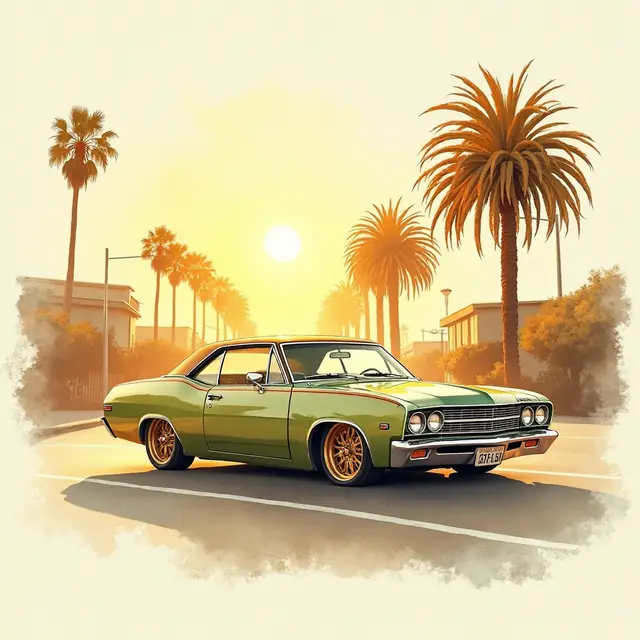
It is six in the evening on a Long Beach boulevard where the sun hits sideways, staining the asphalt a thick amber that smells of fresh tire rubber and the hot grease of a portable grill. You are leaning against the fender of a sixty-four Chevrolet Impala, feeling the warmth the metal still holds after a full day under the dry July fire. The hydraulic system sighs beneath the chassis with a brief hiss and the car lifts a couple of inches with the sluggish grace of a heavyweight stretching its legs.
From the deck comes the cassette tape of an old record, slightly fuzzy on the highs, but the Roland TR-808 bass, driven by two fifteen-inch subs in the trunk, does not rattle: it pushes the air forward with infinite patience. A Moog synthesizer unfurls its melody with a long portamento, a square-wave snake gliding over the mix like thick smoke rising lazily through the palm trees. Your window is down and your arm rests on the door, a thin gold chain sticking to your neck from the salty sweat of the afternoon.
Nobody is in a hurry on this stretch. The world spins at forty-five revolutions and each second stretches just enough for you to catch the reflection of your own face in the chrome side mirror before the next kick drum strike settles the air with absolute smoothness.
Palette: olive green / rims gold / sunset orange / palm trees amber
- BPM
- 94 BPM
- Family
- Asphalt and Diamonds
- Serial
- ASF-16
- Rarity
- Rare
- Style strength
- 87
- Experimentation
- 30
Typical structure
[Synth Intro] → [Verse] → [Sung hook] → [Verse 2] → [Hook] → [Talkbox bridge] → [Final hook]
The specs above can be copied in a minute. What cannot be copied is the technical judgment: how to calculate the exact breathing room the bass needs so it never crowds the synthesizer lead, or how to write an internal rhyme scheme that sounds as lazy as it is precise without dropping the 808 pocket. All of that lives in an unpublished internal distillate, and the engine crosses it with your story before drafting a single line. When it finishes, an internal judge measures the lyrics against six dimensions of the canon and sends back anything that breaks the groove. The synthesizer is patched. The patience, not.
How a lyric in this style thinks
A G-Funk Revival lyric does not announce its emotion — it lets it idle at the curb until you feel the heat coming off the hood. The genre operates through accumulation rather than declaration: images stack slowly, the way afternoon light spreads across asphalt, and by the time the hook lands you understand what the speaker has been through without them ever having said it plainly. This is the essential discipline of G-Funk Revival writing. The victory is present, but it wears its own posture — one hand on the wheel, sunglasses on, nothing left to prove. Urgency is the enemy. If a line feels rushed, it belongs in a different genre entirely.
The base tone sits somewhere between satisfaction and controlled nostalgia, and emotion arrives through concrete sensory anchors rather than confessional statement. A thin gold chain against a sweating neck, the hydraulic sigh beneath a chassis, the fuzzy high end of a cassette playing through afternoon heat — these are the objects that carry the feeling. G-Funk Revival never reaches for abstraction. The sensory field is hyper-specific: warm metal, low radio, long boulevards, the smell of grilled food drifting past palm trees.
What the genre never touches is domestic interior chaos, rainy-day claustrophobia, or any image that implies speed or panic. The world of this lyric spins at exactly forty-five revolutions per minute and not one faster.
Line length and rhythm follow the BPM with careful looseness. At 94 beats per minute, there is room — more room than most rap cadences allow — and skilled G-Funk Revival writers use that space deliberately. Lines breathe. Syllables land slightly behind the kick drum rather than on top of it, giving the delivery a draped quality, like fabric settling. Repetition in the hook is not lazy; it is architectural. The sung hook exists to let the Moog portamento and the talkbox do half the emotional work, so the words themselves can stay plain.
Short declarative phrases repeated with minor melodic variation carry more weight here than complex internal rhyme schemes. The verse is where the story lives; the hook is where the body responds to it.
Structurally, G-Funk Revival follows a logic that prioritizes texture over narrative momentum. The synth intro is not decoration — it establishes the emotional temperature before a single word is spoken, and a good writer understands that the first verse must honor that temperature rather than break it.
The talkbox bridge functions as the genre's version of a confessional: it is the moment where the vocoder-processed voice says the thing the rapper circled around in both verses, but says it sideways, through a filter, so the vulnerability stays protected. Think of it as speaking through glass. The final hook resolves nothing dramatically; it simply confirms that the narrator is still here, still at the curb, still wearing the same composed expression.
What separates a real G-Funk Revival lyric from an imitation is restraint at exactly the moments where lesser writing would escalate. A generic version of this genre mistakes the serpentine synth lead for permission to be theatrical. It is not. The whining portamento is already doing the drama; the lyric's job is to stay cool beside it. Write the verse as though you are talking to someone who already knows most of the story — because in this world, they do. The neighborhood remembers.
You do not need to explain what you came from or where you arrived. You only need to describe, with precision and without grandstanding, the exact quality of the light at six in the evening when you finally got back to the block and leaned against the fender and let the bass push the air forward with infinite patience.
- SERPENTINE SYNTH
- LOWRIDER IN THE SUN
Sample excerpt
Three-block crawl down Atlantic Avenue Trunk rattling heavy with a bassline tuned Got the window rolled down letting evening cool Passing by the corner where we dropped out of school Now the rims catch the glare of the sunset flash Paid cash for the block with the hard-earned cash
Keep the lowrider floating while the bassline rolls We made it off the cement with our steady souls Just a slow cruise down under palm tree shade Remembering every single promise we made
Workshop note — This verse works by grounding success in specific geography and physical objects like the vibrating trunk and the rolling window, avoiding grand abstractions. The chorus uses a relaxed, sustained rhythm that mimics the bounce of a hydraulic suspension, keeping the emotional weight grounded and calm rather than theatrical.
Sample excerpt written by MUSAI Song. Your lyrics are written from scratch, based on your story.
When to choose this style
Choose this card when the story calls for celebrating a hard-won victory without grandstanding or heavy speeches. It works to tell a brother you finally reached the place you promised to conquer when you had nothing, or to chronicle a return to the neighborhood after making it out, carrying the quiet posture of someone who no longer needs to prove anything to anyone.
It is built for a father who taught you how to drive with one hand on the wheel and the other over the passenger seat, or for a love built on slow heat, without urgency, through long afternoons on the curb with the radio low. Do not pick it for a messy breakup or a fresh mourning: G-Funk does not know how to cry out loud, and trying to force pure tragedy into it will sound like a costume. It is also useless for frantic messages or rushed youth anthems. If you are looking for an urgent, raw confession, the card is Modern Boom Bap.
Your story in this style
MUSAI Song writes original lyrics from your story, in the G-Funk Revival style, and delivers the finished sung song, the ready-to-use style recipe, and an illustrated art plate with its numbered certificate, private by default; public only if its owner publishes it.
- Original lyrics written from your story
- A finished sung song, ready to play and share
- Art plate with a unique seal and a numbered certificate, private by default; public only if its owner publishes it
Frequently asked questions
What BPM is G-Funk Revival?
G-Funk Revival usually runs at 94 BPM.
What does G-Funk Revival sound like?
Serpentine synths and funk bass: G-Funk is a golden lowrider floating down the West Coast.
What song structure does G-Funk Revival use?
[Synth Intro] → [Verse] → [Sung hook] → [Verse 2] → [Hook] → [Talkbox bridge] → [Final hook]
How do I write G-Funk Revival lyrics?
Tell MUSAI Song your story and pick G-Funk Revival: it writes original lyrics for this style at 94 BPM, you edit them word by word, and you get the song sung in G-Funk Revival, with an illustration of the song and its numbered certificate. $19 USD per song, one-time payment.
Explore more styles
- 90s R&B Revival
- Alt-R&B
- Atlanta Dirty South
- Bedroom Emo Rap
- Candlelight Slow Jam
- Crunk Revival
- Detroit Rap
- Drumless Rap
- Gospel Trap
- Hip-Hop Love Song
- Icy Drill
- Incense Neo-Soul
- Introspective Hip-Hop
- Jersey Club Rap
- Lo-Fi Cloud Rap
- Melodic Trap
- Memphis Phonk
- Memphis Rap
- Modern Boom Bap
- Modern R&B
- New Orleans Bounce
- NY Drill
- Pluggnb
- R&B Empowerment
Your idea or story, sung in this style
Card · secure payment via Stripe, charged in USD
If it doesn't move you, we give you your money back · 7 days