Snap Throwback
A whistle, a snap, and suddenly it's 2006.
Get your song in Snap Throwback
Make yours in this styleHear it before you pay.$19 USD · your first song for $5.50 USDIf it doesn't move you, we give you your money back · 7 days.
Snap Throwback is a style from the Asphalt and Diamonds family. 104 BPM, Experimentation 34, Style strength 82.
What is Snap Throwback?
The snap ruled everything: snap music, the ringtone era when a single whistle was all you needed to get the floor moving.
How it sounds
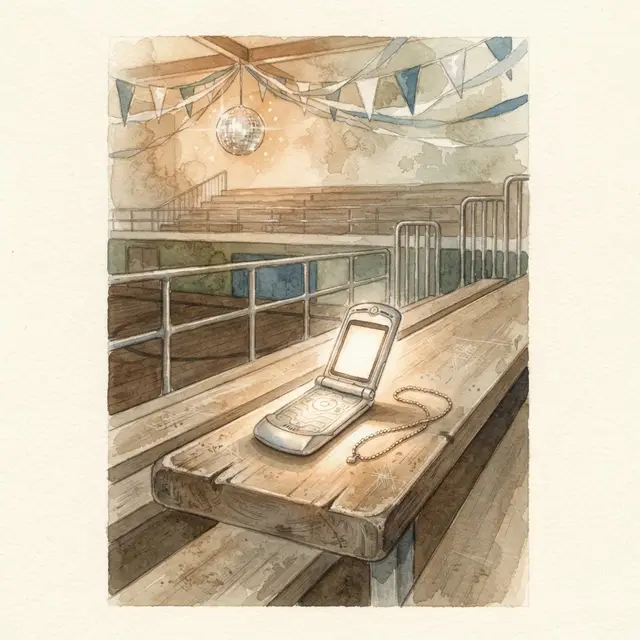
The metal bleachers in the school gym smell of fresh sweat and floor wax. It is a Friday afternoon in 2006, and the overhead fluorescent tubes flicker against the polished linoleum. Someone holds a silver flip phone in their hand, the small screen casting a blue light across half a cheek while a generic midi ringtone plays out to an empty room. There are no massive wall speakers or chest-collapsing bass; just the sharp click of two fingers meeting in midair. A dry, metallic snap cuts through the room right before the drumbeat drops.
A short, piercing whistle slices across the floor, and instantly three people move in sync, marking the step with their heels, taking their time, letting their weight shift while a cheap metal chain on a neck sways with its own momentum. No one is shouting. No one is sweating too much. The movement is economical and exact: a nod of the head, a flick of the wrist, the snap sounding off right on time to organize the room's chaos.
Crinkled paper streamers hang from the basketball hoops, catching a cheap glint beneath the slow-spinning disco ball that turns the floor into a grid of white dots sliding over fresh sneakers. The air is warm, smelling of hot plastic chargers and sweet body spray applied without restraint. Your fingers close in the air, you look for the rhythm with the pad of your thumb against your middle finger, and your body answers before you even reach the next floor tile.
Palette: gray silver / muted blue / warm wood
- BPM
- 104 BPM
- Family
- Asphalt and Diamonds
- Serial
- ASF-30
- Rarity
- Common
- Style strength
- 82
- Experimentation
- 34
Typical structure
[Snap Intro] → [Verse] → [Choreography hook] → [Verse 2] → [Hook] → [Dance break] → [Final hook]
The details above are copied in a minute. What cannot be copied is the judgment: how to keep the rhythm's lightness from going flat without ever slipping into drama, and where to drop the silences so the snap acts like physical punctuation instead of background noise. All of that lives in an unpublished eight-parameter distillate, which the engine crosses with your story before writing a single line. When finished, an internal judge measures the lyrics against six dimensions of the canon and repairs whatever lost its step. The tone is imitated. The balance, not.
How a lyric in this style thinks
A Snap Throwback lyric does one specific thing: it announces arrival. Not arrival after struggle, not arrival despite obstacles — just arrival, clean and unhurried, the way someone walks into a room and the room reorganizes itself around them. The lyric's job is to make that feeling land without explaining it. Snap music operates on confidence as a given, not as something earned in the verse and paid off in the chorus. The emotion is warm and lateral, moving at shoulder height, never reaching up or down. If you find yourself writing about why you deserve this moment, you've already left the genre behind.
The rhythm of a Snap Throwback lyric is built around the finger snap itself — a dry, percussive click that lands on the beat with no reverb tail, no softening. Lines are short and declarative. They tend to fall in pairs, with the second line either mirroring or pivoting just slightly off the first, the way a head nod confirms what the body already knew. Repetition is not laziness here; it is architecture. The hook in this genre is often a chant more than a melody, something that a group of people can deliver in unison with minimal rehearsal.
The choreography hook — the section that exists purely to organize bodies in space — works best when the lyric is almost skeletal: a count, a direction, a single image that tells you exactly where to put your weight.
The sensory field of Snap Throwback is specific and non-negotiable. You are working with linoleum floors and cheap fluorescent light, the blue glow of a flip-phone screen, the metallic glint of a chain, the smell of synthetic body spray and warm plastic. The whistle that cuts across the room before the beat drops is a production signature, not decoration — treat it lyrically the same way, as a signal rather than an ornament.
The tempo sits around 104 BPM, which is not slow and not frantic; it is the pace of someone who has somewhere to be and is not rushing to get there. Production stays minimal: snaps, a spare hi-hat, a bass line that sits low without flooding the room. Your lyrics should match that economy. There is no room here for lush imagery, sweeping metaphors, or anything that requires a second read.
Structurally, the genre opens with a Snap intro — often just the click and a whistle, sometimes a single repeated phrase that primes the room before the verse earns any narrative space. The verse carries a light story: a neighborhood, a Friday, a specific pair of sneakers, a mirror routine everyone knew. Verse 2 advances that story by one step, not ten. The dance break is a section where the lyric either drops almost entirely or reduces to a two-word command, because the body is doing the talking. The final hook lands with more weight than the first pass, not because the words have changed, but because the listener has moved through the structure and the snap now feels inevitable.
What separates a real Snap Throwback lyric from a generic imitation is restraint in the emotional register. Imitations tend to reach for nostalgia as sentiment, leaning on phrases that signal feeling rather than creating it. The real thing stays inside the scene — the crinkled paper streamer, the thumb against the middle finger, the slow-spinning disco ball making a grid of white dots across fresh sneakers — and trusts that the specificity will carry the warmth without announcing it. Neighborhood pride in this genre never raises its voice.
It keeps a steady pace with a crooked smile, and the lyric should do exactly the same: land with the weight of someone who already knows the answer before the question is finished.
- SNAP KING
- RINGTONE ERA
Sample excerpt
Left the coat on the back of the kitchen door Dust on the white tee, shoes touching the floor Got that ringtone bounce hitting loud in the hall No sweat, no rush, nothing heavy at all We just step to the side when the snare kicks in Looking back at the block where we used to begin
Snap to the left, let the shoulder roll low That’s the only move everybody gotta know Keep the chin up high, let the bassline glide Just a clean little walk with the crew outside
Workshop note — This sample relies on short, rhythmic phrasings that match the 104 BPM snap tempo, avoiding heavy metaphors in favor of physical gestures and everyday objects. The chorus uses repetitive instruction lines designed to lock instantly with the beat, keeping the mood loose and celebratory without slipping into complex emotional confessions.
Sample excerpt written by MUSAI Song. Your lyrics are written from scratch, based on your story.
When to choose this style
Choose this card when you want to tell a story of effortless triumph, the kind where you need no explanations or heavy speeches. It works to celebrate stepping out of a grey phase where all you want is to walk down the sidewalk with relaxed shoulders, knowing the worst part is behind you. It is perfect for reuniting with old friends to laugh about who you used to be without a drop of solemnity, or to remember the exact night your biggest worry was nailing the dance routine everyone copied in front of the bathroom mirror.
It fits when neighborhood pride doesn't need to raise its voice, just keep a steady pace with a crooked smile. Do not choose this for deep grief, painful breakups, or stories that demand tears or complex confessions: this sound cannot carry guilt or heavy melancholy, and forcing it turns your memory into an empty joke. It also fails for intimate confessions or emotional breakdowns. If you need to process a loss or an open wound, the card is 90s R&B Revival.
Your story in this style
MUSAI Song writes original lyrics from your story, in the Snap Throwback style, and delivers the finished sung song, the ready-to-use style recipe, and an illustrated art plate with its numbered certificate, private by default; public only if its owner publishes it.
- Original lyrics written from your story
- A finished sung song, ready to play and share
- Art plate with a unique seal and a numbered certificate, private by default; public only if its owner publishes it
Frequently asked questions
What BPM is Snap Throwback?
Snap Throwback usually runs at 104 BPM.
What does Snap Throwback sound like?
The snap ruled everything: snap music, the ringtone era when a single whistle was all you needed to get the floor moving.
What song structure does Snap Throwback use?
[Snap Intro] → [Verse] → [Choreography hook] → [Verse 2] → [Hook] → [Dance break] → [Final hook]
How do I write Snap Throwback lyrics?
Tell MUSAI Song your story and pick Snap Throwback: it writes original lyrics for this style at 104 BPM, you edit them word by word, and you get the song sung in Snap Throwback, with an illustration of the song and its numbered certificate. $19 USD per song, one-time payment.
Explore more styles
- 90s R&B Revival
- Alt-R&B
- Atlanta Dirty South
- Bedroom Emo Rap
- Candlelight Slow Jam
- Crunk Revival
- Detroit Rap
- Drumless Rap
- G-Funk Revival
- Gospel Trap
- Hip-Hop Love Song
- Icy Drill
- Incense Neo-Soul
- Introspective Hip-Hop
- Jersey Club Rap
- Lo-Fi Cloud Rap
- Melodic Trap
- Memphis Phonk
- Memphis Rap
- Modern Boom Bap
- Modern R&B
- New Orleans Bounce
- NY Drill
- Pluggnb
Your idea or story, sung in this style
Card · secure payment via Stripe, charged in USD
If it doesn't move you, we give you your money back · 7 days