Whispered Quiet Storm
The storm is quiet; the feelings are not.
Get your song in Whispered Quiet Storm
Make yours in this styleHear it before you pay.$19 USD · your first song for $5.50 USDIf it doesn't move you, we give you your money back · 7 days.
Whispered Quiet Storm is a style from the Asphalt and Diamonds family. 72 BPM, Experimentation 16, Style strength 88.
What is Whispered Quiet Storm?
The midnight radio made into a genre: saxophone, whisper, and a storm that never raises its voice.
How it sounds
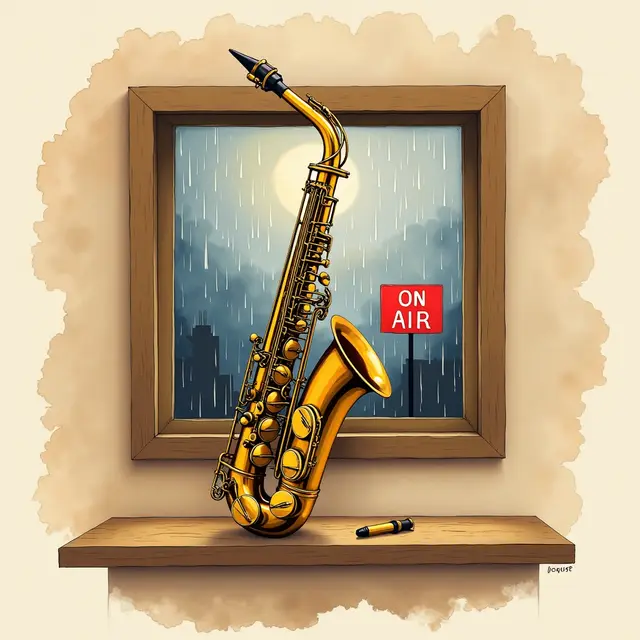
It is a quarter past three in the morning, and the city outside is nothing more than a dull murmur against the double-paned window. Inside, the only light comes from a red sign reading 'ON AIR' and the amber glow of VU meters drifting lazily across the console. The air smells of lukewarm coffee and the vinyl spinning slowly beneath the stylus. There are no callers in the studio.
Just you, the headphone pressed against your left ear, and a low voice sliding straight into your chest, grazing the microphone as if speaking directly into your ear from across the room. The Rhodes piano in the back drops a seventh chord that stretches and floats, heavy and dense, before dissolving into silence. Then the sax enters. It does not scream or chase the center of the floor; it slides between the sheets with a pitch bend so slow the instrument itself seems to be breathing.
Every note is pushed with air, carrying that exact friction of reed against metal that sounds like damp skin. Outside, the rain starts to pour, but the drops blur against the glass because time in here froze the exact moment the music lowered its volume to speak the quietest truth possible.
Palette: intense gold / air on red / night grayish blue / black
- BPM
- 72 BPM
- Family
- Asphalt and Diamonds
- Serial
- ASF-24
- Rarity
- Epic
- Style strength
- 88
- Experimentation
- 16
Typical structure
[Sax Intro] → [Verse] → [Chorus] → [Verse 2] → [Chorus] → [Sax Solo] → [Whispered final chorus]
The data above can be copied in a minute. What cannot be copied is the exact tension between voice and air: how many syllables a line can hold before breaking the atmosphere, where to place the exact pause so the sax breathes without drowning the lyrics. That lives in the internal distillate the motor crosses with your story. When finished, an internal judge measures the lyric against six dimensions of the canon and orders repairs on anything that sounds like a speech. The saxophone is rented. The temperature, not.
How a lyric in this style thinks
A Quiet Storm lyric does not confess — it recognizes. The distinction matters enormously. Where confession implies relief or absolution, recognition is quieter and more dangerous: two people in a dark room simply acknowledging that they see each other, that the months of silence happened, that something remains. The genre earns its name not from meteorological drama but from the way emotion builds pressure without ever breaking the surface. At 72 BPM, the groove barely moves, and the lyric has to honor that stillness.
Lines arrive slowly, with room between them, and the spaces carry as much weight as the words. This is midnight FM radio as a poetic form — the voice leaning into the microphone at 3 a.m., not performing, just speaking into the amber dark.
The base tone in Quiet Storm sits at the intersection of desire and restraint, and every technical choice in the writing should reinforce that tension. Emotionally, the lyric operates at a sustained temperature rather than peaks and valleys. Verses do not build toward the chorus with urgency; they approach it the way a hand moves across a table toward another hand — unhurried, deliberate, already aware of what it will find.
Line lengths tend toward the mid-range, four to six stresses, with internal pauses that let the Rhodes seventh chord breathe underneath. Repetition is a primary structural tool, but it works through slight variation rather than exact return: the same phrase reappears with one word shifted, one syllable softened, so the listener feels the lyric remembering itself rather than insisting on itself.
The sensory field in Quiet Storm is precise and deliberately narrow. The genre lives in indoor textures at night: the friction of a stylus in a groove, lukewarm coffee, the amber drift of VU meters, condensation on a glass, a red light in a darkened room. Rain appears only when it blurs against glass — it never arrives with force. The saxophone is not an ornament here; it is a co-author, and the lyric should leave room for it the way dialogue leaves room for silence.
What the genre never uses: sunlight, open fields, crowds, urgency of any kind, clean moral resolution. If a line feels like it could be shouted, cut it. The whispered final chorus is the structural destination, and everything written before it should make that diminuendo feel inevitable rather than anticlimactic.
Structurally, the canon form — sax intro, two verse-chorus cycles, a sax solo, and a whispered final chorus — tells you something important about where the lyric should spend its energy. The sax intro establishes mood before a single word is spoken, which means the first verse must enter a room already charged. Verse one sets a scene with minimal narration and maximum sensory specificity. The chorus does not erupt; it settles, offering a phrase that functions like a long exhale.
Verse two deepens rather than advances — it finds a different angle on the same moment, not a new event. The sax solo is a structural silence for the lyric, a place where the instrumental says what words have been circling. The whispered final chorus should feel like the song has been working toward a quieter version of itself all along, arriving not at resolution but at acceptance.
What separates a real Quiet Storm lyric from a generic imitation is the refusal to over-explain. Amateur versions reach for the emotion directly — they name it, qualify it, repeat it at volume. The genre demands oblique entry: you write the wet glass, the low light, the half-finished sentence, and trust the listener to feel the rest.
Vocal delivery in production terms means breath is part of the instrument — a slight rasp on the consonants, the sibilance of a whispered word riding just above the noise floor, the kind of microphone proximity that makes the voice sound like it originates inside the listener's own chest. When you write for this genre, read every line aloud at a volume just above silence. If it loses meaning at that volume, it does not belong here.
- MIDNIGHT RADIO
- SAX & WHISPER
Sample excerpt
Three a.m. static on the kitchen tile your coffee cup left half-full since June we measure distance by the miles we didn't cross beneath this amber moon the refrigerator hums a low bass line while the city sleeps in indigo and gray.
Keep your voice down low let the midnight radio carry what we cannot say till the darkness wears away.
Workshop note — This verse relies on physical details like the cold tile and the half-full cup to ground an unspoken reconciliation in a specific room. The short, restrained lines mirror the whispered delivery style, avoiding loud declarations or dramatic outbursts. In this sound, emotional weight comes from what remains unsaid and the steady rhythm of the bass.
Sample excerpt written by MUSAI Song. Your lyrics are written from scratch, based on your story.
When to choose this style
Choose this card when you need to confess something that cannot survive loud tones. It works for a night when two people find each other in a dark kitchen, making no accusations, simply recognizing one another after months of silence. For a love letter written from that precise distance where desire is no longer urgency but a steady temperature. For thanking someone who stayed through the worst moments without making a sound. For a family truce where words are heavy and the only thing that matters is a sustained presence.
Quiet Storm does not work for loud celebrations, euphoric announcements, or a breakup that demands long explanations or shouting. Do not look for this sound if the story calls for urgent catharsis or speed. If you need ironic distance, a shouted confession, or a neat moral ending, this beat will feel wrong. If you are looking for unfiltered street rawness, the letter is Modern Boom Bap.
Your story in this style
MUSAI Song writes original lyrics from your story, in the Whispered Quiet Storm style, and delivers the finished sung song, the ready-to-use style recipe, and an illustrated art plate with its numbered certificate, private by default; public only if its owner publishes it.
- Original lyrics written from your story
- A finished sung song, ready to play and share
- Art plate with a unique seal and a numbered certificate, private by default; public only if its owner publishes it
Frequently asked questions
What BPM is Whispered Quiet Storm?
Whispered Quiet Storm usually runs at 72 BPM.
What does Whispered Quiet Storm sound like?
The midnight radio made into a genre: saxophone, whisper, and a storm that never raises its voice.
What song structure does Whispered Quiet Storm use?
[Sax Intro] → [Verse] → [Chorus] → [Verse 2] → [Chorus] → [Sax Solo] → [Whispered final chorus]
How do I write Whispered Quiet Storm lyrics?
Tell MUSAI Song your story and pick Whispered Quiet Storm: it writes original lyrics for this style at 72 BPM, you edit them word by word, and you get the song sung in Whispered Quiet Storm, with an illustration of the song and its numbered certificate. $19 USD per song, one-time payment.
Explore more styles
- 90s R&B Revival
- Alt-R&B
- Atlanta Dirty South
- Bedroom Emo Rap
- Candlelight Slow Jam
- Crunk Revival
- Detroit Rap
- Drumless Rap
- G-Funk Revival
- Gospel Trap
- Hip-Hop Love Song
- Icy Drill
- Incense Neo-Soul
- Introspective Hip-Hop
- Jersey Club Rap
- Lo-Fi Cloud Rap
- Melodic Trap
- Memphis Phonk
- Memphis Rap
- Modern Boom Bap
- Modern R&B
- New Orleans Bounce
- NY Drill
- Pluggnb
Your idea or story, sung in this style
Card · secure payment via Stripe, charged in USD
If it doesn't move you, we give you your money back · 7 days