Qawwali
Ecstasy is achievable without ever leaving the mat.
Get your song in Qawwali
Make yours in this styleHear it before you pay.$19 USD · your first song for $5.50 USDIf it doesn't move you, we give you your money back · 7 days.
Qawwali is a style from the Distant Worlds family. 100 BPM, Experimentation 28, Style strength 97.
What is Qawwali?
Harmonium, handclaps, and voices rising together toward divine trance. Qawwali, the Sufi devotional music of South Asia: devotion turned to fire, overwhelming, ecstatic, and unstoppable.
How it sounds
The sun drops over the inner courtyard of the dargah and dust motes hang in the slanted light like a golden rain that never touches the ground. Persian rugs are layered thick upon the flagstones, worn thin in the exact spots where generations of knees have rubbed the wool smooth. The air smells of burning sandalwood, dried salt, and the heavy oil of terracotta lamps flickering against the cold stone walls.
At the far end, seated on a raised platform, the lead singer pumps the harmonium with one hand while the other slams ivory keys with an urgency that grants no quarter. The bellows wheeze and groan, a steady drone pushing upward from the chest. Beside him, a player strikes the dholak with an open palm and curled fingers, setting a pace that does not mimic a pulse: it forces it to break step, to race.
Then the lead voice cuts through. It does not sing to please; it sings as though oxygen were the only thing standing between the body and a raging pyre. At first it is a thin wire scaling the dome, but the chorus crashes in instantly, four men with shut eyes and cords in their necks standing out like dry branches. The handclaps begin. They do not keep time; they multiply it. They strike with the force of a slammed door, dozens of palms erasing the silence of the courtyard.
The phrase loops over and over, but with every cycle the pitch creeps up, every repetition turning a screw deeper into the bone. The harmonium shrieks. The voice cracks but refuses to fall, hardening into something white-hot and blade-thin. There is no distance left between listener and sound. The body is nothing now but a shell vibrating against wood, against stretched hide, against an invisible fire climbing the spine until it bursts behind the eyes.
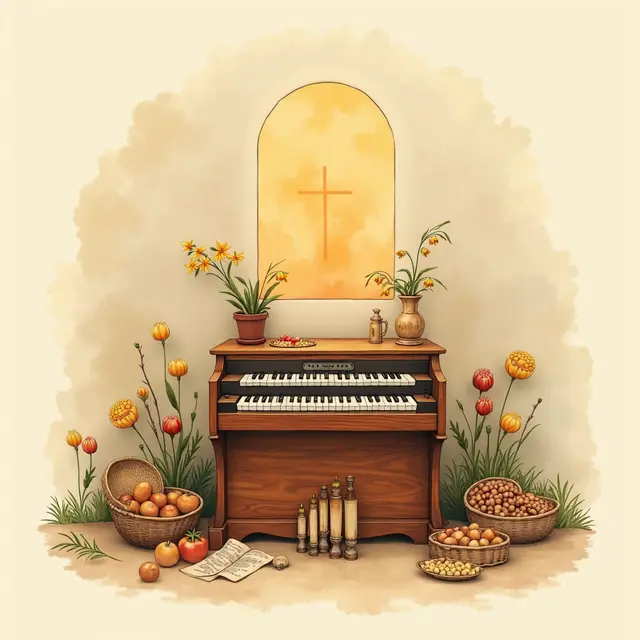
Palette: warm brown / gold yellow / garnet red / foliage green
- BPM
- 100 BPM
- Family
- Distant Worlds
- Serial
- MUN-03
- Rarity
- Epic
- Style strength
- 97
- Experimentation
- 28
Typical structure
[Harmonium Intro] → [Verse] → [Chorus response] → [Acceleration] → [Ecstasy] handclaps and voice at the limit
What you see on the surface is just the harmonium and the drone. Beneath lie two traps a table cannot fix: how to stretch a single phrase for ten minutes without losing the listener, and how to make a vocal peak sound like revelation instead of shouting. That lives inside a hidden distillate of eight unpublished parameters, and the engine cross-references it with your story before writing a line. In the end, an internal judge measures the lyrics against six canons and repairs every flaw. The rhythm is copied. The fire, not.
How a lyric in this style thinks
A qawwali lyric does not describe devotion — it enacts it. The words exist to be repeated until repetition cracks the listener open, until the meaning stops being intellectual and becomes physical, something felt in the sternum and the back of the throat. This is the defining logic of qawwali, the Sufi devotional music of the South Asian subcontinent: the lyric is not a vehicle for a story so much as an engine for a state. You are not narrating surrender; you are inducing it, line by line, cycle by cycle, until the distinction between the singer and the song dissolves entirely.
The emotional register operates without a middle setting. Longing in qawwali is not wistful — it is catastrophic. The beloved, whether human or divine, is so remote and so consuming that the speaker's own existence becomes a problem to be burned away. This is why the language tends toward the absolute: the speaker does not say he misses someone; he says he has been destroyed by absence, that the fire has taken everything and he is grateful for the ash.
Urdu and Punjabi poetic tradition gives qawwali its vocabulary — wine, the moth and the flame, the tavern as a place of forbidden grace — but the English songwriter working in this mode needs the same quality of reckless overstatement. Polite metaphor will not survive the harmonium's first breath.
Line length and rhythm are inseparable from the performance structure. The opening verse tends to arrive slowly, a single voice threading a long melodic phrase over the harmonium's drone, the syllables stretched and ornamented with microtonal bends that a Western ear might call melisma but that carry specific emotional weight in the tradition. Then the chorus crashes in — other voices, handclaps arriving like a door kicked off its hinges — and suddenly the tempo is not a number on a dial but a pressure.
Repetition is the architecture: the same phrase returns, but each cycle the pitch lifts slightly, the percussion multiplies, and what began as a statement becomes a demand. When you write for this structure, you need a central phrase short enough to be repeated twenty times without becoming meaningless — something dense enough to hold more weight each time it lands.
The sensory world of qawwali is specific and non-negotiable. Sandalwood smoke, terracotta oil lamps, worn wool, cold stone, the wheeze of harmonium bellows — these are the textures the music breathes in. The dholak's open-palm stroke and the tabla's sharp snap give the rhythm its dual personality: ceremonial and urgent at once. Handclaps in qawwali are not timekeeping; they are a force that multiplies the tempo from inside, and lyrically this translates to lines that feel cumulative, each one adding weight rather than advancing a narrative.
What the genre never uses: irony, understatement, clever deflection, or the kind of self-aware distance that characterises confessional pop. The speaker in a qawwali lyric has no armor left.
The structural logic moves from invocation through escalation to ecstasy, and the lyric must be built to survive all three. The harmonium intro establishes the tonal center and the emotional temperature before a word is sung — so your first verse needs to meet that temperature, not build toward it. By the time the acceleration section arrives, the words should already be under pressure, syllables compressed against the beat, the central phrase hitting harder because it has been prepared.
The difference between a genuine qawwali lyric and a generic imitation is exactly here: the imitation introduces devotion as a theme; the real thing treats devotion as a physical emergency. If you can still read your lyric calmly from a page, it is not finished yet. The test is whether the central phrase, repeated at full voice with clapping hands around it, feels like release or like restraint — and in qawwali, it must always feel like release.
- VOICES ON FIRE
- DIVINE TRANCE
Sample excerpt
I left my coat on the threshold of your door and walked barefoot across the salt of the courtyard the night is an ink black well with no bottom and every star above us is a nail driven into cedar my hands are empty and my chest is bare open the gate before the morning light catches me here
burn every bridge that brought me to your side let the amber flame swallow what is left of my name there is no return from this holy ruin let the fire take the bone
Workshop note — The verse builds urgency through stark, physical imagery like salt floors and iron nails instead of abstract longing. The chorus uses a relentless circular repetition that mirrors the rising handclaps of a traditional devotional circle. Keep the lines breathless and direct, avoiding gentle metaphors so the vocal can push into total ecstasy without hesitation.
Sample excerpt written by MUSAI Song. Your lyrics are written from scratch, based on your story.
When to choose this style
Choose this card when your story demands absolute surrender, when devotion or love refuses to fit inside polite sentences and requires a blaze that consumes everything in its path. It works for a passion that turned into faith, for a loyalty tested through hard years that asks for no badge only sacrifice, or for a grief so vast the only way through is to let the sound dissolve you entirely.
It fits when you need to scream that losing everything is a fair price for truth, when honoring a teacher whose lessons scorched your hands, or sealing a promise on the cold floor of a sanctuary or in a dark kitchen at dawn.
Do not pick this for a polite chat, a neat apology, or a tepid memory: qawwali knows no middle ground, no careful elegance. It fails for light nostalgia on a lazy Sunday afternoon. If you are recounting a wound that already healed into silence, this card will feel too large. If you need measured structure, quiet grief, and containment, the card is the Armenian Duduk.
Your story in this style
MUSAI Song writes original lyrics from your story, in the Qawwali style, and delivers the finished sung song, the ready-to-use style recipe, and an illustrated art plate with its numbered certificate, private by default; public only if its owner publishes it.
- Original lyrics written from your story
- A finished sung song, ready to play and share
- Art plate with a unique seal and a numbered certificate, private by default; public only if its owner publishes it
Frequently asked questions
What BPM is Qawwali?
Qawwali usually runs at 100 BPM.
What does Qawwali sound like?
Harmonium, handclaps, and voices rising together toward divine trance. Qawwali, the Sufi devotional music of South Asia: devotion turned to fire, overwhelming, ecstatic, and unstoppable.
What song structure does Qawwali use?
[Harmonium Intro] → [Verse] → [Chorus response] → [Acceleration] → [Ecstasy] handclaps and voice at the limit
How do I write Qawwali lyrics?
Tell MUSAI Song your story and pick Qawwali: it writes original lyrics for this style at 100 BPM, you edit them word by word, and you get the song sung in Qawwali, with an illustration of the song and its numbered certificate. $19 USD per song, one-time payment.
Explore more styles
- Afrobeat (Fela)
- Algerian Raï
- Anatolian Psych Rock
- Andalusian Music
- Arabic Flamenco Fusion
- Arabic Music (Tarab)
- Armenian Duduk
- Balinese Gamelan
- Balkan Cinema Fusion
- Bhangra
- Bollywood Filmi
- Bosnian Sevdah
- Carnatic
- Cinematic World Fusion
- Congolese Rumba
- Congolese Soukous
- Desert Blues Tuareg
- Ethio-Jazz
- Greek Laïkó
- Hindustani Raga
- Indo-Jazz Fusion
- Iraqi Maqam
- Mandinka Kora
- Mongolian Throat Singing
Your idea or story, sung in this style
Card · secure payment via Stripe, charged in USD
If it doesn't move you, we give you your money back · 7 days