Iraqi Maqam
The river hears everything and tells no one.
Get your song in Iraqi Maqam
Make yours in this styleHear it before you pay.$19 USD · your first song for $5.50 USDIf it doesn't move you, we give you your money back · 7 days.
Iraqi Maqam is a style from the Distant Worlds family. 72 BPM, Experimentation 28, Style strength 95.
What is Iraqi Maqam?
A santur and an ancient voice tracing thousand-year-old modes. Iraqi maqam, the classical music of Mesopotamia, is deep, ornate, and heavy with centuries of poetry.
How it sounds
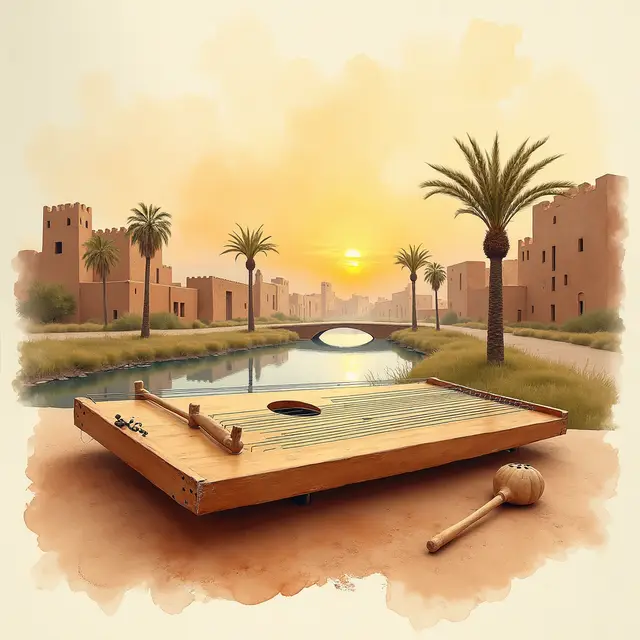
It is well past midnight in a room with sun-baked mudbrick walls that still radiate the day's trapped heat. The light of a single oil lamp flickers across a low wooden table holding a manuscript of brittle, yellowed pages. Outside, date palms carve jagged silhouettes against a sky so dark it feels thick, and far in the distance, the river brushes against the bank with a steady murmur no one notices anymore. The musician bows his head over the santur.
The small wooden mallets strike the strings stretched taut across the soundboard, and the tone does not detonate; it opens like a slow, metallic wound, a tremor that fills the room before dissolving into the heavy air. Then the voice breaks through without warning. It is the tahrir, a sharp, soaring leap that tears the silence from above, a note sustained with an ancient force that suspends time beneath the low ceiling.
There is no steady beat to mark the passage; only the singer's breath shaping the mode with the precision of a goldsmith, bending the microtonal pitch until it aches at the base of the throat. The joza enters from below with its bowed horsehair string, a lament trailing the drop in tone like a thin thread of dark smoke. Every melisma adds weight to the listener's chest. There is no truce in this sonic geometry, only the age-old rigor of a melody that seeks no comfort, naming instead what everyday language has long forgotten how to say.
Palette: warm ochre / sunset gold / reddish terracotta
- BPM
- 72 BPM
- Family
- Distant Worlds
- Serial
- MUN-07
- Rarity
- Common
- Style strength
- 95
- Experimentation
- 28
Typical structure
[Tahrir] high vocal entry → [Maqam development] → [Classical verses] → [Modal cadence]
What you see on the sheet is merely the scenery of Mesopotamia. There are two technical problems that no table parameter solves: how to modulate between quarter-tones without the western ear reading it as an out-of-tune error, and how to stretch the vocal phrase in the exact tahrir so tension never sags before the santur enters. That lives in an unpublished internal distillate of eight parameters that the engine crosses with your story before writing a single line. When finished, an internal judge measures the lyrics against six canons and repairs anything that sounds like a school exercise. The maqam can be studied. The gravity, cannot.
How a lyric in this style thinks
A lyric in Iraqi maqam does not express grief — it holds grief in suspension, the way a bowed string holds a pitch just past the point of comfort. The genre is one of the oldest living classical traditions in the Arab world, a formal system of modes, ornaments, and structured sections that has carried collective loss across centuries of Mesopotamian history. When you write for it, you are not composing a song in the modern sense. You are entering a contract with time: the text must earn the weight of the music, and that weight is considerable.
The voice enters not with a melodic statement but with the tahrir, a sudden high break that splits the air before any words land. Your lyric has to justify that entry. The opening image must already contain everything — the empty room, the river no one listens to anymore, the manuscript no one can finish reading.
The emotional register of Iraqi maqam sits in the lower registers of the ochre and terracotta range — warm, dense, close to the earth, never bright. Emotion does not arrive through confession or dramatic revelation. It arrives through accumulation: a phrase extended past its natural breath, a microtonal bend that makes a vowel ache, a rest that goes on one beat longer than expected.
Line length in the classical verse sections tends to be long and measured, following the prosody of classical Arabic poetry — the bahar, or metrical sea — where syllable count and stress pattern are as formal as a legal document. If you are writing in English for this form, you need to find an equivalent gravity: lines that do not resolve quickly, sentences with subordinate clauses that delay the verb, images that circle the central wound without naming it directly. Repetition here is not a hook device. It is ritual.
The same half-line returns because the feeling has not yet been fully inhabited, not because it wants to be remembered.
The sensory field of Iraqi maqam is specific and non-negotiable. Mudbrick walls that still hold the day's heat. Date palms. A river — the Tigris or Euphrates, or any river that has outlasted the people who named it. Lamp oil and old paper. The santur's metallic bloom, produced by small wooden mallets striking strings stretched across a resonant soundboard, gives the genre its characteristic opening texture: not a pluck, not a strum, but a slow metallic opening, a tremor that fills a room before it dissipates.
The joza, a bowed spike fiddle with a distinctive nasal resonance, enters beneath the voice and trails it like dark smoke. These instruments define the sonic world your lyric inhabits. You do not use images that belong to amplified, electrified, or urban modernity. There are no headlights, no concrete, no glass. The textures are organic and aged — horsehair, wood, clay, parchment.
Structurally, Iraqi maqam follows a formal arc: the tahrir opens high and unaccompanied, the maqam development unfolds the modal territory through ornamented improvisation, the classical verses carry the poetic weight, and the modal cadence closes without resolution in the Western sense — it returns to the root not as arrival but as resignation. Your lyric should mirror this logic. The opening image is not an introduction; it is the full emotional statement, compressed.
The development section is where you allow the language to elaborate, to circle, to add the subordinate details — the name of the street, the specific texture of the absence. The classical verses are where the formal poetic language tightens, where you reach for the line that will be repeated. The cadence does not conclude; it subsides. The last line of a maqam lyric should feel like a door left open because there is no one left to close it.
What separates a genuine Iraqi maqam lyric from a generic imitation is the refusal of consolation. This genre suffocates under any gesture toward resolution, uplift, or redemption. The melisma — the ornamental extension of a single syllable across multiple pitches — is not decoration. It is the sound of language failing to contain what it means. When you write a line that a maqam singer will ornament, you are writing a line that must be able to bear that failure.
The word at the center of the melisma should be the word that cannot be said simply: departure, absence, the name of a place that no longer exists as you knew it. The genre names what everyday language has forgotten how to say, and it does so slowly, with the precision of a goldsmith working in low light.
- ANCESTRAL SANTUR
- ANCIENT MODES
Sample excerpt
The courtyard lime tree drops its dry husk on the stone where my father left his copper key beside the well. No water rises now, only the dust of July afternoons settling on the iron latch and the threshold we abandoned.
Oh river of my ancestors, the bridge is carved of silence and the house holds only shadows leaning against the wall. We carry the ancient weight in our palms like dried earth and no voice can recall the name of the door we locked.
Workshop note — This sample relies on slow, measured line lengths that mimic the unhurried progression of an ancient modal scale. The imagery stays anchored in tangible household relics—a copper key, a dry well, an iron latch—to carry centuries of displacement without relying on modern clichés. Avoid quick turns or upbeat resolutions; the genre demands an open, heavy grief that lingers without comforting conclusions.
Sample excerpt written by MUSAI Song. Your lyrics are written from scratch, based on your story.
When to choose this style
Choose this carta when your story needs the weight of centuries so it does not shatter under the present. It works when family memory drags an exodus that no one manages to tell in plain words. For the moment an elder leaves an empty house and the silence inside weighs as heavy as adobe. For a loss that admits no modern consolation or stock phrases, but demands a long, measured grief held in low notes and sustained laments.
It serves when a place of your own—a village, a street, a familiar river—becomes uninhabitable through the absence of those who are gone, and you need music to hold that ruin with dignity. Do not choose it for fast-resolving stories, for personal triumphs without history behind them, or for everyday joys; Iraqi maqam suffocates if asked to be light. If you seek a modal structure from another latitude for collective pain but through a different plucked-string aesthetic, the carta is Traditional Japanese.
Your story in this style
MUSAI Song writes original lyrics from your story, in the Iraqi Maqam style, and delivers the finished sung song, the ready-to-use style recipe, and an illustrated art plate with its numbered certificate, private by default; public only if its owner publishes it.
- Original lyrics written from your story
- A finished sung song, ready to play and share
- Art plate with a unique seal and a numbered certificate, private by default; public only if its owner publishes it
Frequently asked questions
What BPM is Iraqi Maqam?
Iraqi Maqam usually runs at 72 BPM.
What does Iraqi Maqam sound like?
A santur and an ancient voice tracing thousand-year-old modes. Iraqi maqam, the classical music of Mesopotamia, is deep, ornate, and heavy with centuries of poetry.
What song structure does Iraqi Maqam use?
[Tahrir] high vocal entry → [Maqam development] → [Classical verses] → [Modal cadence]
How do I write Iraqi Maqam lyrics?
Tell MUSAI Song your story and pick Iraqi Maqam: it writes original lyrics for this style at 72 BPM, you edit them word by word, and you get the song sung in Iraqi Maqam, with an illustration of the song and its numbered certificate. $19 USD per song, one-time payment.
Explore more styles
- Afrobeat (Fela)
- Algerian Raï
- Anatolian Psych Rock
- Andalusian Music
- Arabic Flamenco Fusion
- Arabic Music (Tarab)
- Armenian Duduk
- Balinese Gamelan
- Balkan Cinema Fusion
- Bhangra
- Bollywood Filmi
- Bosnian Sevdah
- Carnatic
- Cinematic World Fusion
- Congolese Rumba
- Congolese Soukous
- Desert Blues Tuareg
- Ethio-Jazz
- Greek Laïkó
- Hindustani Raga
- Indo-Jazz Fusion
- Mandinka Kora
- Mongolian Throat Singing
- Ottoman Classical
Your idea or story, sung in this style
Card · secure payment via Stripe, charged in USD
If it doesn't move you, we give you your money back · 7 days