Mandinka Kora
A people's memory lives where the tree casts more shade than time itself.
Get your song in Mandinka Kora
Make yours in this styleHear it before you pay.$19 USD · your first song for $5.50 USDIf it doesn't move you, we give you your money back · 7 days.
Mandinka Kora is a style from the Distant Worlds family. 90 BPM, Experimentation 28, Style strength 94.
What is Mandinka Kora?
A 21-string kora cascading like water while the griot tells the story. Mandinga music, the living memory of West Africa, flows like a luminous waterfall.
How it sounds
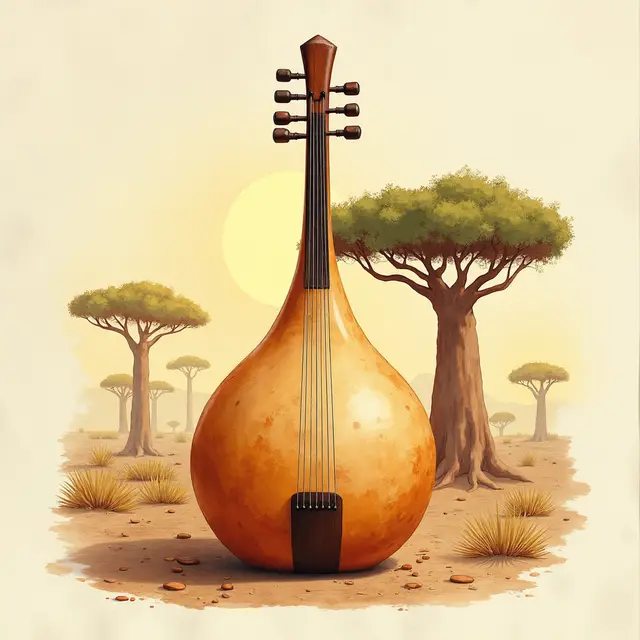
The late sun slants low, turning the fine dust hanging over the tall savannah grass the color of old gold. You are sitting beneath the massive shade of a baobab tree that still holds the day's heavy heat. A few yards away, a dry riverbed scars the earth with pale stone. The air smells of toasted soil, dry wood, and the thin smoke of a camp fire just beginning to take hold. Across from you, someone holds a large calabash resonator draped in cowhide, pierced by a long wooden neck strung with twenty-one taut lines.
The player tunes with a dry, almost imperceptible twist of a peg. Then the strings fall. They do not strike; they spill like clean water over warm stones, a continuous, luminous cascade that leaves no room for empty space. The steady pulse of the kumbengo sets a pace as patient as an ancient river, while the notes cascade above it like mountain runoff. There is no rush here. Every name spoken aloud hangs heavy in the air, weighted with history and memory, caught between the hands of the teller and the listener.
The world slows down until nothing remains except the water of the strings wetting the evening.
Palette: orange gold / ochre / brown / olive green / savanna yellow
- BPM
- 90 BPM
- Family
- Distant Worlds
- Serial
- MUN-25
- Rarity
- Common
- Style strength
- 94
- Experimentation
- 28
Typical structure
[Kumbengo pattern] → [Griot verse] → [Birimintingo] improvisation → [closing theme]
The data above is copied in a minute. What cannot be copied is the criteria: how to meter the twenty-one-string cascade so the music never drowns out the griot, and precisely how to name the past without sounding like a school lesson. All of that lives in an unpublished internal distillate of eight parameters that the engine crosses with your story before writing a line. Upon finishing, an internal judge measures the lyrics against six dimensions of the canon and orders repairs on anything missing the mark. The notes are played. The memory, not.
How a lyric in this style thinks
A lyric in Kora Mandinga does not narrate so much as it witnesses. The words arrive as testimony rather than story, placing names and lineages into the air the way the griot places each phrase between the cascading runs of the kora — carefully, with weight, allowing the silence around each statement to do as much work as the statement itself. This is music built for collective memory, and the lyric reflects that purpose: it does not rush toward resolution, it accumulates. The Kora Mandinga song holds a family history the way a baobab holds water inside its trunk, invisibly, under pressure, over decades.
The base tone is ochre and still. Emotion in this genre does not spike or break; it rises the way heat rises off warm stone in the late afternoon — gradually, perceptibly, without drama. A lyric that reaches for sudden grief or sudden joy will ring false here. Instead, the emotional movement comes through accumulation of concrete detail: the name of a grandparent spoken twice, a border crossing described not by its danger but by what was carried across it, a roof that held through one particular season of heavy rain.
The sensory field is dry and elemental — dust, wood smoke, pale riverbed stone, the smell of toasted earth, the texture of cowhide stretched over a calabash resonator. There is no chrome, no neon, no urban surface of any kind. The imagery lives close to the ground and close to the body.
Rhythm in Kora Mandinga follows the logic of the kumbengo, the repeating ostinato pattern the kora plays beneath everything else. The lyric line tends toward longer, patient phrases that breathe with that steady pulse at roughly 90 BPM — never rushing, never syncopating into urgency. Repetition is structural and intentional. A name or a phrase repeated is not a failure of imagination; it is the griot's method of pressing meaning deeper into the listener, of insisting that this detail be retained.
Line lengths vary, but the lyric always returns to its anchor phrase the way the kora always returns to the kumbengo. The birimintingo sections — the improvised, cascading solo passages — give the lyric permission to open outward briefly before the closing theme draws everything back to the original statement.
Structurally, a Kora Mandinga lyric opens with the kumbengo pattern establishing mood before a single word is spoken. The griot verse arrives into that prepared space, and it does not introduce itself — it begins in the middle of the memory, as though the listener already knows the family and merely needs reminding. The birimintingo improvisation that follows is the lyric's emotional peak, but it is instrumental and wordless; the words have already done their work, and the kora takes over to say what language cannot. The closing theme returns the lyric to its opening tone, often repeating the central name or place one final time, sealing it rather than resolving it.
What separates a genuine Kora Mandinga lyric from a generic imitation is the discipline to stay still. Most imitations reach for ornament too quickly — they add metaphor where the genre wants plain statement, they vary the emotional register where the genre wants constancy, they explain what the genre trusts the listener to feel. The griot tradition assumes an audience that will do the interior work if the exterior detail is precise enough.
Give the listener the specific surname, the specific season, the specific object carried across the border. Trust the cascading strings to carry the feeling. The lyric's job is to name things accurately, in the right order, with patience. That patience is not a stylistic choice — it is the content itself.
- 21-STRING CASCADE
- GRIOT MEMORY
- MANDINGA
Sample excerpt
Your father walked the dust from Kankan at dawn, with a bundle of dried grain tied in goat hide. He knew the names of the wells by the taste of the earth, and he taught you that a house is only as strong as its silence. Twenty years of rains have washed over these walls, yet your grandfather’s wooden stool still sits by the threshold.
The river carries the name, the river holds the stone, you are the vessel built from the clay of the ancestors. Keep the path open, let the amber light guide the lineage.
Workshop note — The Mandinga style relies on the griot's rhythmic storytelling, where lines are measured and steady to match the cascading pulse of the kora. This sample works because it focuses on specific, tactile legacies—like a wooden stool or a pouch of grain—rather than vague emotions. Avoid rushing the rhythm; each line should feel like a stone placed deliberately in a riverbed to mark a path for those who follow.
Sample excerpt written by MUSAI Song. Your lyrics are written from scratch, based on your story.
When to choose this style
Choose this card when you need a family story to survive the passage of time. It works to name the grandparents who crossed borders carrying nothing but their own names, to thank the one who kept the roof steady when everything else collapsed, or to trace the origin of a surname that still matters. This is the right carta when collective memory outweighs individual flash, and when the heritage of a people or a bloodline becomes a river that keeps flowing downward.
It serves to honor those who are gone without slipping into complaint, placing names on the table like sacred stones. Do not choose it for stories of fast urban life, modern breakups full of noise, or celebrations where only the immediate present counts. Manding music asks for stillness and an ancient dignity that cannot be rushed. If you are looking for a harsher, more distant sound where memory is carried through raw ache, the carta is Armenian Duduk.
Your story in this style
MUSAI Song writes original lyrics from your story, in the Mandinka Kora style, and delivers the finished sung song, the ready-to-use style recipe, and an illustrated art plate with its numbered certificate, private by default; public only if its owner publishes it.
- Original lyrics written from your story
- A finished sung song, ready to play and share
- Art plate with a unique seal and a numbered certificate, private by default; public only if its owner publishes it
Frequently asked questions
What BPM is Mandinka Kora?
Mandinka Kora usually runs at 90 BPM.
What does Mandinka Kora sound like?
A 21-string kora cascading like water while the griot tells the story. Mandinga music, the living memory of West Africa, flows like a luminous waterfall.
What song structure does Mandinka Kora use?
[Kumbengo pattern] → [Griot verse] → [Birimintingo] improvisation → [closing theme]
How do I write Mandinka Kora lyrics?
Tell MUSAI Song your story and pick Mandinka Kora: it writes original lyrics for this style at 90 BPM, you edit them word by word, and you get the song sung in Mandinka Kora, with an illustration of the song and its numbered certificate. $19 USD per song, one-time payment.
Explore more styles
- Afrobeat (Fela)
- Algerian Raï
- Anatolian Psych Rock
- Andalusian Music
- Arabic Flamenco Fusion
- Arabic Music (Tarab)
- Armenian Duduk
- Balinese Gamelan
- Balkan Cinema Fusion
- Bhangra
- Bollywood Filmi
- Bosnian Sevdah
- Carnatic
- Cinematic World Fusion
- Congolese Rumba
- Congolese Soukous
- Desert Blues Tuareg
- Ethio-Jazz
- Greek Laïkó
- Hindustani Raga
- Indo-Jazz Fusion
- Iraqi Maqam
- Mongolian Throat Singing
- Ottoman Classical
Your idea or story, sung in this style
Card · secure payment via Stripe, charged in USD
If it doesn't move you, we give you your money back · 7 days