Armenian Duduk
Some grief is so ancient it no longer needs words — just breath.
Get your song in Armenian Duduk
Make yours in this styleHear it before you pay.$19 USD · your first song for $5.50 USDIf it doesn't move you, we give you your money back · 7 days.
Armenian Duduk is a style from the Distant Worlds family. 58 BPM, Experimentation 26, Style strength 95.
What is Armenian Duduk?
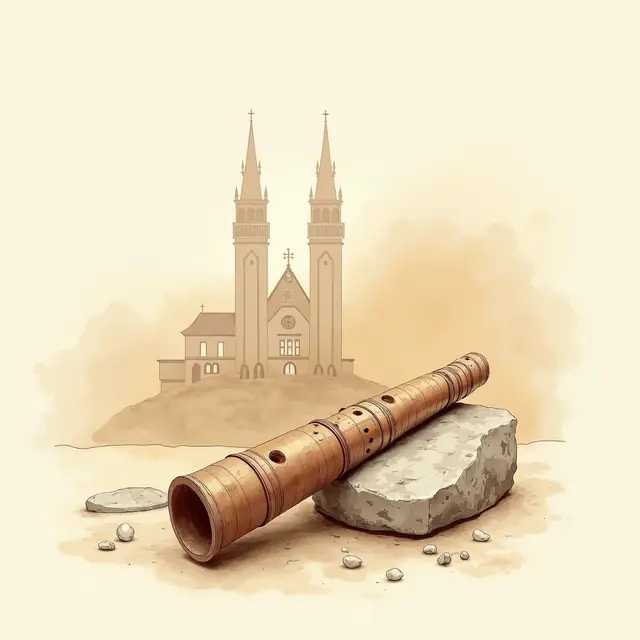
A reed duduk crying the oldest sorrow known to humankind. Armenian music, the sacred lament of the Caucasus: deep, spiritual, and heartbreaking.
How it sounds
The air smells of cold stone and burnt-down wax inside a monastery where light no longer enters through glass, but seeps in, heavy and amber, through cracks in the rock. It is six in the evening on the slopes of Mount Ararat, and the air outside drops with the force of a knife slicing through the mist. You are sitting on a dark wooden bench, hands locked between your knees, staring at the damp flagstone floor. There is no rush here. Time measures things differently.
The low drone begins before you even notice: a dense, continuous hum that comes not from a speaker but from the floor itself, vibrating through the soles of your feet and climbing your spine until the back of your neck grows stiff. Then the apricot wood reed opens the melody. It is not a sharp or strangled sound; it is a thick, rounded voice that seems to drag across the floor looking for something it lost centuries ago.
Each note holds longer than you thought possible, floating in air thick with cold incense, until it fades slowly, in no hurry to die. There is no fast beat or rhythm marking the steps. Only notes that turn the corner of grief and return to the exact same spot, like an old animal crawling back to its corner to finish the night. The walls swallow the sound. The cold settles into your knuckles. Outside, darkness has already claimed the valley, and the mountain is just a black mass pressing against your chest.
Palette: warm copper brown / stone gray / sand beige
- BPM
- 58 BPM
- Family
- Distant Worlds
- Serial
- MUN-30
- Rarity
- Common
- Style strength
- 95
- Experimentation
- 26
Typical structure
[Drone] → [duduk melody] → [mournful development] → [climax] → [final echo]
What you see on the sheet is just the surface. Behind this reed lies a subtle trap: the temptation to fall into ornamental flourishes and cheap self-pity. The duduk breaks if the lyrics turn melodramatic. All of that lives in an internal distillate of eight unpublished parameters, and the engine cross-references it with your history before writing a single line. When finished, an internal judge measures the lyrics against six dimensions of the canon and sends back anything that rings false for repairs. The instrument can be bought anywhere. The grief without shouting, cannot.
How a lyric in this style thinks
A lyric written for Armenian Duduk does not express grief so much as it holds grief still long enough to look at it. The genre is not a cry; it is a stone placed carefully on a flat surface. Where other forms let emotion move and resolve, the duduk lyric suspends the feeling in mid-air, the way the instrument's double-reed sustains a note far past the point where breath seems possible. What lands on the page here must carry the same quality: words that do not rush toward catharsis, lines that circle back to the same image the way an old animal returns to its corner, not because it expects something different but because that corner is the only honest place left.
The emotional register of Armenian Duduk sits in the territory of ancient, unspeakable weight. Not fresh rage, not howling sorrow, but something that has been carried for so long it has changed shape inside the body. Emotion in this genre arrives through restraint and accumulation, never through declaration. A line like 'I still see the door' lands harder than any metaphor about heartbreak, because the duduk itself is already supplying the ache. Your text does not need to compete with the instrument; it needs to lean on it the way you lean on a cold stone wall. Tone stays in copper brown and stone gray, never luminous, never resolving into warmth.
Repetition in this genre is structural and deliberate. The melody of the duduk returns to the same phrase over and over, each time with slightly different weight, and the lyric mirrors this. Short lines work best, often grammatically incomplete, because the drone underneath is already providing the continuous foundation. Line length should feel like breath held and then released slowly, not the quick in-and-out of conversational speech. The rhythm is not metered in a conventional sense; it floats above the 58 BPM pulse the way incense moves above a stone floor. Syllables should be open, vowel-heavy, capable of being held.
The sensory world of Armenian Duduk is precise and cannot be substituted. Cold stone, burnt-down wax, damp flagstone, the particular amber light that seeps through rock rather than glass, the feeling of weight settling into knuckles in a cold room. These are the textures this genre lives inside. What it never uses: anything electric or synthetic-feeling in the imagery, anything urban, anything that implies speed or the present tense of contemporary life.
The instrument itself is made from apricot wood, and that detail matters: the sound is organic, ancient, resonant with a specific geography. The Caucasus mountains, the monastery wall, the valley swallowed by darkness — these are not decorative; they are structural pillars of the lyric.
The section logic follows the canon of the form: a drone that establishes the harmonic floor before anything melodic arrives, then the duduk melody itself opening like a door into a room you recognize but have not entered in years, then a mournful development that deepens rather than accelerates, a climax that is not loud but dense, and a final echo that fades without resolution. The lyric, if present at all, should enter after the drone has settled and exit before the echo fully disappears.
Silence is not the absence of content here; it is content. What separates a real Armenian Duduk lyric from a generic imitation is exactly this: the imitation fills every available space with language, while the real thing understands that the reed is already speaking, and the words are only the human hand placed alongside it, not above it.
- WEEPING DUDUK
- SACRED LAMENT
- INSTRUMENTAL
Sample excerpt
The iron key sits cold on the oak table. I trace the deep scratches in the grain, where the dust gathers in the amber light. My grandfather left his boots by the door and walked into the fog without a sound.
The mountain shadow keeps the secret, a heavy stone in the valley of dry grass. We carry the silence he left behind.
Workshop note — The lyric works by prioritizing stillness and physical objects over emotional declarations, mirroring the duduk's mournful, drone-heavy atmosphere. Keep your lines brief and weighted with gravity, avoiding rhyme schemes that might sound too playful or modern. The genre rejects frantic pacing, so allow the rhythm to feel as heavy and slow as a long-settled winter frost.
Sample excerpt written by MUSAI Song. Your lyrics are written from scratch, based on your story.
When to choose this style
Choose this track when you carry an ancient ache that no longer bleeds but weighs like stone in your pocket. It works for a loss from years ago that time has failed to soften, turning it instead into something hard. For when you lost a place you know you will never return to, and you look back without anger, only with the certainty that the empty space stayed behind forever. To honor someone who bore life without making noise, the kind who bend their backs but never break.
It serves for a family memory carried in silence, a secret everyone knows but nobody names at the table. Do not choose it for a recent breakup that still burns, or for a frantic grief that needs to scream or hit a wall; the duduk has no room for hysteria or urgency. Neither for celebrating an achievement, a birthday, or a birth: its register is solemn, liturgical, and knows nothing of feasts. If you are looking for raw, electric tearing, the track is Anatolian Rock.
Your story in this style
MUSAI Song writes original lyrics from your story, in the Armenian Duduk style, and delivers the finished sung song, the ready-to-use style recipe, and an illustrated art plate with its numbered certificate, private by default; public only if its owner publishes it.
- Original lyrics written from your story
- A finished sung song, ready to play and share
- Art plate with a unique seal and a numbered certificate, private by default; public only if its owner publishes it
Frequently asked questions
What BPM is Armenian Duduk?
Armenian Duduk usually runs at 58 BPM.
What does Armenian Duduk sound like?
A reed duduk crying the oldest sorrow known to humankind. Armenian music, the sacred lament of the Caucasus: deep, spiritual, and heartbreaking.
What song structure does Armenian Duduk use?
[Drone] → [duduk melody] → [mournful development] → [climax] → [final echo]
How do I write Armenian Duduk lyrics?
Tell MUSAI Song your story and pick Armenian Duduk: it writes original lyrics for this style at 58 BPM, you edit them word by word, and you get the song sung in Armenian Duduk, with an illustration of the song and its numbered certificate. $19 USD per song, one-time payment.
Explore more styles
- Afrobeat (Fela)
- Algerian Raï
- Anatolian Psych Rock
- Andalusian Music
- Arabic Flamenco Fusion
- Arabic Music (Tarab)
- Balinese Gamelan
- Balkan Cinema Fusion
- Bhangra
- Bollywood Filmi
- Bosnian Sevdah
- Carnatic
- Cinematic World Fusion
- Congolese Rumba
- Congolese Soukous
- Desert Blues Tuareg
- Ethio-Jazz
- Greek Laïkó
- Hindustani Raga
- Indo-Jazz Fusion
- Iraqi Maqam
- Mandinka Kora
- Mongolian Throat Singing
- Ottoman Classical
Your idea or story, sung in this style
Card · secure payment via Stripe, charged in USD
If it doesn't move you, we give you your money back · 7 days