Carnatic
Every syllable arrives before the mouth has let it go.
Get your song in Carnatic
Make yours in this styleHear it before you pay.$19 USD · your first song for $5.50 USDIf it doesn't move you, we give you your money back · 7 days.
Carnatic is a style from the Distant Worlds family. 90 BPM, Experimentation 30, Style strength 96.
What is Carnatic?
Voice and mridangam weaving impossible rhythmic cycles with devotion. Carnatic music, the classical tradition of South India, is sacred mathematics: virtuosic and deeply spiritual.
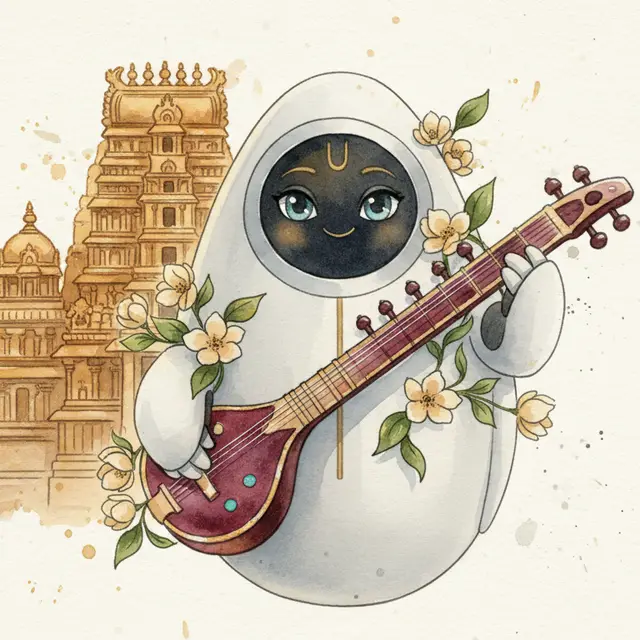
How it sounds
It is six in the evening inside a dark stone mandapam where the heavy Chennai humidity mixes with the scent of sandalwood powder and burnt sesame oil from the brass diyas. There are no pews; you stand barefoot on the cold granite that still holds the day's trapped heat.
In the center, the vocalist closes their eyes and the voice rises effortlessly, sliding through the microtones of a twilight raga, stretching every vowel with a precise tremor known as gamaka—a silk thread that never rests on the exact pitch, but rather in the invisible space right beside it.
To the right, the mridangam player strikes the drum with the heel of the palm, a sharp impact muffled by the wet rice paste patched onto the center hide, locking in a tala cycle that carves time into sixteen subdivisions no untrained ear could track without losing balance. The violin trails a fraction behind the vocal line, like a shadow that would rather duplicate the ache than leave it behind. The air smells of fresh jasmine braided into hair three rows ahead and fading charcoal embers.
The music does not beg for your attention; it surrounds you, forcing your breath to align with a mathematical pulse that beats like a second bloodstream, an ancient river moving toward the ocean without haste or mercy, until the entire room dissolves of walls and becomes a single vibration carrying the weight of the earth.
Palette: garnet / gold / turquoise / green
- BPM
- 90 BPM
- Family
- Distant Worlds
- Serial
- MUN-02
- Rarity
- Rare
- Style strength
- 96
- Experimentation
- 30
Typical structure
[Alapana] → [Kriti] → [Niraval improvisation] → [Swarakalpana] → [Tani Avartanam percussion]
Those details above take a minute to copy. What cannot be copied is the rigor: how to sustain emotional tension inside a mathematical structure so strict that a millisecond error breaks the spell, or how to control the weight of a gamaka without tipping into western operatic excess. That lives inside an unpublished internal distillate of eight parameters, which the engine crosses with your story before writing a single line. When it finishes, an internal judge measures the lyrics against six canons and sends back anything that misses the mark. The raga is in the texts. The exact devotion, not.
How a lyric in this style thinks
A lyric written for Carnatic music does not express devotion — it enacts it. The words exist to be dissolved into the raga, stretched across microtonal intervals until meaning arrives not through statement but through the physical sensation of sustained vowels bending in the invisible space beside a pitch. This is the core discipline of Carnática: language becomes a vessel that the music empties and refills with something the language could not hold on its own.
The lyric's job is to provide a grammatical skeleton that the vocalist and the veena can ornament into near-unrecognisability, each gamaka — that precise tremor that slides past the note rather than landing on it — carrying more emotional weight than any direct declaration ever could.
Emotion in this tradition arrives slowly, like heat rising from granite that has been absorbing sun all day. The base tone is reverence without urgency, a gratitude so settled it no longer needs to announce itself. Line lengths in a Carnatic lyric tend to be compact in their literal text, because each syllable will be extended, repeated, and turned over many times before the music releases it.
This means the lyric writer must choose words with long vowels and soft consonant clusters — sounds that can sustain the gamaka without choking the ornament. Repetition is structural, not rhetorical: a phrase returns not to emphasise but because the tala cycle, divided into sixteen or more subdivisions, demands that the text complete its own rhythmic geometry before the mridangam can resolve. You are not repeating for effect; you are closing a mathematical interval.
The sensory field of Carnática is specific and cannot be substituted. Sandalwood, sesame oil, cold stone underfoot, jasmine braided into hair, the dull resonance of a drum patched with wet rice paste — these are the textures this music inhabits. The concrete objects that belong here are ancient and elemental: brass lamps, granite floors, the silk thread of a single vocal line. What the genre refuses is equally clear: no urban clutter, no synthetic brightness, no imagery that belongs to speed or youth or individual triumph.
The self does not celebrate itself here. Every image should point outward or inward, never upward toward personal glory. A lyric that insists on the singer's singularity will break the form from the inside.
Structurally, a Carnatic composition moves through distinct phases that mirror a kind of spiritual logic. The Alapana opens without percussion — pure melodic exploration, no fixed pulse, the raga introduced the way you might enter a dark room and wait for your eyes to adjust. The Kriti is the composed centrepiece, where text and melody are fixed and the lyric carries its clearest narrative weight.
The Niraval improvisation takes a single line from the Kriti and turns it endlessly, finding every angle; this is where a lyric line must be simple enough to survive infinite variation without losing coherence. The Swarakalpana replaces words with solmisation syllables, and the Tani Avartanam hands the architecture entirely to the mridangam. The lyric writer must understand that their words will govern only a portion of the total duration — and that the portions without words must already be implied in the emotional logic of what was written.
What separates a genuine Carnatic lyric from a generic imitation is the quality of surrender built into the text. Imitations tend to overwrite — they pile metaphors, insist on clarity, try to resolve the emotion before the music has had time to work. A real lyric in this genre leaves deliberate unresolved space, trusting the raga to complete what the words began.
The vocabulary traditionally draws from Tamil or Telugu, languages whose phonology suits the gamaka ornament naturally, but when writing in English the same principle applies: choose words that can be held in the mouth, that have room inside them for the voice to move. The mridangam locks the pulse at a tempo that feels unhurried at ninety beats per minute but subdivides internally into cycles no casual listener tracks consciously.
Write toward that internal complexity — not the surface slowness, but the intricate order underneath it, the sacred mathematics that makes every loss, every decade of quiet devotion, occupy its precise and irreplaceable position in the turning cycle.
- IMPOSSIBLE RHYTHMS
- SACRED MATHEMATICS
Sample excerpt
Seven beats pressed against the hollow palm, The brass lamp steady by the courtyard threshold. You brought the bitter broth in ceramic bowls, Forty monsoons turned without a single grievance. The garland wilts, the garnet border remains, Every breath measured to the turning drum.
No claim upon the fruit of what you gave, Only the hands open beneath the bell. We count the cycle round, and start again, Where every sorrow settles into gold.
Workshop note — Carnatic lyricism relies on rhythmic discipline and spiritual surrender rather than confessional angst or romantic clamor. The lines anchor themselves in daily ritual and the steady tally of time, evoking the mathematical precision of the underlying tala. The chorus dissolves individual pride into cyclical devotion, ensuring every repeated syllable serves reverence rather than personal ego.
Sample excerpt written by MUSAI Song. Your lyrics are written from scratch, based on your story.
When to choose this style
Choose this card when you need to name a devotion so absolute that everyday language falls short. It fits an unwavering gratitude toward someone who kept a household standing through a long illness without demanding explanations. For a love measured in decades rather than outbursts, rooted in surrender rather than possession. For a family ritual repeated year after year with the rigid precision of an old clock. For grief that has aged into sacred geometry, a clean order where every loss occupies its precise slot in the turning cycle.
Do not choose this for urban hustle, rapid youth romances, or noisy breakups filled with recrimination; carnatic music does not know how to scream or rush for effect. It also fails for celebrations centered entirely on individual ego, because this genre demands the total disappearance of the self. If you are looking for a secular prayer crossing distance through intricate strings and complex cycles, the card is Kora Mandinga.
Your story in this style
MUSAI Song writes original lyrics from your story, in the Carnatic style, and delivers the finished sung song, the ready-to-use style recipe, and an illustrated art plate with its numbered certificate, private by default; public only if its owner publishes it.
- Original lyrics written from your story
- A finished sung song, ready to play and share
- Art plate with a unique seal and a numbered certificate, private by default; public only if its owner publishes it
Frequently asked questions
What BPM is Carnatic?
Carnatic usually runs at 90 BPM.
What does Carnatic sound like?
Voice and mridangam weaving impossible rhythmic cycles with devotion. Carnatic music, the classical tradition of South India, is sacred mathematics: virtuosic and deeply spiritual.
What song structure does Carnatic use?
[Alapana] → [Kriti] → [Niraval improvisation] → [Swarakalpana] → [Tani Avartanam percussion]
How do I write Carnatic lyrics?
Tell MUSAI Song your story and pick Carnatic: it writes original lyrics for this style at 90 BPM, you edit them word by word, and you get the song sung in Carnatic, with an illustration of the song and its numbered certificate. $19 USD per song, one-time payment.
Explore more styles
- Afrobeat (Fela)
- Algerian Raï
- Anatolian Psych Rock
- Andalusian Music
- Arabic Flamenco Fusion
- Arabic Music (Tarab)
- Armenian Duduk
- Balinese Gamelan
- Balkan Cinema Fusion
- Bhangra
- Bollywood Filmi
- Bosnian Sevdah
- Cinematic World Fusion
- Congolese Rumba
- Congolese Soukous
- Desert Blues Tuareg
- Ethio-Jazz
- Greek Laïkó
- Hindustani Raga
- Indo-Jazz Fusion
- Iraqi Maqam
- Mandinka Kora
- Mongolian Throat Singing
- Ottoman Classical
Your idea or story, sung in this style
Card · secure payment via Stripe, charged in USD
If it doesn't move you, we give you your money back · 7 days