Arabic Flamenco Fusion
The footwork and the maqam have never owed each other an apology.
Get your song in Arabic Flamenco Fusion
Make yours in this styleHear it before you pay.$19 USD · your first song for $5.50 USDIf it doesn't move you, we give you your money back · 7 days.
Arabic Flamenco Fusion is a style from the Distant Worlds family. 100 BPM, Experimentation 32, Style strength 93.
What is Arabic Flamenco Fusion?
A flamenco guitar and an oud finding each other again after eight centuries apart. Flamenco árabe fusion is the embrace of southern Spain and northern Africa: passionate, hypnotic, and ancient all at once.
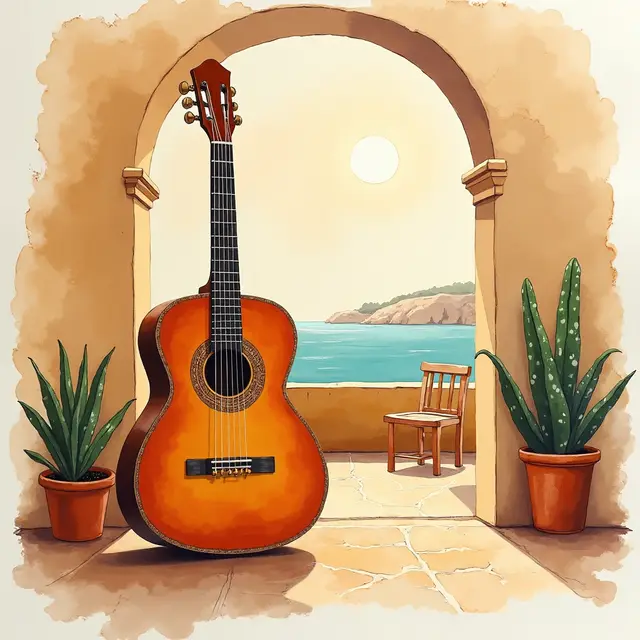
How it sounds
It is the final hour of late afternoon in a Cordoba courtyard where the stone heat still rises against the soles of your feet. The air smells of wilted jasmine and salt carried from a distant port. You sit on a low stool,forearms braced against your knees, staring at the chipped blue tile inside a dry fountain. Three meters away, a man bent over a dark wooden oud tunes the fourth string with a microscopic twist of the peg, hunting the exact quarter-tone the flamenco guitar on your left needs in order not to feel alone.
The first chord is not a strum: it is a dry strike against the soundboard that kicks up dust trapped between the bricks. The oud answers with a slow, descending scale that folds onto itself like smoke in a shut room. There is no meter yet, only the tension of two tunings recognizing each other before touching. The handclaps begin far off, muffled, marking a three-beat pulse that stretches toward northern duple time until both hands—the gypsy and the Moorish—fall together on the exact same beat.
Your skin breaks into goosebumps despite the heavy air. The voice enters without warning, cracked at the tip of the tongue, holding a long note that asks no permission to hurt or to take up residence in your chest.
Palette: amber orange / brown / turquoise / green / terracotta
- BPM
- 100 BPM
- Family
- Distant Worlds
- Serial
- MUN-28
- Rarity
- Rare
- Style strength
- 93
- Experimentation
- 32
Typical structure
[Taqsim-falseta] → [compás] → [Verse] → [climax with palmas] → [ecstatic close]
The data above is copied in a minute. What cannot be copied is the rigor: how to measure the exact distance between the flamenco fret and the maqam quarter-tone so memory stays in tune, or where to place the silence so the oud's breath sounds like a declaration rather than decoration. That lives in an internal distillate of eight un publicado parameters and the engine crosses it with the buyer's story. Upon finishing, an internal judge measures the lyric against six dimensions of the canon and orders repairs on what falls short. The rhythm is learned. The reconciliation, no.
How a lyric in this style thinks
A lyric in Flamenco Árabe Fusión does not describe longing — it enacts it. The words arrive already torn, already mid-sentence, as if the singer has been holding them since before the song began. This is a genre that earns its fractures honestly: the flamenco guitar and the oud are not decorating each other but negotiating, and the lyric must do the same. Two tonal systems coexist in the same room, the Spanish modal pull against the Arabic maqam, and the text has to live inside that unresolved tension rather than resolve it. If you write toward closure, you have already left the genre behind.
The structure follows a logic of gradual ignition. The taqsim-falseta section opens things with instrumental solo improvisation — the oud descending in slow quarter-tones while the flamenco guitar answers with a dry, percussive strike against the soundboard rather than a chord. No lyric should appear here, but if you are writing liner notes or a spoken intro, this is where a single fragmentary image belongs: a dry fountain, a tile with a crack running through the glaze, a port smell arriving on air that has no business carrying it.
When the compás locks in, the handclaps mark a three-beat pulse that keeps stretching toward duple time, and the verse enters on that instability. Lines in Flamenco Árabe Fusión tend to be long and asymmetrical, ending on a held vowel that the voice can crack open. Rhyme is loose, more sonic echo than strict scheme, because the melody is already doing the structural work.
The sensory field of this genre is specific and non-negotiable. Stone heat rising through leather soles. Wilted jasmine and salt. Dark wood, the amber of old varnish, the terracotta of a courtyard wall. Turquoise tilework chipped at the corner. These are not decorative choices — they are the genre's coordinates. What Flamenco Árabe Fusión never uses: anything clinical, anything ironic, anything that requires the listener to stand at a distance. The emotional delivery is direct to the sternum.
Production-wise, the vocals sit close in the mix, often slightly dry, with room reverb added sparingly so the cracked attack of the voice stays present. Palmas — the flamenco handclaps — enter the climax section not as rhythm decoration but as a second percussion voice answering the hand drum, and the lyric at that moment should be at its most stripped: a single repeated line, a name, a direction, a question that will not be answered.
What separates a real lyric in this genre from a generic imitation is the refusal to explain the duality. Amateur writing about two cultures tends to name both, to announce the bridge, to say look, here is where they meet. Flamenco Árabe Fusión does not announce the meeting — it places you already inside it, already past the introductions, already in the kitchen where the argument and the dancing are the same gesture.
The verse does not set up the climax with palmas; it accelerates into it the way a conversation accelerates when both people finally say the real thing. The ecstatic close is not a resolution. It is the moment when both tuning systems land on the exact same beat and the skin breaks into goosebumps precisely because that alignment cannot last. Write toward that beat, not past it.
- GUITAR AND OUD
- TWO SHORES REUNITED
Sample excerpt
Your ring of keys still hangs by the terracotta door I measure the dust left on the threshold of your silence My hands trace the grain of the floorboards like a dry riverbed While the oud remembers the humidity of a different morning The indigo shadow creeps past the chair where you sat Tracing the lines where the map split in two.
One shore pulses under the amber sun The other holds its breath beneath the moon I am the bridge that burns to stay warm.
Workshop note — This genre thrives on the friction between the sharp, percussive nature of the guitar and the microtonal, fluid phrasing of the oud. Keep the imagery grounded in physical objects like doors or keys to prevent the emotional weight from becoming too abstract. The chorus works best when it anchors the listener in the tension of dual belonging, using short, rhythmic lines that mimic the urgent beat of the palmas.
Sample excerpt written by MUSAI Song. Your lyrics are written from scratch, based on your story.
When to choose this style
Choose this card when your story refuses to fit inside a single language or a single shore. It works when you carry two homelands inside and neither fully claims you. For a love born between two worlds that eye each other with suspicion yet end up dancing in the same kitchen. For when you try explaining where you come from and ordinary words fall short, demanding a fracture that is urgent rather than sad.
For reuniting with a relative unseen since before the borders shifted, or for the dull guilt of leaving behind a land that still aches in the arches of your feet. This style is the map of dual memory: it serves when your goal is not to resolve the past, but to make it sound in the same room until it stops biting. Do not choose this for light tales, bright family celebrations, or griefs that require only quiet.
Neither for a simple reconciliation nor everyday gratitude: this genre knows no half measures and demands blood on the hands before it tunes. If you are looking for a direct, clean confession, the card is Duduk Armenio.
Your story in this style
MUSAI Song writes original lyrics from your story, in the Arabic Flamenco Fusion style, and delivers the finished sung song, the ready-to-use style recipe, and an illustrated art plate with its numbered certificate, private by default; public only if its owner publishes it.
- Original lyrics written from your story
- A finished sung song, ready to play and share
- Art plate with a unique seal and a numbered certificate, private by default; public only if its owner publishes it
Frequently asked questions
What BPM is Arabic Flamenco Fusion?
Arabic Flamenco Fusion usually runs at 100 BPM.
What does Arabic Flamenco Fusion sound like?
A flamenco guitar and an oud finding each other again after eight centuries apart. Flamenco árabe fusion is the embrace of southern Spain and northern Africa: passionate, hypnotic, and ancient all at once.
What song structure does Arabic Flamenco Fusion use?
[Taqsim-falseta] → [compás] → [Verse] → [climax with palmas] → [ecstatic close]
How do I write Arabic Flamenco Fusion lyrics?
Tell MUSAI Song your story and pick Arabic Flamenco Fusion: it writes original lyrics for this style at 100 BPM, you edit them word by word, and you get the song sung in Arabic Flamenco Fusion, with an illustration of the song and its numbered certificate. $19 USD per song, one-time payment.
Explore more styles
- Afrobeat (Fela)
- Algerian Raï
- Anatolian Psych Rock
- Andalusian Music
- Arabic Music (Tarab)
- Armenian Duduk
- Balinese Gamelan
- Balkan Cinema Fusion
- Bhangra
- Bollywood Filmi
- Bosnian Sevdah
- Carnatic
- Cinematic World Fusion
- Congolese Rumba
- Congolese Soukous
- Desert Blues Tuareg
- Ethio-Jazz
- Greek Laïkó
- Hindustani Raga
- Indo-Jazz Fusion
- Iraqi Maqam
- Mandinka Kora
- Mongolian Throat Singing
- Ottoman Classical
Your idea or story, sung in this style
Card · secure payment via Stripe, charged in USD
If it doesn't move you, we give you your money back · 7 days