Congolese Rumba
Kinshasa needs no excuse to let the guitar speak for everyone.
Get your song in Congolese Rumba
Make yours in this styleHear it before you pay.$19 USD · your first song for $5.50 USDIf it doesn't move you, we give you your money back · 7 days.
Congolese Rumba is a style from the Distant Worlds family. 110 BPM, Experimentation 22, Style strength 93.
What is Congolese Rumba?
Smooth guitars and warm brass locked into the most elegant groove in the Congo. Rumba congolesa, the root of all modern African music, sweet and luminous.
How it sounds
It is eight in the evening in an inner courtyard in Kinshasa where the air still holds the weight of the afternoon, warm and thick as palm oil. The green wooden shutters are wide open to catch the breeze from the Congo River, which barely arrives but is deeply welcomed. In the back, under the shade of a giant mango tree, someone wipes a damp cloth across the body of a single-coil semi-acoustic guitar, prepping it for the night. The wood has the matte sheen of years and the constant friction of fingertips against the frets.
There is no rush because no one is waiting. The groove starts before the instruments even sound: the brush of a hand on a thigh, the turn of a waist measuring space with precise geometry. The guitars enter in a double dialogue, rhythm and lead weaving in circular patterns, high notes falling like drops of cool water on a hot stone. Behind them, the brass section enters late, just to round out the air with a golden warmth that does not push, but embraces.
There are no shouts or jumps; movement here is a continuous line, a sway where the hips understand the geometry of the beat without an explanation. Cold beer bottles sweat on the formica table, water sliding down to form a tiny puddle. The sun drops all at once, swallowed by the horizon, and the music stretches into a sebene that does not break the rhythm, turning it liquid instead, a steady current carrying you with the softness of someone who knows exactly where they are headed.
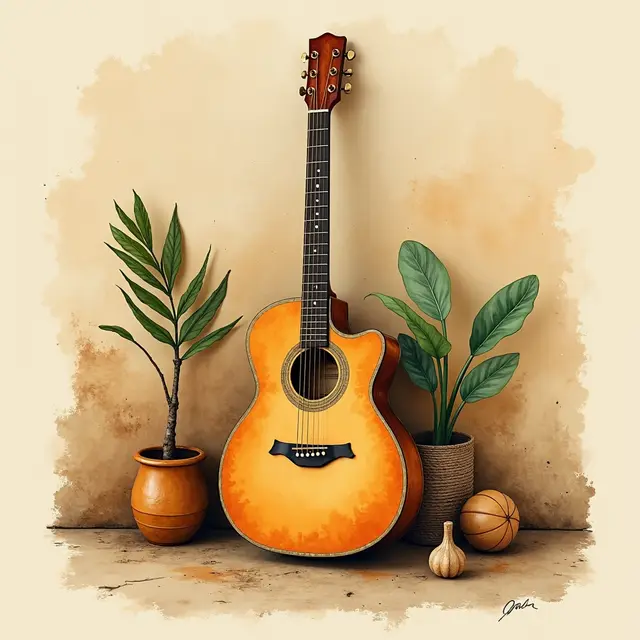
Palette: gold orange / warm brown / dark green
- BPM
- 110 BPM
- Family
- Distant Worlds
- Serial
- MUN-26
- Rarity
- Common
- Style strength
- 93
- Experimentation
- 22
Typical structure
[Guitar Intro] → [Melodic Verse] → [Chorus] → [Soft Sebene] → [Final Chorus]
The data above can be copied in a minute with any open tuning. What cannot be copied is the exact tension between the lightness of the picking and the gravitational weight of the bass, nor the way Lingala demands that every vowel falls just before the offbeat without feeling forced. That lives in an internal distillate of eight unreleased parameters, and the engine crosses it with the buyer's history so the lyrics carry the exact grace of a tailor-made suit. When finished, an internal judge measures the text against six dimensions of the canon and orders repairs on anything that breaks the elegance. The beat is found on any street corner. The sustained grace, not.
How a lyric in this style thinks
A lyric in Rumba Congolesa does not confess — it accompanies. Where other genres push toward revelation or catharsis, this one settles into the room beside you, matching your breathing, content to stay. The emotion arrives not through declaration but through sustained presence: a phrase repeated until it becomes familiar as a name, a melody that circles back not because it forgot where it was going but because it finds value in the return. Rumba Congolesa is the oldest trunk from which most modern Central and West African popular music branches, and its lyrical logic reflects that rootedness — patient, warm, structurally assured.
The base tone is amber-warm gratitude without sentimentality. Feeling in this genre does not spike; it accumulates. A verse earns its weight by accumulating small, specific images — the formica table, the damp cloth on the guitar body, the beer bottle sweating in the evening heat — rather than by naming the emotion directly. Repetition is not a weakness here but a mechanism of deepening: the chorus phrase returns not to remind you what the song is about but to let the meaning settle further into the body each time through.
Line lengths tend toward the mid-range, conversational without being clipped, and the rhythm of the lyric follows the guitar's circular phrasing rather than fighting it. You are writing for a voice that sways, not one that punches.
The sensory field of Rumba Congolesa is specific and non-negotiable. It lives in inner courtyards, open shutters, mango-tree shade, the last warmth of an afternoon that has not yet decided to become night. The textures are matte wood, damp skin, still-warm stone.
The instruments that anchor the lyric's emotional world are the single-coil semi-acoustic guitar — clean, slightly bright, with a sustain that feels like a hand resting on a shoulder — and a brass section that enters late and low, not to announce itself but to fill whatever space the guitars left open. What this genre never uses: cold, angular imagery; industrial or urban-industrial references; the vocabulary of urgency or rupture. No broken plates, no shouted names.
If you find yourself writing a lyric that sounds like someone is trying to be heard over noise, you have left the genre.
The structure follows a logic of gradual warmth rather than dramatic arc. The guitar intro is not an overture — it is an invitation, establishing the groove as a shared agreement before a single word is sung. The melodic verse carries the story in a register that is almost spoken-sung, close to conversation, with Lingala's vowel-rich cadences giving the lines a natural legato even when the subject is ordinary. The chorus does not erupt; it rises by about one degree, confirming rather than contrasting.
Then comes the sebene, the section that separates Rumba Congolesa from every imitation of it: the tempo does not accelerate so much as liquefy, the guitar lead opening into longer melodic runs, the lyric stepping back to let the body lead. The final chorus returns with the authority of something already proven.
What separates a real Rumba Congolesa lyric from a generic tropical ballad is the quality of its restraint. The generic version tells you what the feeling is. The real version places you in the courtyard at eight in the evening and trusts that you will feel it yourself. The subject — a long marriage, a brother who held the house steady, a return to the porch where family waits with a clean smile and a steaming pot — is treated as something already understood between the singer and the listener, needing no explanation, only the right groove to carry it. Love in this genre does not burn; it shelters. Write accordingly.
- SMOOTH GUITARS
- CONGOLESE ELEGANCE
Sample excerpt
The amber light leans against the kitchen wall, your hands move slow, tracing circles on the wood. Twenty years of dust and quiet mornings, you pour the tea without looking, knowing I am here. The floorboards hum under our shuffling feet, we do not need to speak to fill the heavy air.
Keep the rhythm steady, stay in the loop, we are the gold thread pulled tight through the cloth. Just this glide, just this ease.
Workshop note — This style relies on long, flowing sentences that mirror the fluid interplay of the guitars, avoiding choppy rhymes to maintain a sense of continuous motion. The chorus functions as a grounding mantra, emphasizing endurance and stability rather than fleeting passion. Avoid sharp, aggressive consonants or metaphors of conflict, as the music requires a soft, melodic delivery to let the brass sections shine.
Sample excerpt written by MUSAI Song. Your lyrics are written from scratch, based on your story.
When to choose this style
Choose this card when you need to tell of a reconciliation that requires no apologies, only shared time. It works to celebrate years accumulated with someone without falling into clichés, acknowledging the exact weight of companionship. For a wedding anniversary where bodies already know each other by heart and the only urgency is dancing close in the kitchen. For thanking an older brother who held the house together when the floor was shaking. For a return to your hometown where family waits on the porch with a steaming pot and a clean smile.
Congolese rumba is the card of sustained elegance: it serves when you want to convey that love or gratitude does not burn, but shelters. Do not choose it for a painful breakup, an urgent grief, or a family fight that left broken plates; this groove knows nothing of open wounds or shouting, and forcing it here would sound like a party where no one is celebrating. If you look for the raw urgency of distance and open-air cold, the card is Traditional Japanese.
Your story in this style
MUSAI Song writes original lyrics from your story, in the Congolese Rumba style, and delivers the finished sung song, the ready-to-use style recipe, and an illustrated art plate with its numbered certificate, private by default; public only if its owner publishes it.
- Original lyrics written from your story
- A finished sung song, ready to play and share
- Art plate with a unique seal and a numbered certificate, private by default; public only if its owner publishes it
Frequently asked questions
What BPM is Congolese Rumba?
Congolese Rumba usually runs at 110 BPM.
What does Congolese Rumba sound like?
Smooth guitars and warm brass locked into the most elegant groove in the Congo. Rumba congolesa, the root of all modern African music, sweet and luminous.
What song structure does Congolese Rumba use?
[Guitar Intro] → [Melodic Verse] → [Chorus] → [Soft Sebene] → [Final Chorus]
How do I write Congolese Rumba lyrics?
Tell MUSAI Song your story and pick Congolese Rumba: it writes original lyrics for this style at 110 BPM, you edit them word by word, and you get the song sung in Congolese Rumba, with an illustration of the song and its numbered certificate. $19 USD per song, one-time payment.
Explore more styles
- Afrobeat (Fela)
- Algerian Raï
- Anatolian Psych Rock
- Andalusian Music
- Arabic Flamenco Fusion
- Arabic Music (Tarab)
- Armenian Duduk
- Balinese Gamelan
- Balkan Cinema Fusion
- Bhangra
- Bollywood Filmi
- Bosnian Sevdah
- Carnatic
- Cinematic World Fusion
- Congolese Soukous
- Desert Blues Tuareg
- Ethio-Jazz
- Greek Laïkó
- Hindustani Raga
- Indo-Jazz Fusion
- Iraqi Maqam
- Mandinka Kora
- Mongolian Throat Singing
- Ottoman Classical
Your idea or story, sung in this style
Card · secure payment via Stripe, charged in USD
If it doesn't move you, we give you your money back · 7 days