Desert Blues Tuareg
The sand keeps the rhythm far better than any city ever could.
Get your song in Desert Blues Tuareg
Make yours in this styleHear it before you pay.$19 USD · your first song for $5.50 USDIf it doesn't move you, we give you your money back · 7 days.
Desert Blues Tuareg is a style from the Distant Worlds family. 92 BPM, Experimentation 30, Style strength 94.
What is Desert Blues Tuareg?
Electric guitar looping like a mirage shimmering over the sand. Tuareg desert blues, the trance of the Sahara, hypnotic, nomadic, and endless.
How it sounds
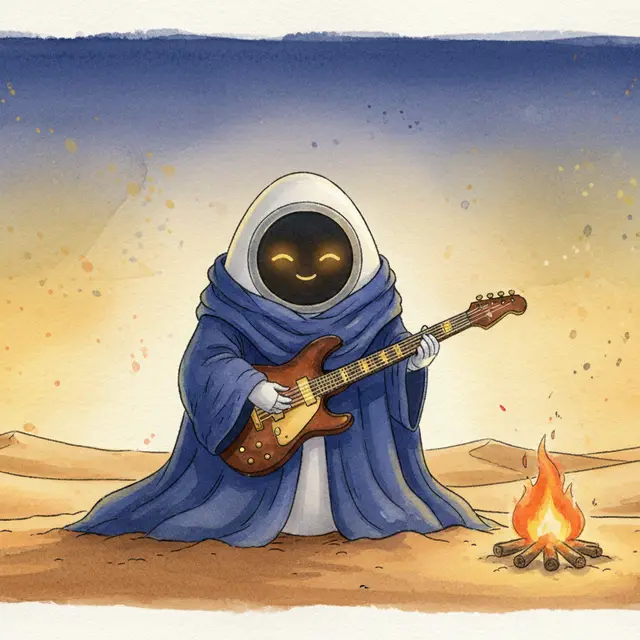
It is nine at night, three hours past the last paved road. The sand that burned through your boot soles at noon is dumping its heat so fast you can feel the chill climbing your ankles. In front of you, an acacia wood campfire breathes a thick, sweet smoke, surrounded by six men wrapped in yards of indigo cotton that cover up to their cheekbones. One of them rests a battered Fender Stratocaster across his lap.
There is no stage here and no heavy PA system: just a compact amp hooked up to a truck battery and an analog delay pedal whose red LED blinks the pace of everything to come. When the first strum hits in open tuning, the guitar doesn't sound clean or distorted; it sounds like a steel wire dragged through the wind. A three-note riff loops onto itself, spinning until you lose track of time and measures.
Beside him, palms begin striking the head of a tuned djembe, and the surrounding circle joins in with dry handclaps on the offbeat, locking the ninety-two BPM with ancient precision. A gravelly voice hurls a short phrase in Tamasheq out into the dark, and a second later, three voices respond in harmony, throwing the line back one step lower. There is zero hurry. The trance doesn't grab you all at once; it settles like fine dust between the seams of your jacket.
You feel the leather and steel vibrating against your teeth, and the horizon fades into a bottomless dark line where distance stops making sense.
Palette: blue indigo / sand ochre / fire orange
- BPM
- 92 BPM
- Family
- Distant Worlds
- Serial
- MUN-21
- Rarity
- Rare
- Style strength
- 94
- Experimentation
- 30
Typical structure
[Hypnotic Riff] → [Verse] → [call-and-response chorus] → [trance groove] → [final chorus]
The parameters listed above are merely the outer shell. What stays off the page is how to build lyrics around hypnotic repetition without becoming monotonous, or how to tune the call-and-response refrain so it sounds like shared tribal memory rather than a dry translation. Those nuances live in an internal blend of eight hidden parameters that the engine matches against your personal story before writing a single line. When finished, an internal judge evaluates the text across six canonical dimensions and corrects anything out of line. You can copy the guitar loop. You cannot copy the vastness.
How a lyric in this style thinks
A lyric in Desert Blues Tuareg does not arrive to explain itself. It states a condition — the sky before a sandstorm, the weight of an absent elder, the particular silence between two people who have known each other longer than any city they have lived in — and then it circles that condition the way a hawk circles thermals, never landing, never resolving. The genre works by accumulation rather than argument. Emotion does not climb toward a climax; it settles, as fine particulate settles, until the listener realizes they have been inside the feeling for some time without knowing when it entered.
The base tone is arid and patient. Grief here is not wet or theatrical; it is the kind that has dried out over years and become structural, like the ridgeline of a dune. The call-and-response architecture is not a stylistic flourish — it is the skeletal logic of the whole form. A short phrase is hurled outward, often just four to seven syllables, and the answering voices return it slightly transformed, a step lower, a shade darker. When you write the call line, write it as a declaration or a question that does not wait for an answer. The response line is not an answer either; it is an echo that knows something the caller does not. That asymmetry is where the tension lives.
Line length in Desert Blues Tuareg stays short and percussive. Long, subordinate-clause sentences belong to a different landscape. The rhythm locks to the ninety-two BPM grid with the handclaps and the djembe, which means syllables need to land on time without being hurried. Open tuning on an electric guitar — often a battered Stratocaster run through an analog delay set to a long, blinking repeat — creates a three-note riff that loops until the measure dissolves.
Your lyrics should carry that same quality: a phrase that sounds complete, then repeats with one word shifted, then repeats again until the listener cannot remember which iteration was first. That is the trance mechanism, and it is entirely intentional.
The sensory field is specific and irreplaceable. Sand that has released its heat by nine at night, acacia smoke, indigo cotton pressed against a face, the vibration of steel strings felt in the teeth rather than heard through speakers, a horizon that has become a pure dark line. These are the textures that anchor the form. What this genre refuses: neon, glass, speed, the vocabulary of convenience. There is no room for a lyric that could have been written indoors.
The concrete objects must carry geological weight — they should feel like they predate the singer by several generations. If your imagery could belong to a highway or an apartment, revise it until it belongs only to open ground under stars.
Structurally, the form opens with the hypnotic riff establishing the tonal center before a single word is sung. Resist the urge to rush the verse in. The verse carries the story — a migration, a bond, a heritage that will not release its hold — in spare, declarative language. The call-and-response chorus does not summarize or underline; it widens the frame, pulling the personal out toward something communal and ancient. The trance groove section is instrumental in spirit even when voices are present: syllables become texture, not narrative. The final chorus returns the opening phrase but the listener hears it differently now, which is the only resolution this genre offers or needs.
What separates a genuine Desert Blues Tuareg lyric from a generic imitation is the refusal of urgency. Every instinct trained by contemporary songwriting will push you toward the payoff, the turn, the release. Resist all of it. The desert has no patience for tight schedules or theatrical confessions, and neither does this form. A lyric that earns the genre is one that could be sung in three-minute segments across four hours of a campfire night and feel, each time, like it has only just begun.
- MIRAGE GUITAR
- SAHARAN TRANCE
Sample excerpt
The dry well remembers the taste of the rain We walk on the salt where the camel bones lie My uncle left dust on the edge of his blade And the horizon burns like an ember at dusk
O wind from the south, carry my name Carry my name across the wide sand O wind from the south, carry my name We left our tracks where the storm has passed
Workshop note — This excerpt uses sparse, grounded imagery to create a hypnotic trance. The repetition in the chorus acts like a continuous guitar loop, allowing the lyrics to breathe and stretch across the desert landscape without rushing.
Sample excerpt written by MUSAI Song. Your lyrics are written from scratch, based on your story.
When to choose this style
Pick this card when your story belongs to a distant root that refuses to fade, a heritage that keeps pulling at you even ten thousand miles away. It works when a grandfather left you nothing but the quiet habit of reading the sky before speaking. For honoring a long migration, the journey of a family that crossed borders carrying nothing but their names. For the deep bond between lifelong friends who can go years without speaking and pick up the exact same thought over a fire or a drink.
Do not pick it for urgent city romance, sudden bursts of rage, or a fast-paced night out. The desert demands room to breathe and has no patience for tight schedules or theatrical confessions. It won't suit a recent apology that is still looking for someone to blame. If you are looking for wind-swept mystical grief and a slow lament over loss, the card is Armenian Duduk.
Your story in this style
MUSAI Song writes original lyrics from your story, in the Desert Blues Tuareg style, and delivers the finished sung song, the ready-to-use style recipe, and an illustrated art plate with its numbered certificate, private by default; public only if its owner publishes it.
- Original lyrics written from your story
- A finished sung song, ready to play and share
- Art plate with a unique seal and a numbered certificate, private by default; public only if its owner publishes it
Frequently asked questions
What BPM is Desert Blues Tuareg?
Desert Blues Tuareg usually runs at 92 BPM.
What does Desert Blues Tuareg sound like?
Electric guitar looping like a mirage shimmering over the sand. Tuareg desert blues, the trance of the Sahara, hypnotic, nomadic, and endless.
What song structure does Desert Blues Tuareg use?
[Hypnotic Riff] → [Verse] → [call-and-response chorus] → [trance groove] → [final chorus]
How do I write Desert Blues Tuareg lyrics?
Tell MUSAI Song your story and pick Desert Blues Tuareg: it writes original lyrics for this style at 92 BPM, you edit them word by word, and you get the song sung in Desert Blues Tuareg, with an illustration of the song and its numbered certificate. $19 USD per song, one-time payment.
Explore more styles
- Afrobeat (Fela)
- Algerian Raï
- Anatolian Psych Rock
- Andalusian Music
- Arabic Flamenco Fusion
- Arabic Music (Tarab)
- Armenian Duduk
- Balinese Gamelan
- Balkan Cinema Fusion
- Bhangra
- Bollywood Filmi
- Bosnian Sevdah
- Carnatic
- Cinematic World Fusion
- Congolese Rumba
- Congolese Soukous
- Ethio-Jazz
- Greek Laïkó
- Hindustani Raga
- Indo-Jazz Fusion
- Iraqi Maqam
- Mandinka Kora
- Mongolian Throat Singing
- Ottoman Classical
Your idea or story, sung in this style
Card · secure payment via Stripe, charged in USD
If it doesn't move you, we give you your money back · 7 days