Bhangra
The harvest can wait. Your feet cannot.
Get your song in Bhangra
Make yours in this styleHear it before you pay.$19 USD · your first song for $5.50 USDIf it doesn't move you, we give you your money back · 7 days.
Bhangra is a style from the Distant Worlds family. 140 BPM, Experimentation 20, Style strength 93.
What is Bhangra?
Thundering dhol and a bouncing tumbi in pure harvest joy. Bhangra, the Punjabi folk dance music, is Punjab's most energetic celebration — explosive, festive, and completely irresistible.
How it sounds
It is midday and the sun beats flat against the mustard fields of Punjab, dyeing the dense air a blinding yellow. Orange dust kicks up from the dry earth with every step, sticking to the sweat on bare arms and foreheads. There is no shade for miles. In the distance, an old tractor sputters and dies, but the real sound comes from the center of the clearing, where calloused hands strike the drumheads of a dhol with the force of a hammer hitting an anvil.
The sound does not just reach your ears; it rattles your ribs, shoves your diaphragm, and forces your body to keep time before your brain can process it. Right above that heavy thunder, a tumbi cuts the air with a bright, metallic ping, bouncing like a spark off flint. Someone unwraps a soaked turban and waves it overhead as a cluster of people link arms, locking into a human chain that stomps the ground with coordinated, joyful fury.
The music is not soundtracking the party: it is the engine itself, spinning so fast it cannot be stopped, a collective impulse where nobody dances to be watched, but to make the earth answer back.
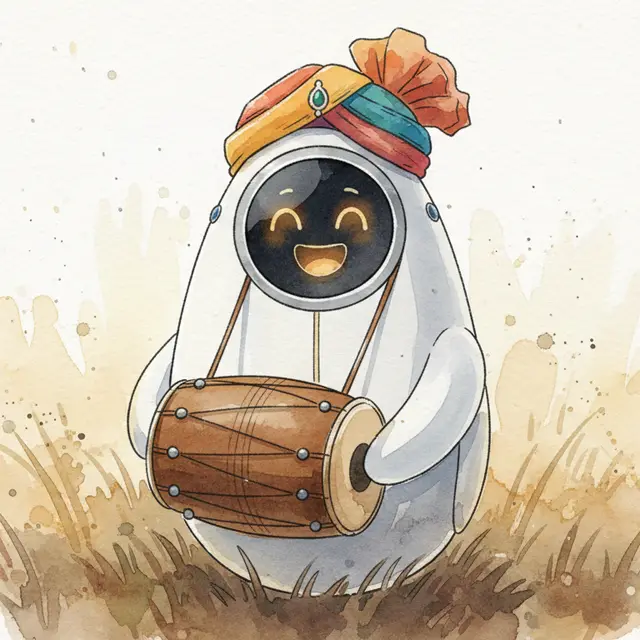
Palette: turban turquoise orange mustard yellow
- BPM
- 140 BPM
- Family
- Distant Worlds
- Serial
- MUN-05
- Rarity
- Common
- Style strength
- 93
- Experimentation
- 20
Typical structure
[Dhol Intro] → [Verse] → [Chorus] → [Percussion break] → [Final chorus]
What you see above is merely the surface scenery. The real hurdles in this genre are twofold: keeping the celebratory tension alive for three minutes without sounding like an ad agency, and writing a group call-and-response that avoids sounding like a stadium chant. That lives in an internal distillate of eight unreleased parameters that the engine crosses with your story before a single line is written. Once finished, an internal judge measures the lyrics against six dimensions of the canon and sends back anything that misses the mark. The rhythm can be copied. The raw drive of the dhol, cannot.
How a lyric in this style thinks
A bhangra lyric does not describe a celebration — it becomes the physical mechanism that makes one happen. The words are not there to be read or even heard clearly; they are there to be felt through the chest wall, launched from the throat in short bursts that land exactly on the dhol's downbeat and vanish before the next strike arrives. This is a genre where the voice functions like a percussion instrument with pitch, and every line is a cue for the body to respond. The emotional payload is not built slowly; it detonates on the first beat and sustains that detonation for the entire track. Bhangra does not warm up — it arrives at full force and stays there.
The tone is unambiguously triumphant, but triumph here is physical and communal rather than reflective. There is no room for the interior monologue, no space for the singer to pull back and comment on the joy from a distance. The emotion arrives through volume, velocity, and repetition — a short phrase hammered three or four times until the crowd can shout it back without thinking.
Line lengths are short and punchy, often three to five syllables in the original Punjabi tradition, and when you adapt that logic to English you want the same compressed weight: one idea, no subordinate clauses, delivered before the next dhol strike lands. The chorus in a bhangra structure is less a melodic peak and more a collective exhale — everyone in the room says the same thing at the same time, and the saying is the event.
The sensory world bhangra inhabits is brutally specific: dry earth, open sky, the physical shock of a drumhead struck with the flat palm, mustard fields burning under noon sun, orange dust coating every surface, the particular ache of arms linked with strangers who become family inside eight bars.
The tumbi — a single-stringed instrument that cuts above the dhol like a spark above thunder — gives the lyric its bright counterpoint, and a well-written bhangra verse should carry that same contrast: something heavy and grounded answered immediately by something quick and metallic. What bhangra never uses is softness of any kind. No candlelight, no rain on windows, no whispered confessions. The genre does not know interior spaces. Every image must be able to survive in direct sunlight with the wind blowing.
Structurally, bhangra follows a logic that is almost architectural in its clarity: the dhol intro establishes the pulse before a single word is sung, the verse delivers the specific story in compressed snapshots, the chorus locks the central declaration into memory through sheer repetition, the percussion break strips everything away so the body can reset, and the final chorus lands with extra mass because the break has built the tension back to maximum.
When you write for this structure, resist the urge to save your best line for the final chorus — bhangra front-loads its energy. The first verse should already feel like a finish line being crossed. The festive call-outs scattered through the arrangement — short, wordless or near-wordless vocal stabs — function as punctuation, and leaving space for them in the lyric is not an omission, it is craft.
What separates a genuine bhangra lyric from a generic imitation is the refusal to explain the joy. Generic versions tell you that people are happy, that the harvest came in, that the family endured. Real bhangra shows calloused hands hitting drumheads, shows the soaked turban waving overhead, shows the stomp that makes the earth answer back. At 140 BPM with a booming dhol driving everything forward, the lyric has no time for abstraction.
Every word must earn its place by adding weight or velocity to the moment, and anything that slows the forward motion — a qualification, a second thought, a tender aside — belongs in a different genre entirely. Bhangra does not whisper, does not pause to consider, and does not apologise for taking up space.
- THUNDERING DHOL
- HARVEST JOY
Sample excerpt
Six years of iron gears grinding in the shed, Oil stains permanent on the calloused skin, We traded sleep for the hum of the heavy lathe, Now the floorboards shake as the drums begin, Lift the shutter high, let the morning sun spill, The engine finally roars like a mountain bull.
Shake the dust from the rafters, let the pulse ignite, We earned the gold of the harvest through the long dark night, Turn the volume to the edge, let the shoulders sway, Everything we built is standing tall today.
Workshop note — Bhangra thrives on short, punchy lines that mirror the rhythmic thud of the dhol, creating a momentum that demands physical movement. The chorus functions as a communal declaration, focusing on collective achievement rather than individual reflection. Avoid contemplative or abstract themes, as the genre requires high-energy, concrete imagery to sustain its celebratory, explosive spirit.
Sample excerpt written by MUSAI Song. Your lyrics are written from scratch, based on your story.
When to choose this style
Choose this card when you want to mark a shared milestone that refuses to fit into a quiet dinner. It works when a crew finishes a grueling multi-year project and needs to scream the exhaustion out of their lungs. For the anniversary of a family business that weathered every storm and throws its doors wide open today. For the birthday of someone who despises ballads and prefers noise, dust, and full-body motion. For a wedding where families actually collide and the joy is explosive rather than polite.
Do not pick this for an intimate two-person talk, a late-night confession, or a hushed reconciliation; bhangra does not know how to whisper and will shatter if forced to hold sadness. It is also useless for grief that still demands answers. If what you need is melancholic warmth or a quiet embrace, the card is Kora Mandinga.
Your story in this style
MUSAI Song writes original lyrics from your story, in the Bhangra style, and delivers the finished sung song, the ready-to-use style recipe, and an illustrated art plate with its numbered certificate, private by default; public only if its owner publishes it.
- Original lyrics written from your story
- A finished sung song, ready to play and share
- Art plate with a unique seal and a numbered certificate, private by default; public only if its owner publishes it
Frequently asked questions
What BPM is Bhangra?
Bhangra usually runs at 140 BPM.
What does Bhangra sound like?
Thundering dhol and a bouncing tumbi in pure harvest joy. Bhangra, the Punjabi folk dance music, is Punjab's most energetic celebration — explosive, festive, and completely irresistible.
What song structure does Bhangra use?
[Dhol Intro] → [Verse] → [Chorus] → [Percussion break] → [Final chorus]
How do I write Bhangra lyrics?
Tell MUSAI Song your story and pick Bhangra: it writes original lyrics for this style at 140 BPM, you edit them word by word, and you get the song sung in Bhangra, with an illustration of the song and its numbered certificate. $19 USD per song, one-time payment.
Explore more styles
- Afrobeat (Fela)
- Algerian Raï
- Anatolian Psych Rock
- Andalusian Music
- Arabic Flamenco Fusion
- Arabic Music (Tarab)
- Armenian Duduk
- Balinese Gamelan
- Balkan Cinema Fusion
- Bollywood Filmi
- Bosnian Sevdah
- Carnatic
- Cinematic World Fusion
- Congolese Rumba
- Congolese Soukous
- Desert Blues Tuareg
- Ethio-Jazz
- Greek Laïkó
- Hindustani Raga
- Indo-Jazz Fusion
- Iraqi Maqam
- Mandinka Kora
- Mongolian Throat Singing
- Ottoman Classical
Your idea or story, sung in this style
Card · secure payment via Stripe, charged in USD
If it doesn't move you, we give you your money back · 7 days