Andalusian Music
The water has been keeping the beat since before the kings arrived.
Get your song in Andalusian Music
Make yours in this styleHear it before you pay.$19 USD · your first song for $5.50 USDIf it doesn't move you, we give you your money back · 7 days.
Andalusian Music is a style from the Distant Worlds family. 76 BPM, Experimentation 24, Style strength 95.
What is Andalusian Music?
An Arab-Andalusian orchestra unfolding nubas a thousand years in the making. Andalusi music, the living bridge between Al-Andalus and the Maghreb, refined, noble, and luminous.
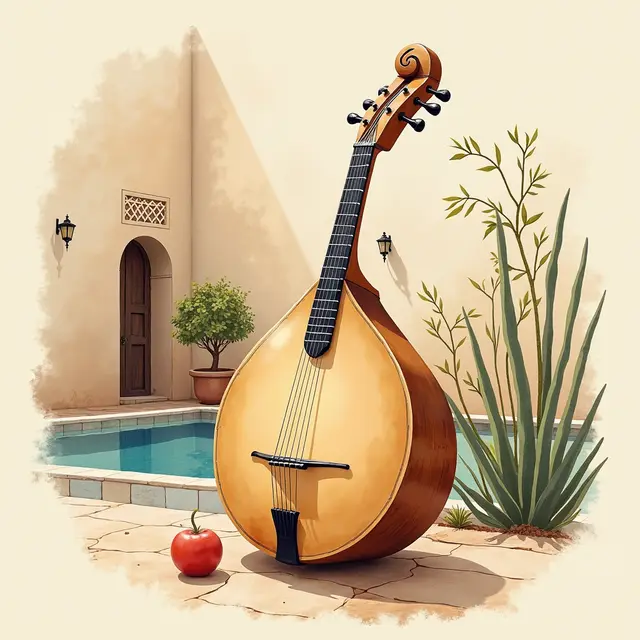
How it sounds
It is the final hour of the afternoon inside a secluded courtyard in Fez. The limestone walls have surrendered the day's heat, leaving behind a cool shade scented with wet mortar and orange blossom. You are seated on worn ceramic tiles as golden sunlight cuts diagonally across the carved plaster arches. In front of you, six seasoned musicians tune their instruments without urgency. The master of the oud runs a horn plectrum over rosewood; the sound does not boom, it vibrates deep inside timber aged for decades. Beside him, brass rings strike the seventy-eight strings of the qanun, a dry, precise shimmer that mirrors water dripping onto marble.
The mizan rhythm settles at seventy-six beats per minute. There is no hurry. The frame drum sets a deliberate pace for a nuba preserved solely by ear for ten centuries. When the two-stringed rebab enters, its horsehair bow draws across the wooden soundbox with a texture like raw silk dragged over fresh lime wall. The full orchestra joins in a unison chorus, filling the courtyard without raising its voice.
The tempo begins to accelerate so gradually that you do not register the shift in speed, only the gathering brightness: the melodic lines tighten, the ornamentation grows dense, and the initial calm builds into a dignified, luminous wave. You do not feel grief or loss; you feel the weight of something sculpted by time that needs no permission to endure.
Palette: honey gold / mahogany brown / turquoise blue / green / red
- BPM
- 76 BPM
- Family
- Distant Worlds
- Serial
- MUN-09
- Rarity
- Common
- Style strength
- 95
- Experimentation
- 24
Typical structure
[Slow mizan] → [gradual acceleration] → [orchestral chorus] → noble [cadence]
The figures above are merely the visible framework. What cannot fit into a table is how to balance ornate poetic imagery without turning the lyrics into a museum exhibit, or how to scale the narrative tension alongside the mizan's acceleration while maintaining orchestral restraint. That logic lives within an internal distillation of eight parameters that the engine crosses with your story. Once drafted, an internal judge evaluates the text against six dimensions of the canonical tradition and orders revisions if anything strays. Anyone can record an oud. The poise of the cadence cannot be faked.
How a lyric in this style thinks
A lyric written for Música Andalusí does not announce its feeling — it carries it the way carved plaster carries the memory of the hand that shaped it. The emotion arrives through accumulation, through the slow layering of image and invocation, never through a sudden declaration. This is classical Arab-Andalusian music built around the nuba, a multi-movement suite that has been passed down by ear across ten centuries, and the lyric form follows that architecture exactly: it begins in stillness, earns its brightness, and closes with the composed authority of something that has already outlasted doubt.
The base tone is dignified restraint. Grief, if it appears, is refined into elegy; joy, if it comes, arrives as luminous clarity rather than celebration. Emotion in Música Andalusí is architectural. A line does not erupt — it accumulates mass the way limestone accumulates warmth through an afternoon, releasing it only when the sun has moved on.
Repetition is central to the lyric logic: a phrase returns not because the writer ran out of ideas but because returning to it reveals new weight each time, the way the same courtyard looks different at the third hour than at the first. Line lengths tend toward the measured and even, holding a ceremonial cadence that mirrors the mizan, the rhythmic cycle set around seventy-six beats per minute at the opening, which only gradually quickens as the suite progresses.
The sensory world of Música Andalusí is specific and irreplaceable. Wet mortar and orange blossom, worn ceramic tile, the dry shimmer of brass rings on a qanun's strings, the texture of horsehair drawn slowly across aged timber — these are the textures a lyric reaches for. Water on marble, carved plaster, the diagonal cut of late afternoon light through an arch: this genre lives in materials that have endured. It never reaches for synthetic surfaces, urban noise, or the vocabulary of speed and friction.
The instruments themselves — oud, rebab, qanun, frame drum — carry timbral meaning that a lyric should echo: the oud's resonance comes from deep inside aged wood, not from amplification, and the lyric's imagery should carry that same interior quality, sourced from depth rather than volume.
Structurally, the lyric follows the nuba's own logic: a slow, expansive opening movement that establishes the emotional territory without rushing it, a middle passage where ornamentation grows denser and the melodic lines tighten as tempo imperceptibly climbs, a choral moment where individual voice joins collective voice in unison, and a final cadence that does not resolve into relief but into composure. The closing lines of a Música Andalusí lyric should feel earned and permanent, not cathartic. You are not releasing tension; you are placing something into memory with full deliberateness.
What separates a genuine lyric in this genre from an imitation is the quality of its patience. A generic imitation reaches for ornate language and calls it classical. A real Música Andalusí lyric earns its ornamentation through structural discipline — the image of orange blossom or amber light only lands because the surrounding lines have been spare enough to give it room. The lyric should move the way the tempo moves in a nuba: the quickening is real and eventually undeniable, but you should not be able to locate the exact moment it began.
Write toward the gathered brightness at the end, and trust that the weight of what came before is what makes that brightness feel noble rather than merely pretty.
- THOUSAND-YEAR NUBAS
- BRIDGE BETWEEN SHORES
Sample excerpt
The courtyard tiles hold the shadow of your palms, where amber tea pours from a silver spout. You measured time in the turning of a heavy iron key, and kept the jasmine vines pruned against the drought.
Your hands are the bridge across the cooling sand, roots drinking deep where the hidden waters flow, a legacy of turquoise silence in the palm of my hand.
Workshop note — This style relies on measured, poetic imagery that elevates the mundane into something ceremonial, mirroring the slow, cyclical nature of the nuba. We prioritize long, flowing lines that evoke a sense of architectural permanence rather than modern emotional venting. Avoid sudden exclamations or choppy syntax, as the dignity of the song depends on a steady, resonant pace.
Sample excerpt written by MUSAI Song. Your lyrics are written from scratch, based on your story.
When to choose this style
Choose this card when your story calls for dignity, heritage, or the memory of something beautiful that time could not erase. It is built to honor the life of a grandparent or matriarch who created a legacy through quiet grace. Perfect for a family history defined by resilience across borders, a long marriage that has retained its elegance through decades, or a tribute to a mentor who taught you composure under pressure. Use it when returning to a foundational place or celebrating roots that run deep.
Do not select it for sudden rage, urban friction, or raw heartbreak. Andalusian music does not operate in distortion, haste, or sharp conflict; forcing it into a modern argument or a sudden impulse strips away its poise. It is equally unfit for uncontained grief or violent venting. If you need the stark, lonely lament of exile, the card is Duduk Armenio.
Your story in this style
MUSAI Song writes original lyrics from your story, in the Andalusian Music style, and delivers the finished sung song, the ready-to-use style recipe, and an illustrated art plate with its numbered certificate, private by default; public only if its owner publishes it.
- Original lyrics written from your story
- A finished sung song, ready to play and share
- Art plate with a unique seal and a numbered certificate, private by default; public only if its owner publishes it
Frequently asked questions
What BPM is Andalusian Music?
Andalusian Music usually runs at 76 BPM.
What does Andalusian Music sound like?
An Arab-Andalusian orchestra unfolding nubas a thousand years in the making. Andalusi music, the living bridge between Al-Andalus and the Maghreb, refined, noble, and luminous.
What song structure does Andalusian Music use?
[Slow mizan] → [gradual acceleration] → [orchestral chorus] → noble [cadence]
How do I write Andalusian Music lyrics?
Tell MUSAI Song your story and pick Andalusian Music: it writes original lyrics for this style at 76 BPM, you edit them word by word, and you get the song sung in Andalusian Music, with an illustration of the song and its numbered certificate. $19 USD per song, one-time payment.
Explore more styles
- Afrobeat (Fela)
- Algerian Raï
- Anatolian Psych Rock
- Arabic Flamenco Fusion
- Arabic Music (Tarab)
- Armenian Duduk
- Balinese Gamelan
- Balkan Cinema Fusion
- Bhangra
- Bollywood Filmi
- Bosnian Sevdah
- Carnatic
- Cinematic World Fusion
- Congolese Rumba
- Congolese Soukous
- Desert Blues Tuareg
- Ethio-Jazz
- Greek Laïkó
- Hindustani Raga
- Indo-Jazz Fusion
- Iraqi Maqam
- Mandinka Kora
- Mongolian Throat Singing
- Ottoman Classical
Your idea or story, sung in this style
Card · secure payment via Stripe, charged in USD
If it doesn't move you, we give you your money back · 7 days