Persian Classical
The garden smells of roses and the santur charges admission.
Get your song in Persian Classical
Make yours in this styleHear it before you pay.$19 USD · your first song for $5.50 USDIf it doesn't move you, we give you your money back · 7 days.
Persian Classical is a style from the Distant Worlds family. 68 BPM, Experimentation 28, Style strength 95.
What is Persian Classical?
Santur and setar beneath a voice reciting Rumi through the dastgah modes. Persian classical music: Sufi poetry made sound — refined, mystical, and deeply beautiful.
How it sounds
It is six in the evening in an interior courtyard in Isfahan. The slanted sun no longer warms the turquoise tiles, merely tracing golden geometry across red brick that has dried in the open air for centuries. There is the scent of water just splashed over the stone channel and a thin thread of amber incense burning slowly in a corner. You are sitting on a densely knotted carpet, your tea cooling between your hands because the sound has arrested you before your first sip.
A santur opens the space: small wooden mallets strike seventy-two strings stretched across the soundboard with a precision that seeks not volume but exact tremor, as though each note were a grain of sand falling onto a perfectly smooth surface. A second later, the setar enters, plucking a single gut string with a fingernail, a fine thread cutting through the air to open the path of the dastgah. The voice does not push; it exhales.
It delivers the lines of Rumi from the exact center of the mode, devoid of unnecessary vibrato, like someone not performing a poem but repeating aloud a secret heard upon waking that they fear forgetting. There is no haste because there is no destination: time here stretches over quarter-tones, over the tension of the tombak marking a pulse that seems to halt before every strike.
The light fades from the high walls, the deep reds of the roses turn black, and the sound remains, hovering in the cool evening space like dust suspended in a sunbeam that no longer exists.
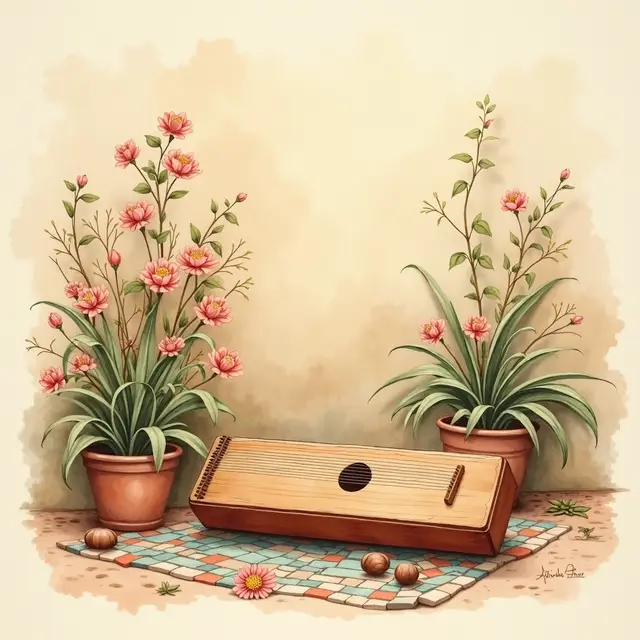
Palette: mosaic turquoise / terracotta garnet / floral pink / wood gold
- BPM
- 68 BPM
- Family
- Distant Worlds
- Serial
- MUN-29
- Rarity
- Common
- Style strength
- 95
- Experimentation
- 28
Typical structure
[Pishdaramad] → free-form [Avaz] vocal → [Tasnif] → [Reng] → modal [cadence]
What you see above is merely the visible map of the garden. Two of the real writing problems in this style are preventing the reference to Rumi from sounding like an orientalist postcard and maintaining restrained grief beneath modal elegance without falling into obvious lament. That lives in an unpublished internal distillate of eight parameters that the engine crosses with your story before drafting a single line. When finished, an internal judge measures the lyrics against six canons and orders repairs on anything falling short. The santur can be tuned. The restraint, cannot.
How a lyric in this style thinks
A lyric in Persian Classical music does not announce its grief — it lets grief settle into the room the way dust settles after someone has left and closed the door quietly behind them. The tradition operates through restraint so precise it becomes its own form of intensity. Where most Western song structures push toward a climactic release, the Persian Classical lyric withholds.
The voice enters the dastgah mode not to confess but to inhabit, circling a feeling the way water circles a stone, wearing it smooth over time rather than breaking it open. If you are writing for this genre, the emotional logic is not arrival but residence: the lyric asks the listener to stay inside a particular quality of silence, not to be moved through it toward resolution.
The structural skeleton matters enormously here. The Pishdaramad opens as instrumental ceremony, establishing the modal atmosphere before a word is spoken — which means your lyric inherits a space already weighted with feeling by the time the voice enters. The Avaz section is where the core poetic material lives: this is free-form, rhythmically elastic, the vocal line bending around quarter-tones that exist between the notes a Western ear expects. Lines here breathe at their own pace.
A single phrase can expand or contract depending on where the singer finds the emotional center of the mode. The Tasnif introduces more metric regularity, a composed song within the improvised whole, and this is where your most finished verse should sit — clear enough to be remembered, still ornamented enough to feel discovered rather than delivered. The Reng closes with a lighter instrumental character, and the modal cadence resolves nothing so much as it acknowledges that some things do not resolve.
The sensory field of a Persian Classical lyric is specific and non-negotiable. You are writing inside a courtyard, not a street. The objects are the santur's struck strings, the setar's single gut thread drawn by a fingernail, the tombak's skin marking a pulse that seems to breathe rather than drive. Incense, cooling tea, terracotta walls holding afternoon heat after the sun has moved — these textures anchor the abstract. What this genre never uses: urgency, percussion that pushes, images of crowds or noise or velocity.
The emotional weight comes from enclosure and stillness, not exposure. When you reach for a concrete image, reach for something that registers temperature or weight rather than colour or motion: the cold clarity at the bottom of a well, the precise heaviness of an absence in a room that once held someone.
Repetition in Persian Classical lyric functions differently than in pop or folk traditions. A line does not return because it is a hook — it returns because the mode demands that the same ground be traversed again at a different depth. Rumi's verse, which saturates this tradition, works through paradox restated rather than argument advanced: the wound and the remedy arriving in the same breath, the separation and the longing for reunion held simultaneously without either cancelling the other.
If you write in this register, resist the urge to explain. The lyric should name the condition — the love that withdrew without bitterness, the understanding that arrived cold and clear after years of misdirection — and then hold still. Explanation is the enemy of the dastgah. The mode does the emotional work; the word marks the location.
What separates a genuine Persian Classical lyric from a generic imitation is the absence of performance in the writing itself. The voice in this tradition does not demonstrate feeling — it reports from inside it, without vibrato, without ornament that isn't earned by the phrase. On a production level, the santur's tremor and the setar's single-string incision create a texture so precise that any lyric competing with them for attention will lose.
Write lines that can coexist with that sound: short enough to leave space, weighted enough to justify the silence around them. The tempo hovers near 68 bpm but behaves more like breath than clock — the tombak holds back before each strike, and your lyric should hold back before each image. Refined mysticism is not vague spirituality. It is the specific geometry of light on a tile that no longer holds warmth.
- RUMI'S POETRY
- REFINED MYSTICISM
Sample excerpt
The jasmine vine has pulled away from the stone wall, leaving behind a map of dried roots on the terracotta. I pour amber tea into a glass that carries your thumbprint, watching the steam curve toward the high, silent ceiling.
The well is deep, the water is cold, and I finally reach for the stone at the bottom, where the memory of your shadow remains perfectly still.
Workshop note — In this genre, the lyric functions as a meditation rather than a narrative, favoring slow, contemplative imagery over active verbs. Use long, flowing lines that mirror the melodic sustain of the setar, and avoid rhyme schemes that feel forced or pop-oriented, as the beauty lies in the rhythmic cadence of the recitation.
Sample excerpt written by MUSAI Song. Your lyrics are written from scratch, based on your story.
When to choose this style
Choose this carta when you need to name a loss so profound that any attempt at explanation would be redundant. It works for a love that withdrew in silence without leaving bitterness, only the precise weight of its absence in a house that feels too large. For mourning someone whose memory asks not for consolation but for stillness, a space to remember them without the chest tightening from raw grief.
For when you have finally understood something about yourself after years of searching in the wrong place, and that realization arrives without fireworks, carrying only the cold clarity of water at the bottom of a well. Do not choose it to recount anger, vengeance, or a noisy triumph; classical Persian music holds no register for shouting or urgency. Neither is it suited for celebrating a cheerful birthday nor for an affection built on daily jokes and casual proximity.
If you are looking for a direct, earthy confession, the carta is Tradicional Japonés.
Your story in this style
MUSAI Song writes original lyrics from your story, in the Persian Classical style, and delivers the finished sung song, the ready-to-use style recipe, and an illustrated art plate with its numbered certificate, private by default; public only if its owner publishes it.
- Original lyrics written from your story
- A finished sung song, ready to play and share
- Art plate with a unique seal and a numbered certificate, private by default; public only if its owner publishes it
Frequently asked questions
What BPM is Persian Classical?
Persian Classical usually runs at 68 BPM.
What does Persian Classical sound like?
Santur and setar beneath a voice reciting Rumi through the dastgah modes. Persian classical music: Sufi poetry made sound — refined, mystical, and deeply beautiful.
What song structure does Persian Classical use?
[Pishdaramad] → free-form [Avaz] vocal → [Tasnif] → [Reng] → modal [cadence]
How do I write Persian Classical lyrics?
Tell MUSAI Song your story and pick Persian Classical: it writes original lyrics for this style at 68 BPM, you edit them word by word, and you get the song sung in Persian Classical, with an illustration of the song and its numbered certificate. $19 USD per song, one-time payment.
Explore more styles
- Afrobeat (Fela)
- Algerian Raï
- Anatolian Psych Rock
- Andalusian Music
- Arabic Flamenco Fusion
- Arabic Music (Tarab)
- Armenian Duduk
- Balinese Gamelan
- Balkan Cinema Fusion
- Bhangra
- Bollywood Filmi
- Bosnian Sevdah
- Carnatic
- Cinematic World Fusion
- Congolese Rumba
- Congolese Soukous
- Desert Blues Tuareg
- Ethio-Jazz
- Greek Laïkó
- Hindustani Raga
- Indo-Jazz Fusion
- Iraqi Maqam
- Mandinka Kora
- Mongolian Throat Singing
Your idea or story, sung in this style
Card · secure payment via Stripe, charged in USD
If it doesn't move you, we give you your money back · 7 days