Senegalese Mbalax
The drum gives warning; the hips were already on their way.
Get your song in Senegalese Mbalax
Make yours in this styleHear it before you pay.$19 USD · your first song for $5.50 USDIf it doesn't move you, we give you your money back · 7 days.
Senegalese Mbalax is a style from the Distant Worlds family. 120 BPM, Experimentation 26, Style strength 92.
What is Senegalese Mbalax?
Sabar drums in dizzying polyrhythms beneath a powerful Wolof voice. Senegalese mbalax, the defining dance music of West Africa, is explosive and hypnotic.
How it sounds
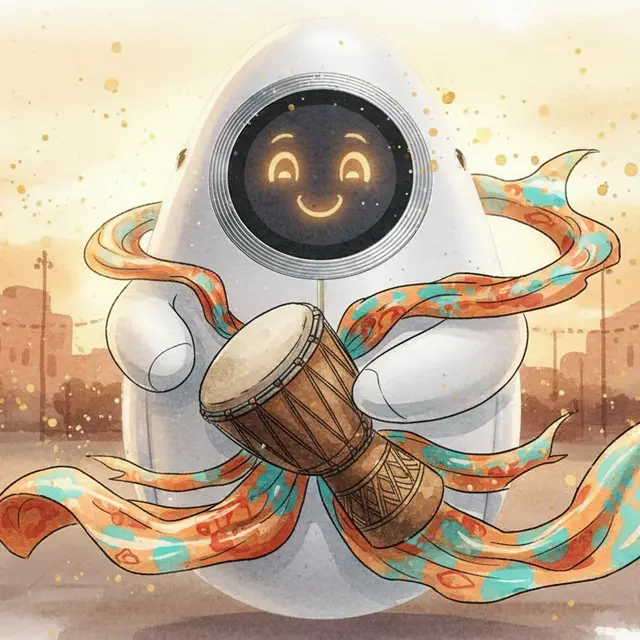
The sun drops over Dakar and the Atlantic turns a thick, heavy lead grey that barely holds the day's last heat. You stand in the middle of an earthen square where dust floats like a fine cloud, kicked up by the footsteps of a hundred people forming a tight circle. Wax fabrics in fierce shades of orange and turquoise collide and blur in a dizzying wave of bright color. In the center, the sabar drums lay down an unappealable law.
The goatskin is pulled so taut that every strike from the thin stick and the bare palm hits like a dry whip shaking your ribs. The polyrhythms lock in at one hundred and twenty beats per minute, so fast and interwoven that your brain stops trying to count them and hands total control over to your flesh. The lead vocalist cuts straight through the air, piercing and sharp, throwing out calls that the crowd answers instantly with clapping hands and barefoot stomps against the dirt.
Sweat runs down your forehead, mixing with the dust on your cheeks into a warm crust. Someone beside you spins on their own axis with arms wide, defying the vertigo of the beat. There is no room left to think about yesterday or what comes tomorrow; there is only the next strike of the drum forcing your hips to answer before you can even doubt it.
Palette: orange / yellow gold and turquoise
- BPM
- 120 BPM
- Family
- Distant Worlds
- Serial
- MUN-23
- Rarity
- Common
- Style strength
- 92
- Experimentation
- 26
Typical structure
[Sabar Intro] → [Verse] → [Chorus] → [Sabar percussion break] → [Final chorus]
What you see on the sheet is just the scenery of the square. Writing in this style requires solving two invisible problems: how to interweave three distinct polyrhythms without the lyrics getting in the way of the sabar, and how to make a vocal melody carry the same explosive punch as a percussion call. That lives in an unpublished internal distillate of eight parameters that the engine crosses with the story you brought. When finished, an internal judge measures the result against six dimensions of the canon and orders repairs on anything that fails to push with the required force. The drums can be bought. The pulse that rips you off the ground cannot.
How a lyric in this style thinks
A lyric in Senegalese mbalax does not describe the celebration — it becomes the percussion. Every line is a strike, a call that demands an answer, and the answer is physical: feet on earth, hips ahead of thought, the crowd already moving before the phrase resolves. This is the fundamental contract of the genre. The voice is not a narrator standing outside the event; it is the event's ignition point, thrown into the air at 120 beats per minute where the sabar drums have already made thinking impossible.
Mbalax is the defining dance music of West Africa, and its lyrics carry that weight: they are designed to travel across an open square, cut through polyrhythm, and land in the body before they reach the mind.
The emotional register starts at high and climbs. There is no softening approach, no verse that lulls before the chorus lifts — the sabar intro has already done the emotional work before a single word arrives. When the voice enters, it enters at full commitment: declarative, sharp, rising at the end of phrases in a way that sounds like a challenge thrown to the crowd. The base tone is communal pride and forward momentum. Grief, when it appears, is not held quietly — it is converted into velocity. The mourning is danced into dust, as the scene demands. Tenderness, if it comes, arrives in the grain of the voice, not in the softness of the words.
Line length in mbalax lyrics tends to be short and percussive, built to slot into the spaces the sabar leaves open. Repetition is structural, not decorative — a phrase repeated three times is not emphasis, it is the drum pattern made verbal. The call-and-response logic means that even in a recorded lyric, you write for two voices: the lead that cuts, and the crowd that confirms. Chorus sections in this genre behave differently from Western pop choruses.
They are not a melodic peak so much as a collective statement, a moment where the distinction between singer and audience dissolves. The sabar percussion break that follows is not a rest — it is the section where the lyric's meaning is danced rather than sung, so what you wrote before it needs to be dense enough to sustain that physical elaboration.
The sensory field of mbalax is specific: goatskin pulled tight, the dry crack of a thin stick, bare palms, earthen squares, amber dust rising at ankle height, the collision of wax fabric in deep turquoise and amber gold. The horns that appear in fuller arrangements punch rather than soar — they are rhythmic instruments wearing melodic clothing. What the genre does not use: reverb-soaked ambiguity, intimate whisper, images of solitude, interior monologue. A line about sitting alone in a darkened room would not survive contact with the sabar. The concrete world of mbalax is always collective, always outdoors, always in motion.
What separates a real mbalax lyric from a generic imitation is its relationship to Wolof phonetics and tonal rhythm. Even when writing in translation or adapting the form, the cadence must carry that same whip-crack quality: consonants that hit hard at the front of the mouth, vowels that open and carry across distance. Generic imitation tends to write for the ear alone; mbalax writes for the whole skeleton.
A Suno prompt built around this genre should anchor itself in the sabar drums and talking drum first — the vocal delivery is energetic and piercing, the polyrhythms are the foundation everything else locks against. If the percussion does not feel like an unappealable law, the lyric has nowhere to land.
- DIZZYING SABAR
- VIBRANT POLYRHYTHMS
Sample excerpt
The red dust rises off the road at noon. My leather sandals beat the baked earth. I carried the heavy water jugs for years. Now the gold coins jingle in my pocket. Grandmother watch me from the wooden porch. My brothers call my name across the square.
Step hard where the shadows grow thin. Raise your chin above the rising heat. We are the rhythm that shakes the stone.
Workshop note — Mbalax relies on percussive, short-syllable phrasing that mirrors the frantic snap of the sabar drums. Keep your lines punchy and rhythmic, avoiding long, flowery metaphors in favor of direct, assertive declarations of presence. The chorus should function as a collective chant, meant to be projected with high energy to cut through the intense, layered percussion.
Sample excerpt written by MUSAI Song. Your lyrics are written from scratch, based on your story.
When to choose this style
Choose this card when you need a story of personal triumph or family pride to hit with the force of an advancing army. It works to celebrate survival in a harsh environment where nobody handed you anything. For when an entire community rallies after a loss and decides the mourning won't stay silent, but will be danced into a cloud of dust. For a milestone birthday where the guest of honor wants no sweet words, just a celebration that rattles the foundation of the room. For a homecoming after years away, where the joy is so massive the feet refuse to stay still.
Do not choose it for a quiet breakup, a melancholic love letter, or to tell an intimate grief that requires darkness and low volume; mbalax does not know how to whisper and forcing it would sound like painted cardboard. Neither for solitary introspection nor sad farewells. If you are looking for a fragile, contained confession, the card is Tradicional Japonés.
Your story in this style
MUSAI Song writes original lyrics from your story, in the Senegalese Mbalax style, and delivers the finished sung song, the ready-to-use style recipe, and an illustrated art plate with its numbered certificate, private by default; public only if its owner publishes it.
- Original lyrics written from your story
- A finished sung song, ready to play and share
- Art plate with a unique seal and a numbered certificate, private by default; public only if its owner publishes it
Frequently asked questions
What BPM is Senegalese Mbalax?
Senegalese Mbalax usually runs at 120 BPM.
What does Senegalese Mbalax sound like?
Sabar drums in dizzying polyrhythms beneath a powerful Wolof voice. Senegalese mbalax, the defining dance music of West Africa, is explosive and hypnotic.
What song structure does Senegalese Mbalax use?
[Sabar Intro] → [Verse] → [Chorus] → [Sabar percussion break] → [Final chorus]
How do I write Senegalese Mbalax lyrics?
Tell MUSAI Song your story and pick Senegalese Mbalax: it writes original lyrics for this style at 120 BPM, you edit them word by word, and you get the song sung in Senegalese Mbalax, with an illustration of the song and its numbered certificate. $19 USD per song, one-time payment.
Explore more styles
- Afrobeat (Fela)
- Algerian Raï
- Anatolian Psych Rock
- Andalusian Music
- Arabic Flamenco Fusion
- Arabic Music (Tarab)
- Armenian Duduk
- Balinese Gamelan
- Balkan Cinema Fusion
- Bhangra
- Bollywood Filmi
- Bosnian Sevdah
- Carnatic
- Cinematic World Fusion
- Congolese Rumba
- Congolese Soukous
- Desert Blues Tuareg
- Ethio-Jazz
- Greek Laïkó
- Hindustani Raga
- Indo-Jazz Fusion
- Iraqi Maqam
- Mandinka Kora
- Mongolian Throat Singing
Your idea or story, sung in this style
Card · secure payment via Stripe, charged in USD
If it doesn't move you, we give you your money back · 7 days