Traditional Japanese
Silence is also in tune.
Get your song in Traditional Japanese
Make yours in this styleHear it before you pay.$19 USD · your first song for $5.50 USDIf it doesn't move you, we give you your money back · 7 days.
Traditional Japanese is a style from the Distant Worlds family. 60 BPM, Experimentation 28, Style strength 95.
What is Traditional Japanese?
Koto and shakuhachi flute leaving space between each note, like breathing. Traditional Japanese music: the beauty of silence and nature rendered as sound.
How it sounds
It is five in the morning and the mountain mist rolls down the slope in Kyoto, clinging to the rice paper sliding doors like a cold breath. The wooden house smells of aged tatami, clean dampness, and the warm trace of sandalwood incense that burned out hours ago. Outside, in the garden pond, a single koi fish barely disturbs the still water while a lone cherry blossom petal floats, locked in the exact center of the surface.
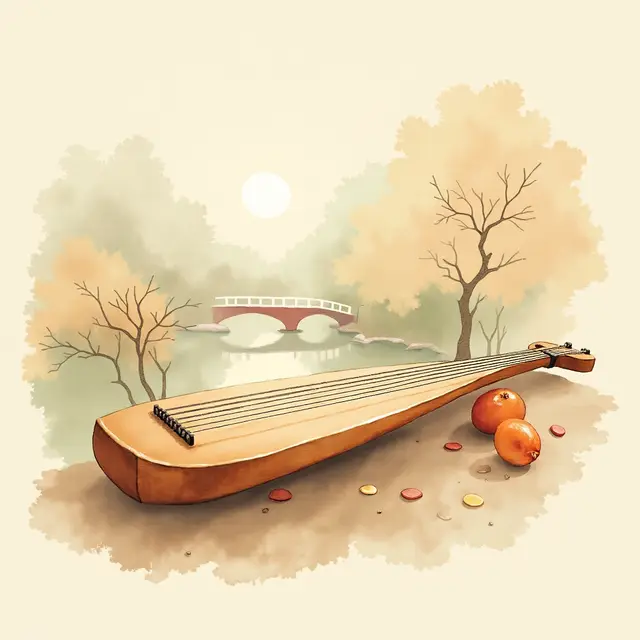
The koto rests on the low floor before you. The paulownia wood holds the chill of the night. When your ivory pick grazes the silk string, the sound does not try to fill the room: it breaches it and immediately pulls back, leaving a gap so heavy you can hear the timber settling as it cools.
A second later, the shakuhachi flute answers from the far edge of the garden. The breath moves through the bamboo tube with a dry, earthy scrape that sounds precisely like wind passing through pine needles. There is no beat keeping time. There is only a single note, then a silence that aches from its sheer size, and then another tone falling right into the space left behind.
The air is cold enough to turn every breath white. Your fingers are stiff against the fabric. There is no rush anywhere. The world has shrunk to the precise distance between a string fading out and the air rushing back to take its place.
Palette: honey gold / terracotta orange / muted moss green / brick red
- BPM
- 60 BPM
- Family
- Distant Worlds
- Serial
- MUN-15
- Rarity
- Common
- Style strength
- 95
- Experimentation
- 28
Typical structure
[Koto phrase] → [shakuhachi response] → [development] → [silence] → [cadence]
The data above can be copied in a minute. What cannot be copied is the exact tension between sound and nothingness: knowing which word to pull out so the line carries more weight than before, or how to build an image that avoids explaining sorrow and simply lets it drop onto the table. That lives in an internal distillate of eight unpublished parameters that the engine crosses with your story before writing a single line. Afterward, an internal judge measures the lyrics against six dimensions of the canon and sends back anything that misses the mark. The notes are anywhere. The weight of the silence is not.
How a lyric in this style thinks
A lyric written for Traditional Japanese music does not express feeling — it creates the conditions under which feeling can arrive on its own. The words do not point at emotion; they point at an object, a temperature, a small event in the physical world, and then step back. The reader or listener does the rest. This is not restraint for restraint's sake. It is the governing logic of the form: that a single koto note striking silk and then retreating into silence carries more weight than any declaration, and the lyric must behave accordingly.
The emotional register of Traditional Japanese music sits in what you might call the territory after the storm — not numbness, but a grief that has already consumed its own urgency. The base tone is quiet attention. Nothing is announced. A cooling cup of tea, the sound of a sliding paper door settling, the way mist holds to a garden wall: these are not metaphors decorating a feeling. They are the feeling, rendered in material form.
Line length tends to be short and irregular, mimicking the phrasing of the koto itself — a cluster of syllables, then open air, then another cluster arriving slightly off the beat you expected. Repetition, when it appears, is subtle: a word returning two stanzas later, changed in weight because everything around it has shifted.
The sensory field is narrow and deliberate. Cold wood, damp stone, incense gone cool, the exact sound of bamboo creaking in wind. The shakuhachi's dry, earthy breath through its tube is a useful model for how a syllable should land — not smooth, not polished, carrying the texture of the material it came from. This genre never reaches for abstraction. It does not use words like soul, forever, destiny, or truth. It stays in the room, in the garden, in the specific hour before dawn when the timber of an old house settles with an audible crack. That crack is enough. You do not need to explain what it means.
Structurally, a Traditional Japanese lyric follows the logic of call and response rather than verse-chorus architecture. One image is offered — the koto phrase. Then silence. Then another image answers from a different angle — the shakuhachi response from the far edge of the garden. Development in this form is not escalation; it is deepening. The same territory is revisited with slightly different light. Then comes the silence that is itself a section, a pause long enough to be felt as a presence rather than an absence. The cadence does not resolve so much as it releases — the final image simply stops pressing, and what remains is whatever the listener brought into the room.
What separates a genuine Traditional Japanese lyric from a generic imitation is the willingness to leave the gap unfilled. Most western songwriting instincts drive toward connection, toward the moment where meaning is confirmed. Here, meaning lives in the distance between one line and the next. If you are producing this for platforms like Suno using the koto, shakuhachi, and sparse meditative phrasing that define the genre's sonic palette, resist the urge to add words that explain the silence. The silence is not a problem to solve. It is where the song actually lives, sitting steady and unhurried across from you in the cold morning light.
- SPACE BETWEEN NOTES
- BEAUTY OF SILENCE
- INSTRUMENTAL
Sample excerpt
The charcoal embers turn to white ash. Frost settles on the stone basin. A single maple leaf drifts downward, Landing on the ink black pond.
The mountain swallows the low fog. Quiet tea, cooling in the porcelain bowl. Only the wind knows where you have gone.
Workshop note — This style relies on long, deliberate pauses between short phrases to mimic the natural decay of a koto string. By focusing on solitary, observable objects in nature, the lyrics create a vessel for grief without needing to state the emotion explicitly. Avoid rhyme and rhythmic consistency, as these disrupt the meditative flow required for this soundscape.
Sample excerpt written by MUSAI Song. Your lyrics are written from scratch, based on your story.
When to choose this style
Choose this carta when your story requires a space large enough to hold loss without anyone needing to shout. It works when a love left slowly, without slammed doors or broken plates, only with distance growing between two cooling cups of tea. For the moment you stare at an empty room and let the quiet explain everything. For remembering an elder who spoke seldom but whose hands made sense of the world. For grief that has already burned through rage and is now just a steady presence sitting across from you at the kitchen table in the morning.
This carta does not serve family arguments or career milestones. Neither does it fit tales requiring speed, noise, or cheerful resolution. If your narrative demands clear conclusions, tearful embraces, or explicit life lessons, the koto and flute will not supply the volume you seek. If you are looking for an energetic and driving finish, the carta is Anatolian Rock.
Your story in this style
MUSAI Song writes original lyrics from your story, in the Traditional Japanese style, and delivers the finished sung song, the ready-to-use style recipe, and an illustrated art plate with its numbered certificate, private by default; public only if its owner publishes it.
- Original lyrics written from your story
- A finished sung song, ready to play and share
- Art plate with a unique seal and a numbered certificate, private by default; public only if its owner publishes it
Frequently asked questions
What BPM is Traditional Japanese?
Traditional Japanese usually runs at 60 BPM.
What does Traditional Japanese sound like?
Koto and shakuhachi flute leaving space between each note, like breathing. Traditional Japanese music: the beauty of silence and nature rendered as sound.
What song structure does Traditional Japanese use?
[Koto phrase] → [shakuhachi response] → [development] → [silence] → [cadence]
How do I write Traditional Japanese lyrics?
Tell MUSAI Song your story and pick Traditional Japanese: it writes original lyrics for this style at 60 BPM, you edit them word by word, and you get the song sung in Traditional Japanese, with an illustration of the song and its numbered certificate. $19 USD per song, one-time payment.
Explore more styles
- Afrobeat (Fela)
- Algerian Raï
- Anatolian Psych Rock
- Andalusian Music
- Arabic Flamenco Fusion
- Arabic Music (Tarab)
- Armenian Duduk
- Balinese Gamelan
- Balkan Cinema Fusion
- Bhangra
- Bollywood Filmi
- Bosnian Sevdah
- Carnatic
- Cinematic World Fusion
- Congolese Rumba
- Congolese Soukous
- Desert Blues Tuareg
- Ethio-Jazz
- Greek Laïkó
- Hindustani Raga
- Indo-Jazz Fusion
- Iraqi Maqam
- Mandinka Kora
- Mongolian Throat Singing
Your idea or story, sung in this style
Card · secure payment via Stripe, charged in USD
If it doesn't move you, we give you your money back · 7 days